Tuesday, December 02, 2008 

Tracking tabloid hypocrisy.

The thing about arguing against the excesses of the gutter press is often that those they target are little more pleasant than the papers themselves. Even when you consider the utter hypocrisy of the tabloids attacking Paul Burrell for making money out of his relationship with Princess Diana, something they've been doing for over two decades, there's little doubt that going from the princess's rock to helming reality series' in the US and Australia and promoting "Royal Butler" wine is somewhat plumbing the depths. That doesn't however mean that you should be allowed to get away with printing such trash as "BURRELL: I HAD SEX WITH DIANA" by paying his brother-in-law to "remember" conversations they had 15 years ago, and then fail to allow the man himself to deny such scurrilous allegations.

Much the same is the case with another bastion of good taste, Simon Cowell. There's nothing quite like making a good amount of your yearly wage out of humiliating those who have the temerity to believe that they have something resembling a talent - which, after all, is conspicuous in its absence in Cowell himself. There has been at least one recent case of someone who auditioned in front of Cowell subsequently committing suicide, although the woman in that instance was apparently more "obsessed" with another female judge. Nonetheless, however much of an arrogant git Cowell might be, he has the right like everyone else to a private life. Hence the apparent revelation that a "tracking device" was attached to his car, in a letter sent around to media organisations by his lawyers Carter-Fuck, is another sign of the kind of desperation which is still afflicting the tabloids in the media environment.

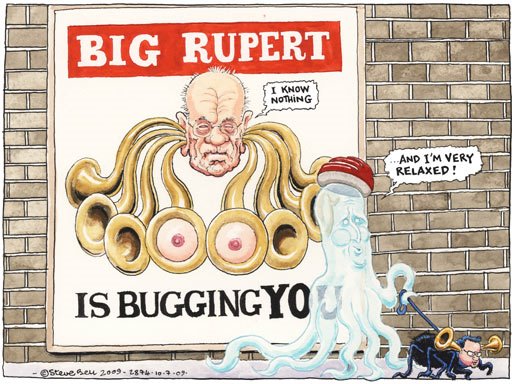
Paul Dacre, of course, just a couple of weeks back told us that "[U]nder the auspices of PressBoF, we have produced a guidance note on DPA [Data Protection Act] that has been sent to every paper in Britain." Fat lot of good that obviously did. In the same speech Dacre boasted about how he, along with representatives from the Telegraph and News International had successfully lobbied the government to drop the threat of journalists being jailed for obtaining information via deception, i.e. using private detectives as almost all the press instutitions in this country had to get information from government databases. Tracking devices are just as illegal as getting the likes of Stephen Whittamore to break the law for you to track the activities of celebrities and their relatives. It would be nice for Paul Dacre to explain how the use of such a device would be in the public interest, and how and why the journalist responsible for attempting to spy on Cowell shouldn't lose his job as a result.

It is after all the same newspapers responsible for such intrusion into private lives that so rail against the state doing exactly that. The ones currently screaming blue murder over the arrest of Damian Green and how the arrest of an opposition politician means we are living in a police state, but who when not fulminating against the government think nothing of indulging in almost identical practices to that of the police and security services just to be able to be ahead of the game when it comes to the celebrity exclusives which in Dacre's terms now provide the press with the means to be able to report on politics at all. Take away the scandal, he more or less argued, and you can forget their contribution to our democracy entirely. Nick Davies in Flat Earth News (criticised by Dacre) argued that the Whittamore case had came very close to bringing down the entire edifice of the media's "dark arts", and that it was only continuing now under far more cover. Doubtless then the discovery of the "tracking device" on Cowell's car will probably give them further pause for thought, at least for a while. Then they'll be back to harassing celebrities for our amusement.

Labels: , , , , , , ,

AddThis Social Bookmark Button

Friday, August 01, 2008 

Jordan gets her kit off for the Times.

A couple of years back the Guardian delighted its readers by giving column space to Peaches Honeyblossom Michelle Charlotte Angel Vanessa Geldof to talk about herself whilst one of the regulars was away. Giving Simon Jenkins a run for his money, she wrote of MySpace, her boyfriend and her dog.

At least Peaches probably wrote the column herself. You can't necessarily say the same for Katie Price, who's taken to the pages of the Times (yes, that's the Times) to bemoan the fact that she wasn't allowed to attend a polo meeting, told, despite paying £6,000, that she wasn't the sort of person they wanted.

Normally this blog would be completely opposed to snobbery it all its forms, including to a thick as horse shit glamour model who personifies everything wrong with modern culture. Can you however imagine a more suitable place for a missile or meteor to strike than the Cartier Polo International, at the Chinawhite tent, where those inside have paid £6,000 for the privilege of watching people who resemble horses ride horses while whacking around a white ball?

No, we couldn't afford to lose Jordan in such a way. There has to surely be a more fitting, violent and amusing demise for her to suffer. Like a knitting needle to the chest.

(I'm dreadfully sorry for this unfunny rubbish. Jenni Russell, incidentally, metaphorically eviscerates her.)

Labels: , , , , , ,

AddThis Social Bookmark Button

Wednesday, April 02, 2008 

The dark arts and the real power in the land.

As mentioned in one of the previous posts, the government appears to be backtracking about making the buying and selling of private data an imprisonable offence. This is almost certainly a direct result of lobbying by Associated Newspapers, News International and even apparently the Telegraph group, all under the pretext that it would have a chilling effect on investigative journalism.

That claim and defence is rubbish. Journalism in the clear public interest is already protected, and if the Guardian was duly concerned, then the very journalists that got the story, David Leigh and Rob Evans, would be incredibly worried, as it was they that broke the story over BAE's Saudi slush fund, which would have almost certainly employed some of the methods that the information commissioner, Richard Thomas, wants to crack down on, as did their investigations into Jonathan Aitken in the 1990s.

Rather what bill is meant to target is the widespread use, especially by the tabloids, but also increasingly by the broadsheets, to employ private detectives who through their own contacts sell information, often from government or public services databases, direct to journalists. This all stems directly from the case of Steve Whittamore, the private detective who was raided back in 2003. When the police subsequently went through his computer, they found that he had kept exact details of every transaction with each publication, information which the information commissioner subsequently released back in December of 2006. It showed that the Daily Mail alone used his services 952 times, with almost 60 different journalists making separate requests. At Whittamore's trial the prosecution outlined that his associate Paul Marshall had used Scotland Yard's computer databases to access information for newspapers on two actresses from EastEnders, the family of Ricky Tomlinson, and a former Big Brother contestant, alongside information on Ken Livingstone and his partner and Bow Crow, head of the RMT. Despite this, Whittamore and his friend were all given conditional discharges, as a result of a previous ruling in a trial involving Marshall, where the judge accepted that he was seriously ill and about to die. Whittamore was meant to face another case brought by the Information Commission itself, but the cost to the public purse, and the fact that all the men could point to the previous trial and the sentences given there meant that they forced to drop it. They all in effect completely got away with it.

This isn't then out of high principles and making sure that investigative journalism, what little of it remains in the British press, is protected. This is so the tabloids and others like them can continue to stalk and chase celebrities and their families if necessary, and that as soon as a major crime and happens and suspects are named that they can get as much information on them as they possibly can. As Nick Davies outlines in the entire chapter on this in Flat Earth News, these are known as the "dark arts". One ex-Mail journalist told Davies that they used to use the social security computer as if it were an extension of the Daily Mail library, just having to phone their contact who would then supply the information or the persons with the same name in around five minutes time, with their home address, phone numbers and maybe their workplace. Another said that if the Mail comes after you, they'll get all your information, phone numbers, schoolmates, what's on your credit card and every call from your phone. This was probably how the Mail recently turned up at the home of Fiona MacKeown, breaking in and taking photographs of her murdered daughter Scarlett's "bedroom".

Some of this isn't of course high-tech or even strictly breaking the law. Clive Goodman, jailed after he was caught "hacking" into the mobile phone of Prince William, just used the well-known trick of phoning his voicemail and then seeing if the password was unchanged, as most are, enabling him to "intercept" his messages. Goodman went down because the charges were brought under the Regulation of Investigatory Powers Act, not the Data Protection Act, which deals with the "blagging" offences and those involving the breaching of databases. This measure was really about bring the punishments into line, and upping the costs of getting caught so that there's far more of a deterrent. Getting a conditional discharge or an "unlimited" fine won't stop private detectives that have been raking in hundreds of thousands of pounds through such work, but a prison sentence will.

It's little wonder then that the Mail and Sun groups are so opposed to this measure. It threatens their incredibly lucrative phishing expeditions which so contribute to their celebrity exposes and who's shagging who nonsense which arrives on Sunday mornings. One of Gordon Brown's dearest friends just happens to be Paul Dacre, so much so that Brown has even given him a review to overlook. As for the Conservatives, the editor of the News of the Screws at the time of Goodman's offences, for which he too had resign was none other than Andy Coulson, now their chief spin doctor. Aside from protecting the privacy of celebrities and those caught up in events beyond their control, this is another reason to oppose the continuing obsession with databases across government and public services sphere. The amount of information that'll be on the ID card database has journalists and private dicks drooling already, as will the Spine, the NHS database that'll have the records of every patient on, not to mention ContactPoint, the children's database, which might have celebrities' children omitted from it, directly because of the fear of that information being sold on to the highest bidder. It just does go to continue to show that those who have the most power in Britain are not the politicians themselves, but the media barons and their editors who have obsessions with crime and criminals, except when themselves commit it in the pursuit of a good story. The information commissioner had little chance when coming up against them.

Related post:
Chicken Yoghurt - Newspapers and personal data: a level playing field at last

Labels: , , , , , , , , , , ,

AddThis Social Bookmark Button

About

  • This is septicisle
profile

Links

Archives

Powered by Blogger
and Blogger Templates