Tuesday, May 20, 2008 

We are ruled over by cu*ts.

Two separate issues that arrive on the same day could not more sum up the possibly permanent damage to civil liberties in this country.

The first, that apparently "calling" a religion devised by a science fiction writer with the sole purpose of enriching himself a cult is now an offence under the Public Order Act shows the depths to which freedom of speech in this country has now apparently sank. In one way, we shouldn't really be surprised: New Labour, also uniquely made up of individuals who spent their youths demonstrating on causes rather more left-wing than any they now espouse, has done more than any other government in recent memory to dilute the right to protest. Laws meant to deal with stalking have been abused by the police, stop and search powers under section 44 of the Terrorism Act routinely used to harass protesters, and most shamefully of all, the right to protest without prior permission within a mile of parliament barred altogether. In the aftermath of the Danish embassy protests, where a line was clearly crossed, the immediate response of the government was not to instruct the police to intervene in such circumstances, but to propose the banning of the burning of flags, as well as wearing masks on such demos.

All these new laws are less to do with actually stopping protest but with controlling it; they want to know who the trouble-makers are, whether the trouble-makers are entirely peaceful or not. This is why the police now routinely film all protests and take photographs of those on them, all for purely innocent reasons, naturally. It's why the police in London have taken to taking photographs of youths they now stop and search, even if they've done nothing wrong. It's all to add to their databases of potential offenders, don't you know? You don't want crimes to go unsolved do you? What are you, some sort of enemy of the people? We can get you on some technicality for that, surely.

It's that same sort of thinking, the kind of argument which the government knows it can get away with making which shapes the latest database to centralise more or less everything that you've ever done. The Times reports that a new database is being proposed that will collect every email and phone call you make along with the time you spend online all in one place, to replace the native ISP's which currently do the job at the moment. This is about as impracticable an idea as it's possible to imagine, but that doesn't make it any less sinister. As the Register points out, this is the sort of system that would be completely ripe for data-mining and fishing. It's not necessarily the government that we have to worry about from such huge databases, but from those that have access to them. Corporations would pay huge amounts to get a hold of such information, as would those other scum suckers, the tabloids, whom we already know use the other government databases as if they were extensions of their own libraries, with the government happily deciding that there was no need to tighten the penalties for doing so. With our government's brilliant record of losing huge amounts of such data, expecting them to be competent in dealing with the billions upon billions of such records is akin to trusting Nadine Dorries to tell the truth.

As with some much else of the government's attempts to please those demanding that something must be done, it also wouldn't be so bad if the proposals actually would do something to help prevent or cut crime. Instead, keeping the records of those using the internet or phone calls is a joke way of doing so in the 21st century, when so many don't bother to secure their wireless networks enabling anyone to use them free of charge whilst leaving no data trails of themselves via their IP address. More suggestions on how daft this is are offered by comment leavers on Mr Eugenides:

or using pay-as-you-go mobile phones, discarded after a short spell of use; or cars with false number plates; or sending e-mails from internet cafes or by 'stealing' someone else's unsecured broadband access; or any other easy ruse that would avoid the criminals' being caught by this pointless, repellent scheme.

So get a VOIP phone (a base model Cisco 79xx series goes for about $50 on eBay), a BSD or Linux server and the same again for the other end. Set up a VPN (any PFY worth his salt can do this). Now you can talk in private and there is not a damn thing your ISP or the fuzz can do about it, short of banning end-to-end encryption. With a bit of jiggery pokery there's no way they can even tell if you're making a call, as all you need is a little daemon to send data back and forth when the VOIP connection is idle. All cats (encrypted packets) look grey in the dark, so it stuffs their traffic analysis up.


The only ones getting caught out will, as always, be the incompetent and the law-abiding.

Still, if you've got nothing to hide you've got nothing to fear, right? Except the government losing all that information, of course. Typically, it's the powerful that gain and the powerless that will be even more at risk from this, just as the Scientologists through glad-handing the police appear capable of ensuring that no protester potentially offends their wonderful and completely legitimate religion. Similarly, if you happen to be wearing a uniform which identifies you as a member of the armed forces, then you too need more protection from anyone who might dare to insult you. As for being shot at in illegal wars, well, that's tough. Priorities? What are they?

Labels: , , , , , ,

AddThis Social Bookmark Button

Friday, April 04, 2008 

The tabloids always win part one.

The tabloids have won. They always win:

Tabloid newspapers will be able to carry on using private detectives without fear of jail sentences after a government climb-down was confirmed last night.

Ministers decided to table a last-minute amendment to the current criminal justice bill under which a longstanding promise to impose jail sentences for data theft will be dropped.


The clause will remain in the bill but the threat of jail will be suspended for now. It's another "compromise" which isn't anything like a compromise: the tabloids will just carry on as they have before, laughing at how easy it is to get the government to roll over when they repeatedly break the law and lie about how it would "affect investigative journalism", the kind they haven't practised for decades.

As David Leigh, the Guardian's head of investigations, says on CiF:

Industry lobbyists have claimed that journalists might be in unjustified peril because they often commission inquiries not being certain where they will lead, and therefore might be unable to establish a public interest defence. This is the purest hogwash. If you buy Amy Winehouse's mother's mobile phone records, say, then you know perfectly well there is no public interest involved.

Not to mention how it often doesn't even lead anywhere. Ken Livingstone notes that he's been one of those most targeted by these kind of "investigations" before, getting into his bank details, with Steve Whittamore and his gang being involved also, and still none of them managed to find out until very recently that he had fathered another three children, with him breaking the news to kill the paper's "scoop".

As one Whitehall figure said this week: "These media barons - just how much power do they have?"

Labels: , , , , , ,

AddThis Social Bookmark Button

Wednesday, April 02, 2008 

The dark arts and the real power in the land.

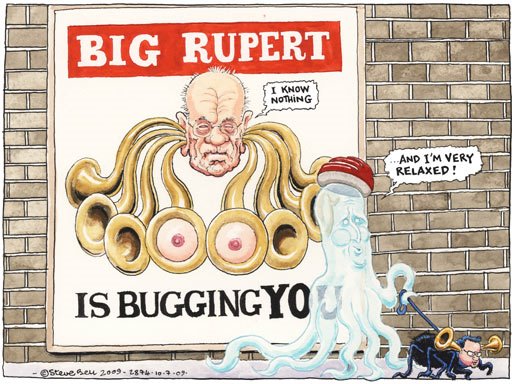
As mentioned in one of the previous posts, the government appears to be backtracking about making the buying and selling of private data an imprisonable offence. This is almost certainly a direct result of lobbying by Associated Newspapers, News International and even apparently the Telegraph group, all under the pretext that it would have a chilling effect on investigative journalism.

That claim and defence is rubbish. Journalism in the clear public interest is already protected, and if the Guardian was duly concerned, then the very journalists that got the story, David Leigh and Rob Evans, would be incredibly worried, as it was they that broke the story over BAE's Saudi slush fund, which would have almost certainly employed some of the methods that the information commissioner, Richard Thomas, wants to crack down on, as did their investigations into Jonathan Aitken in the 1990s.

Rather what bill is meant to target is the widespread use, especially by the tabloids, but also increasingly by the broadsheets, to employ private detectives who through their own contacts sell information, often from government or public services databases, direct to journalists. This all stems directly from the case of Steve Whittamore, the private detective who was raided back in 2003. When the police subsequently went through his computer, they found that he had kept exact details of every transaction with each publication, information which the information commissioner subsequently released back in December of 2006. It showed that the Daily Mail alone used his services 952 times, with almost 60 different journalists making separate requests. At Whittamore's trial the prosecution outlined that his associate Paul Marshall had used Scotland Yard's computer databases to access information for newspapers on two actresses from EastEnders, the family of Ricky Tomlinson, and a former Big Brother contestant, alongside information on Ken Livingstone and his partner and Bow Crow, head of the RMT. Despite this, Whittamore and his friend were all given conditional discharges, as a result of a previous ruling in a trial involving Marshall, where the judge accepted that he was seriously ill and about to die. Whittamore was meant to face another case brought by the Information Commission itself, but the cost to the public purse, and the fact that all the men could point to the previous trial and the sentences given there meant that they forced to drop it. They all in effect completely got away with it.

This isn't then out of high principles and making sure that investigative journalism, what little of it remains in the British press, is protected. This is so the tabloids and others like them can continue to stalk and chase celebrities and their families if necessary, and that as soon as a major crime and happens and suspects are named that they can get as much information on them as they possibly can. As Nick Davies outlines in the entire chapter on this in Flat Earth News, these are known as the "dark arts". One ex-Mail journalist told Davies that they used to use the social security computer as if it were an extension of the Daily Mail library, just having to phone their contact who would then supply the information or the persons with the same name in around five minutes time, with their home address, phone numbers and maybe their workplace. Another said that if the Mail comes after you, they'll get all your information, phone numbers, schoolmates, what's on your credit card and every call from your phone. This was probably how the Mail recently turned up at the home of Fiona MacKeown, breaking in and taking photographs of her murdered daughter Scarlett's "bedroom".

Some of this isn't of course high-tech or even strictly breaking the law. Clive Goodman, jailed after he was caught "hacking" into the mobile phone of Prince William, just used the well-known trick of phoning his voicemail and then seeing if the password was unchanged, as most are, enabling him to "intercept" his messages. Goodman went down because the charges were brought under the Regulation of Investigatory Powers Act, not the Data Protection Act, which deals with the "blagging" offences and those involving the breaching of databases. This measure was really about bring the punishments into line, and upping the costs of getting caught so that there's far more of a deterrent. Getting a conditional discharge or an "unlimited" fine won't stop private detectives that have been raking in hundreds of thousands of pounds through such work, but a prison sentence will.

It's little wonder then that the Mail and Sun groups are so opposed to this measure. It threatens their incredibly lucrative phishing expeditions which so contribute to their celebrity exposes and who's shagging who nonsense which arrives on Sunday mornings. One of Gordon Brown's dearest friends just happens to be Paul Dacre, so much so that Brown has even given him a review to overlook. As for the Conservatives, the editor of the News of the Screws at the time of Goodman's offences, for which he too had resign was none other than Andy Coulson, now their chief spin doctor. Aside from protecting the privacy of celebrities and those caught up in events beyond their control, this is another reason to oppose the continuing obsession with databases across government and public services sphere. The amount of information that'll be on the ID card database has journalists and private dicks drooling already, as will the Spine, the NHS database that'll have the records of every patient on, not to mention ContactPoint, the children's database, which might have celebrities' children omitted from it, directly because of the fear of that information being sold on to the highest bidder. It just does go to continue to show that those who have the most power in Britain are not the politicians themselves, but the media barons and their editors who have obsessions with crime and criminals, except when themselves commit it in the pursuit of a good story. The information commissioner had little chance when coming up against them.

Related post:
Chicken Yoghurt - Newspapers and personal data: a level playing field at last

Labels: , , , , , , , , , , ,

AddThis Social Bookmark Button

Monday, June 18, 2007 

If there's one thing we need, it's more databases.

If there's one thing that can be said about this government, it's that it's so bloody-minded that it will just not recognise that it simply cannot do anything to do with IT right. You've got to admire that sort of obnoxious stubbornness.

After disasters involving the IT system which junior doctors submitted their application for jobs to, which it transpired was so insecure that anyone who had access to it could look at anyone's information simply by tapping in their profile number, the continuing debacle of the new IT system for the NHS, currently coming in at a cost of around £12.4bn, and the criminal records bureau fiasco, any government other than this one would probably think twice about going ahead with any other highly ambitious IT programmes involving incredibly sensitive information. This though is New Labour, and there is no reverse gear.

It at least has to be said that the motives behind the "ContactPoint" database are honourable, something which can't be said about the ID card scheme which is being cooked (cocked?) up as we speak. The shocking nature of the Victoria Climbié case, and the failings of the local social services to act is a good an impetus as any.

The report in today's Guardian then makes for ominous reading. Not only are 330,000 people going to have access to it, but it's going to be open from the internet. Sound like a recipe for disaster? Well, it's OK, because they're asking people not to access it from internet cafes or public reception areas. Additionally, it will have a two-part security authentication system, which I sure hope doesn't mean login and password plus captcha.

It doesn't take a genius to realise, putting aside the concerns about snooping, that this is likely to be a hot target for identity thieves. The tax credits scheme has already been infiltrated by such people, and with the whole thing being wide open rather than internal network-based, it's only going to further encourage such attempts to break in. All in all, it's shaping up to make the NHS IT scheme look like a storm in a teacup.

Labels: , , , ,

AddThis Social Bookmark Button

About

  • This is septicisle
profile

Links

Archives

Powered by Blogger
and Blogger Templates