Thursday, September 11, 2008 

Crying over spilt liquid part 4.

Almost certainly the last post on this for now, but Lewis Page over on El Reg has written an excellent piece going into great detail on why the liquid bombs plot in his opinion was viable. Considering that he was a mine clearance diving officer and knows his stuff and I on the other hand have never so much as touched a chemistry set, I'll more than take his word for it.

There are of course still considerations to take into account though. There was, as we know, no evidence they had concocted a viable bomb, although Sarwar does seem to have boiled down the hydrogen peroxide to the right dilution. That still doesn't mean that it necessarily would have exploded - I would have expected they would have wanted to test it first, something more feasible than testing the bombs which the 7/7 and 21/7 attackers made. Considering it took the boffins as Page calls them 30 attempts it wouldn't be surprising if Sarwar had to make a similar number of efforts before getting it right, and even then it wouldn't be certain that he would have got it right for every single one of the devices they were going to make. It has to be remembered that Sarwar had a finite amount of HP and a finite amount of time, although he did have a decent quantity. It does also make you wonder if indeed he had failed repeatedly whether they would then have considered changing their plans to targeting something other than planes, if indeed that was what they were plotting to destroy. Again, then there's still the problem of getting through airport security, and Charlieman on Lib Con thinks this would have been potentially more difficult than Page does.

None of this affects however the trial itself, which didn't rest on their ability to make bombs - although it was certainly a matter of question whether they truly could have done, and one which most certainly needed looking into as I attempted to do - but on the fact that the prosecution, police and the politicians all claimed that they were to explode these bombs on aircraft causing "mass-murder on an unimaginable scale". That still was not justified, nor has it been proved in a court of law, and nor could the plotters have done so due to the amount of surveillance they were under. Exaggerated then yes, a potential threat to our liberties through over-reaction yes, but completely impossible? Definitely not.

Labels: , , , , , ,

AddThis Social Bookmark Button

Wednesday, September 10, 2008 

Crying over spilt liquid part 3.

The Crown Prosecution Service is rather unsurprisingly seeking the retrial of all 7 men in the "liquid bombs" case, on all the charges which the jury couldn't reach a verdict on. While this was always likely, the question has to be asked: what makes the CPS so certain that a second jury won't come to the same verdict if there is no new evidence presented to prove that the plot was to explode liquid bombs on aircraft? As noted ad nauseam already, the actual amount of evidence pointing towards the targeting of transatlantic flights is relatively slight. Originally this was brushed off as being down to how the police and security services had to act quickly due to the arrest of Rashid Rauf, but today a "security source" said this to the Grauniad:

"Even if [the surveillance operation] had gone on for a few more days we would not have found anything better as evidence than what was found in the first 24 hours," the source said.

This is surely either bluster or an attempt to heal the wounds with the Americans, notoriously prickly about their own counter-terror and intelligence efforts. If this plot genuinely was going to target aircraft, surely if the plotters had purchased tickets or had all received their passports that would have made a huge difference to the prosecution case. As it is, one jury has already failed to be convinced by the evidence which this source thinks couldn't have been surpassed.

To go onto more speculative territory, you have to wonder whether this case might help persuade the security services that it's time that intercept evidence was made admissible in court. Considering the breadth of the operation which was undertaken to monitor the suspects, and as yesterday's Panorama showed, this more or less entailed following the main players wherever they went, it would be difficult to believe if they hadn't been bugging their phones or otherwise. While it might not provide the ocular proof if they were as guarded as they may have been, the continuing refusal to admit such evidence becomes more and more untenable as time goes by.

Then, finally, there is Rashid Rauf himself. Does anyone honestly believe the story that he happened to escape whilst being allowed to pray in a roadside mosque, or even that the policemen were bribed into letting him go? His lawyer has suggested that he believes he might have been taken into the black hole which is the ISI's detention, but is it so outlandish to imagine that he might have instead been transferred into US custody and is now languishing in one of their remaining black sites? A few years back that could of easily been dismissed as a fanciful conspiracy theory, but can we completely rule it out now? The lack of condemnation from our side, despite our apparent willingness to arrest two separtists which the Pakistan government requested in return for Rauf might speak volumes. Then again, perhaps Occam's Razor should be applied until there is any compelling evidence to prove otherwise.

We should of course wait and see what this second jury decides. If they do reach the same lack of a verdict which the first did, it will then be highly significant what decision is then taken as to what should be done with them. More compelling evidence could potentially still be revealed. It's hard not to imagine however that if a second jury "fails" in the same way which the first did, that it may well mean the introduction of the very measures which Peter Clarke so boastfully but also sinisterly mentioned we had not yet resorted to yesterday.

Labels: , , , , , , ,

AddThis Social Bookmark Button

Tuesday, September 09, 2008 

Crying over spilt liquid continued.

You'd have to say that the response to the ignominious end of the "liquid bomb" plot trial has been little short of remarkable. I've just finished watching the Panorama special on the plotters, produced with an incredible amount of co-operation with both the police and the security services, which was most likely sitting there waiting to be shown as soon as the jury reached their decision, no doubt hastily re-edited yesterday and today to be in line with the conviction of only three and then not for conspiracy to cause murder through explosions on planes.

It, like almost all the rest of the media, didn't question in any great detail the idea that the plotters could have pulled off the plans that we're told they had in mind, because again, there was little to no evidence presented that they themselves knew what the targets were going to be, and very little dispute that they were almost ready to go. The evidence for the targeting of planes amounts to, as mentioned yesterday, the fact that one of plotters had downloaded information of transatlantic flights to his memory stick, the details from the diary which suggested getting the devices through security, most likely airport security, and that two of the plotters were heard discussing different holiday destinations in line with which were the most popular for British tourists. The questioning of the readiness of the devices themselves amounted to the presenter Peter Taylor asking a government scientist whether what the suspects planned was possible. Mindful of his words and being as non-committal as possible, he said yes, and said that it would have been possible to blow an airplane out of the sky with one of the bombs in a bottle.

Just in case we didn't get that, shown on news bulletins throughout the day on the BBC has been their own experiment using a bomb apparently made to the same specifications being placed inside the hull of an aircraft. It explodes, and punctures the hull successfully, which you can see here. The problem with this is the same as with the other government tests shown to the jury: that these are professionals with experience of what they're doing with the best available materials. It also doesn't take into account the circumstances in which the bombers would be working: the bomb made for the BBC appears to have been put together almost on the spot, something that the bombers would not have done. As Charlieman points out on Liberal Conspiracy, TATP is incredibly volatile and begins to degrade very quickly. This was part of the reason why the 21/7 bombers' devices failed. The liquid bomb plot would have involved even higher dilutions of the hydrogen peroxide, increasing drastically the danger of it going off prematurely while also decreasing its "shelf-life". Additionally, it's by no means certain that such a bomb on board an aircraft would even then have the catastrophic consequences which the police and politicians claimed it would: only recently we saw the consequences of the explosive decompression on the Qantas flight, which managed to land safely. An even worse ED was suffered on Aloha Airlines Flight 243, which also managed to land with the loss of just one person and injuries to 60 others. One of the few other new facts added by the Panorama documentary was that Sarwar, the alleged bomb maker, had successfully boiled down some of the HP to the right dilution. Again though, the programme didn't bother to point that the bombs had still to assembled, that they had not constructed a viable device and that when you consider the difficulty involved in doing so they were still a long way from creating just one, let alone the 7 which the prosecution claimed there would be.

It isn't just however the security services and the police that found the verdict of the jury "astonishing", as spooks' friend Frank Gardner put it, it's also been sections of the media who are incredulous at them not convicting all the men for their obvious murderous ambitions. The Times for one went absolutely overboard, not just enlisting Peter Clarke for an tendentious article on how the "surveillance society" works just wonderfully, but also their lead article, which includes this nugget:

The jury’s indecision in the face of a detailed Crown case raises questions about the public perception of the terror threat that could undermine government attempts to introduce further security legislation.

They just don't seem to get it, do they? You could apply that reasoning to both the hacks and the public. We're told by the Times, Peter Clarke and the security services that this was "strong evidence", "a detailed Crown case" and "the strongest terrorism case ever presented to a court", but they seem to have started believing their own hype. Yes, there was a very strong case here for the men being involved in some sort of terrorist plot, which is why three of them have been convicted of conspiracy to murder, and will likely be sentenced to very long terms of imprisonment, in line with the likes of Dhiren Barot, who had even more laughable plans than those of the non-existent ricin crew. There was however very little hard evidence that planes were the targets, as has been discussed. What seems to have happened is similar to that in cases of miscarriages of justice: the briefers have been out briefing and the journalists' sources have been whispering furiously into ears about the obvious guilt of those on trial, and when it doesn't go according to plan, they respond by blaming everyone other than themselves, with the journalists also flummoxed.

Hence along with the Americans getting the blame for ordering the arrest of Rauf, also being fingered are the jury themselves. The fact that there was a two-week break in proceedings for holidays, that some members of the jury were sick and otherwise is regarded as significant enough to be commented upon, especially by the Daily Mail, referring to it as a "farce". That those involved have given up nearly six months of their lives to hear an incredibly difficult case and then have to come up with a verdict is of no consequence; since they've come to the wrong one they're apparently fair game. They're also hardly likely to be able to defend themselves, as the only jury members I can recall speaking out recently were some of those involved in the ricin case after those acquitted were subjected to control orders, and then some of those involved in the original case involving Barry George, who had changed their minds over time.

It's perhaps a little over-the-top to be concerned immediately about the prospect of jury trials in terrorist cases being curtailed as a result of this verdict, but what if another jury also fails to find the men guilty of conspiring to cause explosions on planes? As the Times also reports, the man completely acquitted of all the charges, Mohammed Gulzar, is now likely to be given a control order. That's justice for you: a jury finds you not guilty but the state with its secret evidence tribunals disregards that entirely. I'm sure I won't be the only one to find potential menace also in the words of Peter Clarke, especially in these two paragraphs:

Take this case. To save the lives of the innocent and convict the would-be killers we used all the tools in the security armoury. Deeply intrusive surveillance, informants, CCTV, DNA, telephone call data and so on. This was not about collecting information for its own sake - it was to secure evidence to put before a court.

Some critics fail to understand that sophisticated, modern evidence gathering has allowed the most complex terrorist conspiracies to be tried in our criminal courts in front of a jury. No need for military commissions or the juryless Diplock courts of Northern Ireland.


And yet despite all of this evidence the jury were still failed to be convinced that planes were the targets. In any event, what Clarke is describing is a false dichotomy between surveillance and security; nothing that the police did broke the current rules as they were, and in fact, in their breaking into the "bomb factory" and planting bugs and live cameras they were using the oldest tricks in the book. It's the implication though in the second paragraph which both needles and worries. To begin with, it's not as if we're some wonderful place where every alleged terrorist is subjected to a court trial: just above we mentioned that Gulzar is likely to be given a control order, where the evidence against him will be heard in secret and not given to his lawyers. It wasn't so long back that we were locking foreign suspects up indefinitely without charge, and Clarke himself was at the forefront of pushing for support for 42 days detention without charge. What though if ever more complex cases keep coming before juries and they keep failing to reach the "correct" result? Are we really so potentially far away from military commissions or Diplock style courts? After all, juries in some fraud trials are already mooted to be abolished. Just how many more cases like yesterday's will it take before populist politicians with an eye on the standard of debate in the tabloids decide that this "farce" should be brought to an end?

Clarke continues:

And what if we had failed? What if the prosecution case was right, and half a dozen American airliners were to be brought down by British terrorists, operating from Britain and in effect using the UK as a launch pad for an attack on the United States? What would have happened to the UK and indeed the global economy? What would the impact have been on UK/US relations? What about the pressure it would have placed on Muslims in the UK? A very senior politician, at the time of the arrests, told me he thought it could have led to a breakdown in the community cohesion that had survived the attacks in 2005.

But these are all suppositions. The security services and police had been aware of these men and were documenting their every movement. There was never the slightest possibility they were going to be allowed to even take the first steps towards actually carrying out an atrocity. The only reason the arrests were brought forward was because of Rauf's arrest, and the possibility of the disruption of the plot. Less plausible is something Clarke says at the beginning of the article:

More worrying still, if they were tipped off to the arrest they might panic and mount a desperate attack.

As we have seen though, the devices simply weren't anywhere near ready, and even if they had the right amounts of diluted HP, there's still no indication that their attempts at constructing the bombs in full would have been any more successful than the government scientists' ones. And please, Clarke really should spare us the spurious concern for community cohesion: he was directly involved in the Forest Gate raid, which did more damage to the rapport with British Muslims and the actions of some in their communities than anything else has.

Should the restrictions now be lifted on liquids then, as Virgin Atlantic has called for? While as I've attempted to document, the dangers are vastly overstated and the problems involved in creating liquid explosives are manifold, I still think it's probably right for the moment for caution to be erred on, although the limit could perhaps be lifted from 100ml bottles to 250ml or above, and the idea that babies' bottles could be used is ridiculous.

Most of all however, the conclusion of this case should not cause panic amongst politicians or security agencies as to whether the public has become blase towards the terrorist threat. They clearly haven't. What is apparent however is that many are increasingly concerned about the febrile exaggeration of such cases, including this one and the claims of mass-murder on an unimaginable scale which simply are not backed up by the facts, and which is often for short-term political gain. The Panorama documentary also completely established that John Reid had long been aware of the "plot", meaning that his speech damning civil libertarians for not getting it just the day before the arrests was cynicism of the absolute worst kind. We don't like it when concerns about terrorism lead jumped-up police officers and community support staff to order people not to take photographs of public buildings, and we also don't like it when the threat of terror is used wholesale to justify the removal of ever more liberties, as the failure to reach a verdict in this trial could yet do. There is a terrorist threat, but it's not going to lead to the demise of this nation, and it doesn't even begin to amount to the that posed either by the Nazis in 1940 or to the Soviet Union during the height of the cold war. The same newspapers and media which want us to be scared are the same ones, ironically, that want us at the same time to have Churchillian resolve in the face of it. We need neither, and that has to be emphasised.

Labels: , , , , , , , , , , , ,

AddThis Social Bookmark Button

Monday, September 08, 2008 

Crying over spilt liquid.

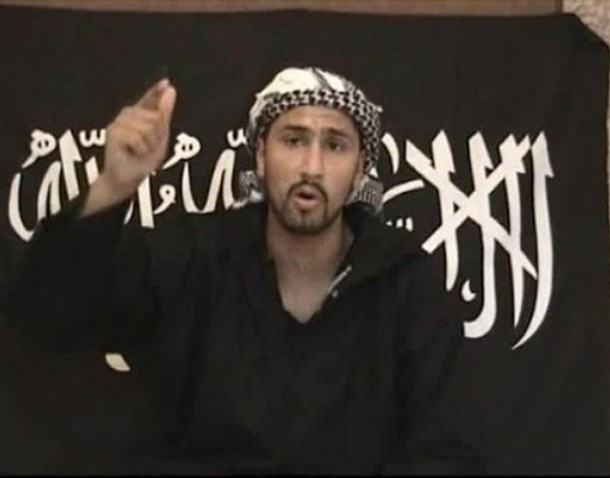
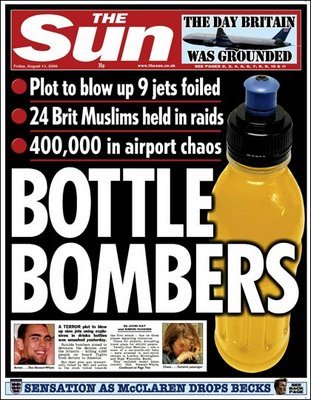
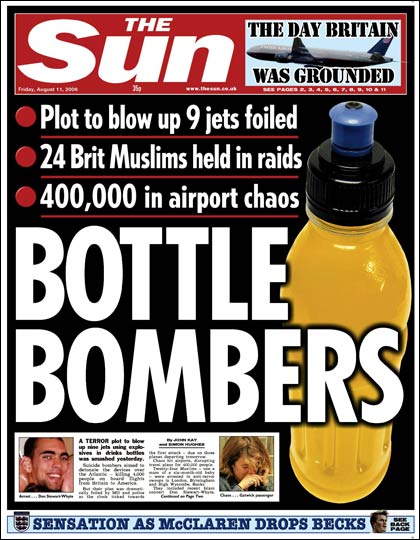
There will be more than a few surprised people tonight, both in the media and outside it, at the verdict reached by the jury in the "liquid explosives" trial. The case, after all, had been presented, as George Tenet famously said, as a "slam-dunk". Here were 8 Muslim extremists, caught red-handed with quantities of hydrogen peroxide, used by both the 7/7 and 21/7 bombers in their attacks, having recorded "martyrdom videos" and with apparent plans for the blowing up mid-flight of an unspecified number of transatlantic planes. There were shrieks of initial incredulity then horror from the press, all liquids in containers above 100ml were banned from planes as a precaution, with mothers having to taste their babies' milk, apparently as a result of claims that the bombers were prepared to blow up their children and use their bottles as containers for the explosives, and from both the police and the politicians, accusations and boasts that they had successfully foiled mass-murder on a grand scale.

Two years later and at the end of the £10,000,000 trial, just three of the suspects have been convicted of conspiracy to murder, and even then not on aircraft. One man has been acquitted altogether, while five others will most likely face a retrial after the jury failed to reach a verdict on their charges of conspiracy to murder. Already we have those with close contacts with the spooks being highly defensive: Frank Gardner on the BBC more or less suggesting that the security services were outraged that the jury had failed to reach the right verdict. The Sun tomorrow has a very similar, defensive editorial from what I've seen.

All of which brings to mind the fiasco of the "ricin" trial, where as everyone now knows, there was no ricin, and where only Kamel Bourgass, who murdered a police officer whom was attempting to arrest him, was convicted of any conceivable plot. The analogy is not quite right, because while the ricin plot was laughable and absurd, this one was clearly not, and what else is clear is that at least the three today convicted of conspiracy to murder were deadly serious. What is similar is that both appeared to have ideas way beyond their station, that they imagined they could pull off an incredibly dastardly and fiendish, murderous plot, despite their own inadequacies and lack of training.

If you examine the actual prosecution against the men somewhat closer, it soon becomes apparent that the case for planes to be blow up in mid-air was if not completely weak, hardly robust. For all the surveillance work that was undertaken on the men, which seems to have amounted to hundreds of hours, they don't seem to have at any point caught them directly discussing the plot, let alone the idea that they were going to blow up planes, or if they did, we don't seem to have been given the access to it which the jury was. The only evidence that convincingly points towards airplanes being the target was the flight times which were found on a memory stick in one of the men's possession, and the diary notes made by the alleged ringleader, Abdulla Ahmed Ali, that give the impression that the materials which were to make the bomb were to be smuggled through security at airports. It's little wonder that the jury failed to reach a verdict, as such evidence was hardly likely to convince a jury beyond reasonable doubt of their guilt, as the prosecution and security services surely knew.

There have been reasons from the very beginning to doubt that even if the plot was to mirror that of Project Bojinka, dreamed up by Ramzi Yousef and Khalid Sheikh Mohammed, that these individuals would have been any more successful than Yousef in their attempts. The story at first was that the ingredients for the bombs were to be taken on the planes and mixed in the toilets, which was quickly laughed at by scientists for its impracticability. Instead what the prosecution set out to prove was that the bombs were instead to be manufactured at the flat beforehand, then smuggled onto the planes in soft drinks bottles, before being detonated mid-flight using hollowed-out batteries filled with the explosive HMTD, with cameras or mp3 players used as the power source. To this end the prosecution showed the jury film of government experts detonating bombs to this specification, and as could be expected, they packed a mighty wallop. Those videos were replayed again today, accompanied by an American video of an aircraft being torn apart by an explosion, supposedly again via similar explosives, although no real explanation about this test was given. What was not as well reported by the media was the fact that the explosives expert giving evidence admitted that it had taken them over 30 attempts to construct a viable bomb, and that the one they showed had been one of a series, doubtless the most powerful. They also had to admit that the components were so volatile that the detonator had to be added by mechanical arm, rather than by a human, lest the mixture go off in their faces.

As I wrote at the time that this evidence was given:

So, as yesterday, this is the experts who know what they're doing using the exact same materials as the rank amateurs were meant to, and the danger of rather than explosives blowing up a plane but instead going off in the face of the bomb-maker was so great that the detonator had to be inserted using a remote-controlled machine. We're meant to assume that if this plot was going to come to fruition that the 8 men were going to overcome the volatility of the materials they were using, something the experts couldn't, succeed in smuggling the bombs onto an airplane without the explosives going off prematurely on the journey to the airport and then the plane, and then again manage, after fully constructing the bomb, to detonate it without anyone else noticing what they were up to with an explosion so successful that it would result in the deaths of everyone on board.

Additionally, the prosecution also admitted that no viable bomb had been constructed by the men, although this was supposedly only a matter of time.

Quickly, now that the trial has reached a somewhat ignominious end, the security services are searching for an acceptable reason other than the over-egging and exaggeration of the plot. Being fingered are the Americans, for upsetting the applecart in the first place. It was they who apparently ordered the Pakistanis to arrest Rashid Rauf, who is alleged to have links to al-Qaida, and who is wanted here in connection with the murder of an uncle. This arrest apparently either would have alerted the bombers to the unravelling of the plot, and so have gone forward with it, despite the apparent lack of readiness, with some of the proposed bombers not having passports, and with no viable bomb actually constructed, or would have led to them destroying the evidence. Indeed, some have suggested that there was a message received from Pakistan for the bombers to "go now", again despite their inability to be able to do so. The difficulty in confirming this version of events is obvious: Rashid Rauf mysteriously "escaped" from custody in December last year, although the charges against him had already been thrown out.

For all these reasons it was prudent to be sceptical about the ability of the men to carry out such a complicated and spectacular attack. Again, there have been repeated accusations of links to al-Qaida, with Ali apparently in Pakistan at the same time as Mohammed Siddique Khan and the ringleader of the 21/7 attacks, but this is hardly conclusive evidence of al-Qaida membership. Despite the success of 9/11, al-Qaida has generally stuck to the tried-and-tested lone bomber or car/truck suicide attack. The difficulties with replicating such tactics here are that the explosives which make those attacks so relatively simple and cheap to pull off are not readily available. The fertiliser bomb plot has been the only recently foiled terror attack which was to involve the more conventional ammonium nitrate. The 7/7 and 21/7 attacks instead involved the boiling of hydrogen peroxide and mixing with other household items to create either TATP or HMTD, both of which are extremely volatile, especially when boiled to the dilution required for the bombs to pack a large enough punch at 500ml. The plotters did have decent quantities of hydrogen peroxide, probably well beyond what they needed for 8 500ml containers. We also now know that they had apparently sought out other targets, including nuclear sites. al-Qaida generally prides itself on its technical abilities; if this was their doing, would they really have been so set on a Project Bojinka style plot where it was by no means certain that it could be pulled off, especially with hydrogen peroxide rather than nitroglycerin? Why not instead go in for a repeat of the 7/7 attacks, or step it up slightly and go for a car bomb targeting another soft target, like the Glasgow airport attackers, but with actual explosives?

All of this ought to have sown doubts in the minds of the jurors over the bombers' intentions. Just to stress again, it's clear that some of these men were potentially highly dangerous, especially those convicted of conspiracy to murder. They were certainly takfirist jihadists, or at least some of them were. Again, this is undermined somewhat by the doubt over just how far the plot had gone along: only one will was found, and the prosecution only seem to have said that Ali was certain to die in the attacks. If they hadn't been arrested or been under surveillance, they may well have gone on to take part in an attack which could have killed innocent people.

Once again though, it's difficult not to be shocked by the incompetence, arrogance, egotism and extreme exaggeration which took place both before and after the disruption of the "plot". It's worth remembering that just the day before John Reid had delivered a speech ridiculing civil libertarians as not getting it, when he most certainly knew that very night that raids were going to be taking place to bring the accused in. He and police officers then delivered bloodcurdling claims that this was to be "mass murder on an unimaginable scale", already potentially affecting the possibility of the men getting a fair trial. As Craig Murray notes, the most diabolical hyperbole was spread about the men potentially killing their children and using babies' bottles, when this was nonsense as the trial showed. All along, they knew just how weak the case was but are now most likely again likely to blame the jury instead of themselves. Then there's the media, which swallowed wholesale from the very beginning the whole idea that such an attack involving liquid explosives was possible, even while experts were disputing it. The coverage of the trial was an absolute joke, as evidenced by my attempts to get to the bottom of the claims about the explosives themselves: different papers and sources seemed to be inclined to provide only one different fact between the lot of them, with the BBC mentioning that up to 30 attempts had been made by the experts before they succeeded, something not reported elsewhere, and the Telegraph reporting on the volatility of the bombs, while only the Press Association and the Guardian mentioned that the men had not succeeded in building a viable device. Half the reason why there will be so much surprise at the verdict is that they failed to bother to report almost any of the defence case apart from the stunt and documentary one. Even much of the prosecution case was ignored.

Some will doubtless argue that if the men had been left longer more damning evidence would have emerged against the men. Most likely it would. That still however leaves the open quandary of the expertise needed for viable bombs to be made, which further gives the impression that they may well have abandoned the Bojinka style plot further down the line, if indeed they had at any point planned to blow up aircraft. None of this however justifies the politicising of the raid by New Labour at the time, the idiotic and reprehensible briefings which accompanied it about the casualties that would have been involved, and the general assuming of guilt which is now common place in terrorist cases. It has to be remembered that cases like this are the ones being used to further dilute our own liberty, the apparently limitless amounts of information which the group had pointed to for why 42 days or longer is needed, all without there being anything approaching a real, immediately dangerous plot being disrupted. We have comprehensively failed to keep the terrorist threat in perspective: it's true that we have to be lucky all the time and the terrorists only have to been lucky once, but this needs to be seen in the context of the failures which are now totting up. First 21/7, which was extremely lucky, then this plot, which was ridiculously overblown, then Abu Beavis and Abu Butthead, with no explosives but plenty of petrol and canisters. Add in Nicky Reilly and what we see are fantasists, unable to live up to their ambitions. If these are the pick of the al-Qaida crop from this country, do we really have so much to fear? It's time that we looked more realistically at the threat and demanded that the age of spin and politicising of it came to an end. Only then might we then learn more about how to more effectively fight it before the raids become necessary.

Labels: , , , , , , , , ,

AddThis Social Bookmark Button

Wednesday, May 14, 2008 

More boom!

Just when you thought that the idea that eight men could build bombs out of "liquid explosives" in Oasis bottles, smuggle them on to airplanes and then detonate them resulting in "mass murder on an unimaginable scale" couldn't get any sillier, the Telegraph reports this further piece of evidence that wasn't mentioned in any of the stories yesterday:

Woolwich Crown Court heard the danger of the homemade device going off was so great that scientists at the Forensic Explosives Laboratory at Fort Halstead in Kent had to insert the detonator with a mechanical arm once they had left the chamber.

So, as yesterday, this is the experts who know what they're doing using the exact same materials as the rank amateurs were meant to, and the danger of rather than explosives blowing up a plane but instead going off in the face of the bomb-maker was so great that the detonator had to be inserted using a remote-controlled machine. We're meant to assume that if this plot was going to come to fruition that the 8 men were going to overcome the volatility of the materials they were using, something the experts couldn't, succeed in smuggling the bombs onto an airplane without the explosives going off prematurely on the journey to the airport and then the plane, and then again manage, after fully constructing the bomb, to detonate it without anyone else noticing what they were up to with an explosion so successful that it would result in the deaths of everyone on board.

Something else worth noting in the reports today, in both the Telegraph and the Sun (most of the other media with the exception of the Mail seem to have ignored the entire exercise, which suggests that if the fourth estate can't even be interested by a bottle going boom they're hardly going to cover the men's defence) is that both now freely admit that the "bombers" hadn't succeeded in constructing a viable device. In fact, despite their experimenting by drilling holes in bottles etc, there isn't any evidence that they had attempted to even do so. We already know that at least two of the men didn't have passports; they might have recorded their arrogant and pathetic "martyrdom videos", but it doesn't seem by any measure that the attacks were as imminent as originally claimed, let alone whether the attacks would have been any more successful had they not been interrupted than last year's adventures by Abu Beavis and Abu Butthead.

To be a little clearer than I perhaps was yesterday, there is little doubt that at least some of these men were suitably radicalised to record messages which leave the implication that they were willing to lay down their lives like other jihadists for the cause of extremist Islam. Like with the other plots that have been "foiled" or have failed however, it has been hyped out of all proportion, with any journalistic intrigue into whether such attacks are actually feasible completely abandoned, believing completely that such plots were not just possible but would have killed hundreds if not thousands of people. It's one thing to want to kill someone; it's whether they have the means, determination and skills to be able to do so. The evidence so far at the "liquid bombs" trial suggests that these men didn't have it. That doesn't mean that they are not dangerous, or that they are innocent of any crime; that will be for the jury to decide. What is clear however is that all are guilty of fantasising, of self-aggrandisment and dilettantism.

Labels: , , , ,

AddThis Social Bookmark Button

Tuesday, May 13, 2008 

Boom!

The "liquid bombs" plot trial descended even further into farce today when the prosecution finally got round to showing its terrifying re-creation of what might have happened had the accused actually got onto the planes and then constructed their mixture of hydrogen proxide and the soft-drink "Tang", which was to be detonated using HMTD hidden in hollowed out batteries.

As you would expect, considering that the bombs have been constructed by experts and not by rank amateurs who previously might not have so much have had a chemistry set, they exploded and packed a reasonably big wallop for what would have been less than 500ml of liquid explosive. It took them at least 30 attempts to achieve an explosion from the materials, and as the explosives expert giving evidence said, this was just one of a series of explosions, doubtless the most powerful, which they carried out.

The problems with this "evidence" are manifest. Firstly, as any fule can see straight away, while such an explosion might well kill those close to it, it isn't strong enough to bring the plane down on its own. We can't know whether it would damage the hull in such a way as to immediately force an emergency landing, but it has to be remembered that planes can survive even catastrophic explosive decompressions: Aloha Airlines Flight 243 is testament to that. Neither did the mastermind of the original plot which this group presumably based their idea upon successful in his attempt to bring down a plane: Ramzi Yousef killed the man who was unfortunate enough to take the seat he planted his nitroglycerin explosives under, but it failed to puncture the plane's fuselage.

This is no doubt why the judge himself raised the relevancy of showing the explosion which they might just if they were very lucky have achieved. It is after all a conspiracy to cause explosions rather than actually causing them or committing murder through them. It is though a integral part of how weak the claims were that this was a plot which would have caused "mass murder on an unimaginable scale", as John Reid said just after the men had been arrested. In a part of the prosecution's opening statement which was hardly reported, it was revealed that the men had not succeeded in creating a viable bomb. We now know that the experts themselves had to try 30 times with the self-same ingredients before they achieved an explosion; the bombers were supposedly going to produce 8 of these bombs separately, all going off with an explosion powerful enough to destroy the plane in mid-air, or at least that was the impression originally given, now rather drastically scaled back.

If it had succeeded, it would have undoubtedly been the most spectacular attack since September the 11th. "If" though is the key term: like with the "bombs" last year outside the Tiger Tiger club and then at Glasgow airport, and also Dhiren Barot's plans for a "dirty bomb", this was a plan which looks wonderful and petrifying on paper or when it's reported in the papers, but which is close to impossible to actually pull off, especially if you don't have the means, the knowledge or the funding to do it. With the equipment that they apparently had, the "liquid explosives" plotters could have pulled off another 7/7: they certainly had enough hydrogen peroxide, although again 21/7 shows us that nothing is certain when you're working with such volatile materials. That they didn't suggests they didn't know how to make such bombs, or that they felt their plan was much purer and more original, even if it was remarkably similar to another foiled plot. Their hubris and ignorance got the better of them. As stated before, we don't have too much to worry about from such hot-headed individuals who think they know better than everyone else and that their plans are fool-proof; what we have to be concerned about is when those who do know their way around explosives and are battle-hardened return from either Iraq or Afghanistan, from what the leader of the Islamic State of Iraq referred to as the "university of terrorism". It might be then that we'll have to move beyond the simple power of nightmares.

Labels: , , , ,

AddThis Social Bookmark Button

Saturday, April 05, 2008 

Boom boom!

I would have thought that this part of Peter Wright QC's opening statement in the "liquid explosives" trial would have been somewhat important. This is from the Press Association's wire story:

The prosecutor added that there was no evidence to confirm that the defendants had managed to build a "viable device".

But he said it was clear that the would-be bombers would eventually have been able to achieve their ultimate aim.


Those are the two closing sentences in the report, after 901 words. The Guardian too reported this, although slightly differently:

The prosecution said the alleged cell may have had access to 40 litres of hydrogen peroxide, which they allegedly planned to place in soft drinks bottles, and then turn into bombs once on the planes. Wright said the cell had not produced a viable bomb, but said: "The successful construction of a viable device was only a matter of time." The jury were shown a video in which scientists recreated the men's planned bomb construction. The videos showed the bombs exploding.

That was 784 words into the report.

Still, at least PA and the Grauniad bothered to report this reasonably important fact. Despite dedicating three separate articles to coverage of the trial, neither the Times nor the Telegraph deigned to mention it at all. Neither did the Independent, although the PA report is also on their website. Or the Sun. Or the BBC, from what I could tell from news bulletins and their online reports.

Doubtless, I'm sure that our press will pay the same amount of attention to the men's defence as it has to the prosecution so far.

Labels: , , , ,

AddThis Social Bookmark Button

Thursday, April 03, 2008 

"Liquid explosives" trial begins.

The court was told that hydrogen peroxide would be the main ingredient used to bring the planes down.

Although hydrogen peroxide is legal, it would have been combined with organic materials to create an explosive mixture.

Wright said the conspirators planned to use a syringe to insert the explosive liquid into the base of 500ml bottles of Oasis and Lucozade in order to smuggle it on board the aircraft.

They would then top the bottles with a soft drink called Tang.

The mixture would be detonated by another substance concealed within batteries, jurors were told.


This trial is going to be fun, isn't it?

Labels: , ,

AddThis Social Bookmark Button

Friday, December 15, 2006 

Craig Murray on the falling apart of the "liquid bombs" plot.

A second and simultaneous development is even more compelling evidence that this massive scare was, as I said at the time, "More propaganda than plot". Thames Valley police have given up after five months scouring the woods near High Wycombe where the bomb materials were allegedly hidden. They told the Home Office on 12 December that they would only continue if the government were prepared to meet the costs; they wished to get back to devoting their resources to real crimes, like armed robbery and burglary.

Remember this was a plot described by the authorities as "Mass murder on an unimaginable scale" and "Bigger than 9/11". There have been instances in the UK of hundreds of police officers deployed for years to find an individual murderer. If the police really believed they were dealing with an effort at "Mass murder on an unimaginable scale", would they be calling off the search after five months? No.

Which brings us to the lies that have been told - one of which concerns this search. An anonymous police source tipped off the media early on that they had discovered a "Suitcase" containing "bomb-making materials". This has recently been described to me by a security service source as "A lot of rubbish from someone's garage dumped in the woods". You could indeed cannibalise bits of old wire, clocks and car parts to form part of a bomb - perhaps you could enclose it in the old suitcase. But have they found stuff that is exclusively concerned with causing explosions, like detonators, explosives or those famous liquid chemicals? No, they haven't found any.

Wycombe Woods, like the sands of Iraq, have failed to yield up the advertised WMD.

More
here.

Labels: , , ,

AddThis Social Bookmark Button

Wednesday, December 13, 2006 

All that's fizzy is not explosive...

The news that "terrorism" charges have been dropped against Rashid Rauf, the alleged ringleader of the August "liquid bombs" plot is curious to say the least. This was the man which Pakistan's interior minister said had given "many, many clues which link this plan with Afghanistan, especially the al-Qaida of Osama bin Laden", so for the charges against him to be decided so flimsy (or badly collected, or presented) that they wouldn't even stand up in a Pakistani court must be a concern for the evidence collected against those accused over here.

Conspiracy theories will obviously abound. Newspapers in Pakistan were less than subtle about the circumstances surrounding Rauf's interrogation by the Pakistani authorities, describing him as being "broken". Whether the use of torture would have had any bearing on the judge's decision is unclear; Human Rights Watch recently described the use of coercive methods in Pakistan as "rampant" in a press release.

Also reported at the time of the arrest was the allegation that money had been funneled to Pakistan to terrorist groups operating in Kashmir, under the guise of aid for those caught up in the earthquake of October 2005. The possibility may be that in investigating Rauf, that Pakistani governmental officials or others had been implicated in the flow of funding to groups such as Jaish-e-Mohammed, which would have came out as a result of trying Rauf under intense media interest, when trials of terrorist suspects are usually brushed under the carpet or simply not carried out at all.

The reality may be much more mundane, however. The Daily Mail (Yes, I know) reported on the 19th of August that despite Pakistan's lack of reticence, little hard evidence had been found, other than the apparent "breaking" of the suspect.

Whether any of this will stop Rauf being deported from Pakistan is unclear. The British government is still apparently seeking his return, rumoured to be to do with the unsolved death of Rauf's uncle, although the police are helpfully refusing to comment on what murder case they actually what to question him about.

In other "terror" news, despite John Reid's scaremongering on Sunday over a potential attack before Christmas, the review headed by the home secretary now seems unlikely to demand 90 days straight away, although as Not Saussure wonders, this may be down to the opposition the measure would undoubtedly face. Another foiled plot however, and the mood might change. The report, according to the Guardian, is also unlikely to put forward the need for wire-tap/intercept evidence to be made admissible as evidence. It can thus be assumed that either the security services' bugging methods are incredibly insecure, which seems doubtful, or that they're so paranoid that the mere presenting of their snooping will put them at risk that they'll potentially limbo terrorist suspects on control orders for ever (Reid has give the go-ahead for 1 further man to be held under virtual house arrest, with 3 others still to be served theirs) which is depressingly the more likely reason.

Labels: , , , , ,

AddThis Social Bookmark Button

About

  • This is septicisle
profile

Links