Wednesday, November 05, 2008 

From the sublime to the ridiculous.

The problem with the election of Obama for our own parliamentary equivalents is that it doesn't exactly show them in the most flattering light. Here's a master of oratory who's managed to inspire millions to go to the polls, and here's our bunch, left looking like a stood-up date on a particularly filthy evening. Whilst we've learned the lesson the hard way about charisma and the apparent "everyman" quality, you're still left absolutely bewildered, wondering where our own personal Obama might suddenly come from. With no suitable candidate in sight, we instead have to make do with both Gordon Brown and David Cameron fighting over which of them is most like Obama, reminiscent of two little boys at school squabbling over who the new girl likes the most.

Appropriately enough, the anti-Barack Obama decided upon today of all days to stick her head above the parapet and talk about something she clearly has absolutely no knowledge of whatsoever. I'm talking of course about the walking, talking, Labour-vote destroying robot which is Hazel Blears. Hazel Blears deciding to talk about political disengagement is a little like getting David Irving to talk about the problem of Holocaust denial; Blears, with perhaps only Tony McNulty for company, is the epitome of everything that an member of parliament should not be. She's loyal to the point of willing to sacrifice herself instead of the leader, or at least was to Tony Blair; she refuses to answer any question with anything resembling a straight answer; she has not a single apparent ideological bone in her body which might explain why she's joined the party she has; and when faced with overwhelming odds against her, she starts making things up. These might all be qualities which are essential to rise up the ranks of almost any political party today, but for those of us who actually want our representatives to have some specialist knowledge of any subject whatsoever, excepting motorbikes, or heaven forbid, even be more intelligent than we are, Blears and her friends, overwhelmingly Blairites, incidentally, are everything that is wrong with our politics as it stands.

All things considered, it therefore takes quite some chutzpah to imagine that you're suitably qualified to lecture anyone on political disengagement. Blears isn't interested in just why people are politically disengaged; she wishes to apportion blame. Predictably, it's not the fault of the politicians themselves for having indistinguishable policies, all the charm of a wet Sunday night in Salford or for prostituting their wares to the gutter press, but rather the media itself and additionally, bloggers.

Says Hazel:

Famously, Tony Blair called the media a "feral beast" in one of his last speeches as prime minister. But behind the eye-catching phrase was a serious and helpful analysis of a 24-hour broadcast media and shrinking, and increasingly competitive, newspaper market which demands more impact from its reporting – not the reporting of facts to enable citizens to make sense of the world, but the translation of every political discussion into a row, every difficulty a crisis, every rocky patch for the prime minister the "worst week ever".

Serious and helpful as in spelling out the bleeding obvious, as your humble narrator set out at the time. The liar in chief himself had to have balls to come out and attack the feral beast, having used said beast to get elected and then stay in power, but he of course didn't attack those most responsible for the cynicism with which politics in this country greeted, the Daily Mail and Sun, because if he had they would have chewed up said balls and spat them out in double-quick time. No, he instead attacked the Independent, which nobly stood up him to over the war and many other things, for daring to put its opinions on its front page, something the other tabloids had been doing for decades. Disingenuous could have been a adjective invented to describe Tony Blair, but he at least made the speech on his way out. Blears you would have thought still desperately believes she's on the way up.

In any event, Blears' claim that somehow it's just the media that exaggerates differences of opinion and bad days is simply nonsense. Blair himself was again partially responsible for this: he demanded and expected complete and utter unstinting loyalty. Read Alastair Campbell's diaries and see how he complained bitterly whenever the Labour party resisted his latest wheeze on principled grounds, with him condemning his colleagues for not "being serious". Blair went for such an uncompromising stance both because he wanted to be seen as the indomitable, strong leader, but also because the media had a hefty role in ensuring that Neil Kinnock never became prime minister. Campbell and Blair himself didn't want to see a Labour prime minister on the front page of the Sun again on election day inside a light-bulb, but the ends, suppressing all dissent and Faustian pacts with the likes of the Sun never justified the means. Politicians have themselves to blame as much as anyone else.

Blears continues:

And I would single out the rise of the commentariat as especially note-worthy. It is within living memory that journalists' names started to appear in newspapers; before then, no name was attached to articles. And in recent years commentary has taken over from investigation or news reporting, to the point where commentators are viewed by some as every bit as important as elected politicians, with views as valid as cabinet ministers. And if you can wield influence and even power, without ever standing for office or being held to account by an electorate, it further undermines our democracy.

As Unity has already argued, this is the equivalent to suggesting that only politicians are allowed to have complete freedom of speech. Blears is correct in suggesting that comment has swelled as investigations and genuine journalism has declined, and that the Guardian's maxim, that comment is free but facts are sacred has irrevocably broken down, but the idea that commentators are viewed as valid as elected politicians is abject nonsense.

As is her follow-up point:

The commentariat operates without scrutiny or redress. They cannot be held to account for their views, even when they perform the most athletic and acrobatic of flip-flops in the space of a few weeks. I can understand when commentators disagree with each other; it's when they disagree with themselves we should worry.

Even before the advent of the blog, commentators had to deal with letters in green ink as well as to the editor, and also the occupational hazard of appearing in Hackwatch in Private Eye, not to mention being parodied by Craig Brown, as many of those considered to be the most influential have been. Half of blogging is mocking what the mainstream thinks, or disagreeing with it, especially the likes of Polly Toynbee, so ruthlessly watched and baited by the right online. The only way in which Blears' statement makes sense is if you remove the word "commentariat" and replace it with "tabloid press", but she's hardly about to start attacking them.

There will always be a role for political commentary, providing perspective, illumination and explanation. But editors need to do more to disentangle it from news reporting, and to allow elected politicians the same kind of prominent space for comment as people who have never stood for office.

Ah yes, that's it; what's wrong with our politics is that politicians themselves don't have enough space to inculcate us with their philosophy and policies. Once they have we'll realise just how wrong we are about the lack of difference between them.

She then gets onto those of us pathetic and vain enough to run blogs:

This brings me to the role of political bloggers. Perhaps because of the nature of the technology, there is a tendency for political blogs to have a Samizdat style. The most popular blogs are rightwing, ranging from the considered Tory views of Iain Dale, to the vicious nihilism of Guido Fawkes. Perhaps this is simply anti-establishment. Blogs have only existed under a Labour government. Perhaps if there was a Tory government, all the leading blogs would be left-of-centre?

There are some informative and entertaining political blogs, including those written by elected councillors. But mostly, political blogs are written by people with a disdain for the political system and politicians, who see their function as unearthing scandals, conspiracies and perceived hypocrisy.

Unless and until political blogging adds value to our political culture, by allowing new and disparate voices, ideas and legitimate protest and challenge, and until the mainstream media reports politics in a calmer, more responsible manner, it will continue to fuel a culture of cynicism and despair.


If Blears thinks that Guido represents vicious nihilism, then she presumably hasn't read the finest of our swear bloggers, more's the pity. She does have something resembling a point regarding how the most popular blogs are right-wing; partly that is obviously because the government is nominally left-wing, but it's also because the left is far more disparate than the right tends to be in this country. As Unity has again already stated, politicians' blogs are almost notable only for their dreariness, with perhaps only Tom Watson and Tom Harris, excluding Bob, rising above it. Blears sees most bloggers as having a disdain for politicians and the political system, but while some are only concerned with the propagation of their own political world view, there are hundreds if not thousands of others who blog because they care about that self-same political system, and think that the current lot are debasing it through their very actions. Of course Blears would see this as a threat: she's wholly satisfied with how things are at the moment, where loyalty to the party counts above what is actually best for the country. She likes how this government has not been held to account for the Iraq war, for the complete abandonment of those that it was elected to defend, and for being in complete subservience to the City over everyone and everything else. Bloggers, for all their faults, and they are myriad, are the future. Barack Obama and the Democrats in America recognised this, and they treated them as more than equals. Instead of learning from their harnessing of the web, Blears only sees the dangers rather than the opportunities. She dares not imagine that she and her party are the problem, not the solution.

Labels: , , , , , , , ,

AddThis Social Bookmark Button

Wednesday, July 23, 2008 

The clunking fist.

When Gordon Brown finally ascended to the job he had so coveted just over twelve months ago, I suspect that most of us, or at least those of us who had regarded Tony Blair for his last few years in office with the same sort of respect as we do a dead skunk, didn't possibly think that things could get worse, or indeed, that the odds were good that such forgotten little things as honesty and accountability would improve, with there was also likely to be less pompous and sanctimonious grandstanding.

For the first couple of months, over Brown's so-called honeymoon period, this actually seemed to be happening. Announcements were being made to the Commons rather than to the press; the cabinet was meeting regularly and debate within it was actually encouraged; and even if a little underwhelming, with some finding it rather sad, Brown's pledge to "do his utmost" as he stood in Downing Street surrounded by cameras felt authentic, compared to all the flannel that we had been used to from Blair.

All of this evaporated in one ill-fated, ignorant decision: not to call off the election after Brown had Grand Old Duke of York style marched his troops to the top of the hill, but to instead go and visit the actual troops in Basra during the Tory party conference, and also to pledge that some of them would be shortly returning home. This understandably on the part of the Conservatives caused widespread anger; not just to be upstaging them, which could be forgiven, but to be playing politics with the armed forces and their loved ones back home for short-term possible gain. Ever since then Brown has floundered.

If this had happened to Blair it would have been forgotten swiftly. Blair could do almost anything, whether it be his overall responsibility for the death of Dr David Kelly because his spin doctor, knowing that the BBC potentially had information which could critically damage both him and his boss, went completely over-the-top in his quest to prove the allegations of sexing up were untrue, or being interviewed by the police over the loans for peerages scandal on the same day on which his press and ministerial team were doing their best to bury it, as his ever loyal attorney general walked over to the House of Lords and announced that the SFO were abandoning the corruption inquiry to the Al-Yamanah weapons deal between BAE and the Saudis, and despite being covered in the proverbial, he still emerged smelling of roses. I suspect that Blair would never have inspired such visceral loathing if he had ever betrayed signs of vulnerability, admitted that he had got something wrong or even if anyone ever laid a real glove on him in a political sense; but they didn't.

Gordon Brown, on the other hand, as others have mentioned, seems to have at the moment the reverse Midas touch. Everything he goes near doesn't turn into gold; it turns into excrement. Take yesterday, in the Commons on the last day of the parliamentary year, where you'd expect both he and the opposition to be de-mob happy. What's more, he had some sort of good news to report. Having just visited Basra again, this time, thanks mainly to the continuing ceasefire of Sadr's Mahdi army after a brief uprising earlier in the year, the city's security has vastly improved, meaning that even though the remaining British troops there are on "overwatch", training the Iraqi army, all troops might now be out, or all but a very minor force, by 2010, with the majority out early next year. We can quibble that we should have never gone in in the first place, that they ought to have been out long ago, and that all Brown is doing is in reality waiting until we find out who the next US president is going to be and what his plans are, but it's possibly the beginning of the end rather than the end of the beginning.

Cameron though, understandably, stands up and raises the point that Brown's posturing last autumn wasn't really fit behaviour from a prime minister. Mark Lancaster, who's served with the TA, went so far as to ask for an apology. Brown's response? He accused the Conservatives of playing politics with the armed forces.

Doubtless, Blair would have done pretty much the same thing in Brown's position. He however would have done it nimbly; Brown's problem is that he has the same sense of subtlety as Jodie Marsh has in the clothes department. Blair called him the clunking fist, and he is, there's no doubt about that. But it's in the truly literal sense, in that you can see him making his move a mile off, and he does in it such a blundering, clumsy manner that it doesn't just offend for a moment before it's forgotten, it sticks in the memory. Tony Blair had chutzpah in spades, but always got away with it. Brown's chutzpah leaves him not looking vulnerable, but looking like both a knave and a fool.

Again, you could perhaps even forgive this if Brown had kept his promises on honesty and accountability, but as the problems have mounted up, this too has been quickly forgotten. You can put a certain amount of blame on the media hysteria over knife crime, but last week's fiasco with Jacqui Smith going round the studios announcing that youths were to be taken into hospitals to see victims, only to deny this was the case a day later when they suddenly realised it wasn't a very good idea and that the presentation in any case was hopeless, was a case in point. That however compared to yesterday's rushing out of 30 end-of-term statements, which can only be described as burying them as even when the newspapers aren't busy they hardly bother to report the happenings at Westminster. Of those rushed out, 10 were prime ministerial statements, a direct breach of the ministerial code, which just incidentally, is enforced by... the prime minister.

Even allowing for the fact that some things are forgotten and may not have genuinely been ready to be announced until yesterday, this is surely cynicism of the highest order. It's not also if this has only occurred this year; last term there were 27 statements on the last day of parliament. The number in Blair's final full year of office? 17.

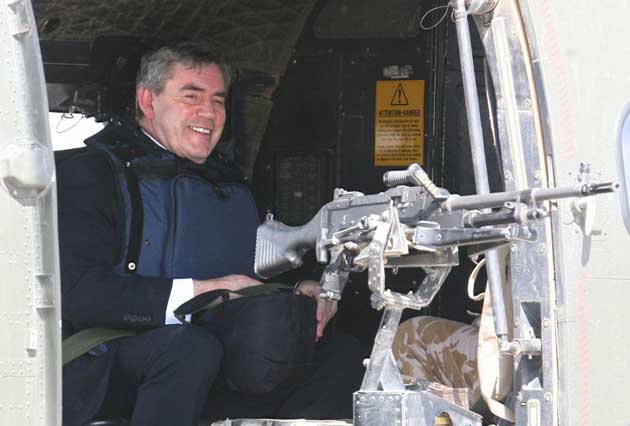
While this is clearly not on the same level as Blair's attempt to bury his meeting with Inspector Knacker, it was that we had come to expect it from the king of spin. From Brown, some of us naively thought that things would be different. Perhaps again though the biggest failure is that Brown's spin, when he's attempted it, has been dire. Alastair Campbell may have deeply distorted and helped bring politics down to its current level of contempt and cynicism, but at least he was good at it. You would never have seen Blair sitting next to a gun in a helicopter, just to begin with. Brown's real failure is not to have led his party to its lowest ratings in a generation; it's that he's failed to be honest with himself, and in doing so, he's left the door wide open for David Cameron, just as agile as Blair, to skulk in.

Labels: , , , , , ,

AddThis Social Bookmark Button

Wednesday, July 16, 2008 

The youth crime action plan.

After the understandable explosion of coverage over the weekend after the deaths of 4 men in London alone on the same day, including the 20th teenager to have been killed in the city this year, the reaction to the actual Youth Crime Plan itself, which has been long in the drawing up, has been almost entirely muted.

Partly this was because over the weekend the government managed to yet again get itself in a frightful muddle of its own making. Spurred into action by the immediate howling that something must be done from the newspapers, and also to respond to the Tories' pledge that anyone caught carrying a knife would be sent to prison, Jacqui Smith toured the studios on the Sunday making clear what the tough community punishments would be, as opposed to locking the miscreants up for God knows how long. This would involve restorative justice sessions, taking teenagers into hospitals to see victims of violent crime, face to face meetings with victims, and community sentences of up to 300 hours to be carried out on Friday and Saturday nights. Because Jacqui Smith was suitably vague, doubtless because all these measures had been thought up incredibly quickly, she gave the impression that teenagers were going to be taken into accident and emergency wards to see victims almost as soon as they had been wheeled into be patched up. The media ran with this, and then also got a father who had lost a child to knife crime in one instance saying that he would have nothing to do with seeing the perpetrators of his son's death face to face. It was apparent this wasn't what the government was suggesting, with them instead giving the possibility that offenders would be taken onto normal wards to see victims of violent crime, and only then if it was agreed with the individuals themselves and the doctors, and that only those who wanted to take part in such restorative face to face schemes with those who had carried knives would be considered for such sessions, but the media screamed U-TURN when Jacqui Smith stood up on Monday and gave a more substantial account of the proposals.

The whole avoidable escapade overshadowed the fact that this was actually a far better and more likely to work scheme than the blunt instrument of the Tory prison for anyone who carries a knife nonsense. No one challenged the Conservatives over the very basics of such a plan: with prisons already overcrowded and close to total capacity, how on earth would they provide the spaces needed for such a draconian policy? The completely useless answer to this is that the Tories plan to sell off some of the Victorian prisons and build new ones (as originally proposed by our friends at Policy Exchange). That this doesn't solve the problem at all, makes you wonder who wants to buy the prisons in the first place, especially in the current climate, and is in the neverland realm of time doesn't seem to matter. How exactly would prison solve anything anyway? We already know that prison for the young either doesn't work, or in fact equips them for an entire life of crime rather than deliver the sharp shock that might be necessary to get them out of carrying a knife, but it's a populist, easy proposal which you can make in opposition and not get called upon for.

The Youth Action Plan generally seems to have understood for the first real time under New Labour that the tough talking, eternal crackdowns and constant new initiatives have not worked. All they have done is just wetted the appetite for more of the same, and given the consistent impression that it's what we're going to get. This change in tact is almost certainly the work of Ed Balls, who's managed to persuade, with the Supreme Leader's help, the more Blair-inclined Smith and Straw of the virtues of a welfare based approach. Out has gone the distraction that was the ABSO, first introduced by Straw but not really used habitually until David Blunkett was home secretary, and in has come the view that targeting of those most at risk of turning to crime, the crucial involvement of parents and the setting up of dedicated local youth offending teams, involving all the local services, from the police to the social services to the schools, all involved in monitoring progress and intervening if necessary.

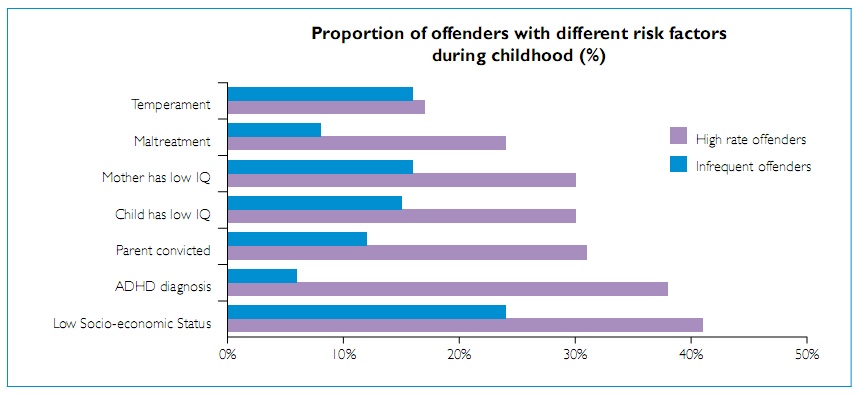
As identified by Mark Easton, the real heart of the report itself is not in the new measures proposed, but in the research behind it to back up its own suppositions. Hence 5% of youth offenders make up 50% of the actual crime committed, the hard core that do so much to give the vast majority a bad name. Equally, it identifies the factors that so increase the chances of someone being a prolific offender rather than one who might get in trouble once or twice during their childhood. Predictably, being a member of a "delinquent" group vastly increases the chances of offending; what doesn't however is a person's temperament, with both infrequent and prolific (high rate) offenders having broadly the same chance. What does make the difference is maltreatment as a child, if a parent is convicted of a crime, ADHD diagnosis, and low socio-economic status. Nothing ground breaking there either, but it has the useful effect of confirming what you already think that you know. This might be where specific targeting and targets can get over their deservedly bad name: specifically intervening where there is potential trouble ahead can in this instance make all the difference. Understandably, this does raise concerns about the nanny state, interfering in the family structure and the potential demonising of individuals; if however we are to make progress and as a result stop the mindless impression that everything is permanently getting worse and that the next generation are going to bring us all down, it might well be a necessary evil.

There are, as Lee Griffin especially has noted, some of the more harebrained ideas still in the plan. The eviction of families from council houses should they consistently fail to comply with successive orders, parenting ones as well as ASBOs, is a barmy idea which either just puts the problem somewhere or potentially makes the family homeless which makes a bad outcome even more likely. It simply isn't going to happen, and is probably only in there for the benefit of the tabloids and to make the whole deal same harsher than it otherwise is. Lee also objects to "unpaid work in the community" on Friday and Saturday night for child criminals, which I think is actually not so bad an idea. It's clearly just another harsher way of saying community service, and carrying it out on the nights when most teenagers go out will be the sort of punishment that might just get through to the minority that if they decide to act like morons or plague people to death that they'll have their leisure time to do so taken away. The only problem is just who will supervise it and given up their own weekends. Where I do agree with Lee and others is on the completely disproportionate mass curfew orders which the government is encouraging, which stigmatise youth as a whole rather than dealing with those who are a pain. Most the time it's not even that they're actually committing any sort of offence, it's that they're daring to be on a street corner or outside at all. There was a local news report the other week about anti-social behaviour where one guy who didn't want to be identified's chief complaint was that some of the youths had "called him names"; for fuck's sake people, grow some sort of a backbone. Especially illiberal is the Redruth saga, where kids who dare to be outside after 9pm during the school holidays are to be marched back home and their parents potentially given orders to keep them inside and otherwise, when they haven't broken any rule but have transgressed over the threshold of being young and outside at night.

On the whole however, the plan is mostly sensible, level-headed, backed up by evidence and might just well actually confront some of the most intransigent problems in some communities that we face today. It's a break with the tough on crime without being tough on the causes sense that has blighted policy for the last decade. The real tragedy is that it's likely to be thrown out the window by the Conservatives before it's even had a chance to work.

Labels: , , , , , , ,

AddThis Social Bookmark Button

Thursday, April 10, 2008 

Contempt is a two-way street.

"Why do they hate us so much?" is one of those wails that occasionally wafts from Westminster and into the press, politicians and commentators alike wondering why our representatives are either spat on, denounced as all the same or just completely ignored. There is a good case for making that the vast majority of politicians are not in it for themselves, that they genuinely do believe in some tangible concepts, and that they serve us with a diligence which many of us ourselves could neither achieve nor would want to attempt to. Then there's days like today, when the case for the defence seems so utterly overwhelming.

As Mr Eugenides writes, it's almost as if Gordon Brown at the moment has a reverse midas touch, where everything he goes near suddenly turns to shit the moment he opens his mouth about it. Here's the former clunking fist, the man accused of being Stalin, and he's being repeatedly made to look as if he's like another fictional ruler, the emperor without any clothes, debasing himself in public in front of the baying and mocking crowds. Half of this is because of his scattergun approach: one day declaring that plastic bags will be banished because the Daily Mail's just started a campaign up about them, the next deciding that malaria is the world's most pressing issue. Tony Blair wasn't immune to this either, as anyone who can recall his plea for Coronation Street's Deirdre's miscarriage of justice to be rectified can testify. The power behind the throne then though was Alastair Campbell, who compared to Brown's current advisers and chief spin doctor Stephen Carter was a genius and rottweiler rolled into one. Where Blair's spin was assured, either because it was done so well, or because the media was still involved in its temporary love affair with New Labour, Brown's is fast becoming his biggest weakness and in danger of turning him into a laughing stock.

Yesterday's announcement that Brown wouldn't after all be attending the opening ceremony of the Olympics was seemingly designed, in light of the protests in London and his own failure to so much as touch the flame when it arrived in Downing Street while the Chinese shell-suit mafia obscured him from vision, to be a good news story. Prime minister does decent thing despite potential pitfall over Britain hosting the next games! Easily offended Chinese get political equivalent of blowing a raspberry! Strong-man Brown says no to human rights abusers! Only, the slightest deeper look at the story exposed it for the fraud that it was. Brown had never explicitly stated that he personally was going to attend the opening ceremony; rather, span Downing Street, he was only always going to attend the closing ceremony, so that the spirit of the Olympics could be passed on. In any case, Tessa Jowell, the truly hapless Olympics minister is still going to attend the opening ceremony, so there's not going to be any boycott of any sort whatsoever. Within minutes of Brown/his lackeys making the announcement on Channel 4 News the entire thing had fell apart. The Conservatives, already fusillading Brown with accusations of dithering have yet another weapon to use against him, while the public themselves, not to mention those whom the gesture was meant to please, just feel cheated and almost lied to.

A very different sort of contempt but still one which reverberates around the country was thrillingly and damningly exposed by
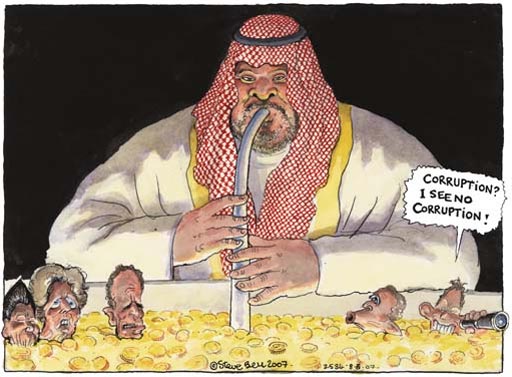
Lord Justice Moses and Lord Justice Sullivan in the Royal Courts of Justice. Although ostensibly the case brought by Corner House and CAAT was against the Serious Fraud Office's Robert Wardle after he caved into pressure from Downing Street and the Attorney General to drop the investigation into BAE's slush fund to the Saudis, this was a judgement that exposed the sham and sheer mendacity of Blair's government in its dying days. Prince Bandar, the man since revealed as receiving up to £1bn through the Al-Yamamah deal, waltzes into Downing Street, feeling the heat on the back of his neck because the SFO is close to accessing Swiss bank accounts that would confirm the allegations against BAE, and says that unless the investigation is abandoned, not only will the Saudis take their next big order of armaments elsewhere, but they'll also cut off diplomatic and intelligence relations. Instead of telling Bandar to get lost and take his blatant blackmail with him, Blair writes directly to Lord Goldsmith, who gives in and orders Wardle to drop the investigation.

It's worth quoting directly from the judgement, so sneering as it is of the government's action:
# The defendant in name, although in reality the Government, contends that the Director was entitled to surrender to the threat. The law is powerless to resist the specific and, as it turns out, successful attempt by a foreign government to pervert the course of justice in the United Kingdom, by causing the investigation to be halted. The court must, so it is argued, accept that whilst the threats and their consequences are "a matter of regret", they are a "part of life". (§ 6)

# So bleak a picture of the impotence of the law invites at least dismay, if not outrage. The danger of so heated a reaction is that it generates steam; this obscures the search for legal principle. The challenge, triggered by this application, is to identify a legal principle which may be deployed in defence of so blatant a threat. However abject the surrender to that threat, if there is no identifiable legal principle by which the threat may be resisted, then the court must itself acquiesce in the capitulation. (§ 7)

and
Had such a threat been made by one who was subject to the criminal law of this country, he would risk being charged with an attempt to pervert the course of justice. (§ 59

The rule of law is nothing if it fails to constrain overweening power.(§ 65)

The government's response to this tearing apart of its decision, this exposition of how they broke the rule of law itself so that one of the most vicious dictatorships on the planet could continue to be sold arms it doesn't need and so that its demagogic royal family can continue to receive vast payments courtesy of the UK taxpayer to be used on prostitutes, private jets and all the other trappings of unearned wealth while their own citizens are not even afforded the most basic of human rights? None. It's refused to comment. As has BAE, and the Serious Fraud Office itself, not to mention Prince Bandar. Perhaps it should be said that all those mainly involved have either gone or are about to go: Blair took Lord Goldsmith along with him, and Wardle himself is shortly to be replaced at the SFO. Even so, it doesn't slightly begin to justify the silence not just from the government, but from the Labour party as a entirety.

Dave Osler has already said this, but it's a point well worth repeating. This week much attention has been paid to events in Dewsbury, and discussion of whether the alleged abduction of Shannon Matthews was a scam from the very beginning. Her mother has been charged with perverting the course of justice, for not informing the police of all she knew and when she knew it. The government back in December 2006 did almost exactly the same thing, except on a scale completely alien to anyone in that part of Yorkshire. The difference is that Matthews is just a member of the underclass; Goldsmith and Blair were the land's highest legal adviser and the prime minister himself, yet they conspired to pervert the course of justice and in doing so broke the rule of law irrevocably. Some of those in Dewsbury have been warned not to take the law into their own hands as a response; who could possibly blame anyone for having complete contempt for the politicians responsible in this much larger and much graver case?

Labels: , , , , , , , , ,

AddThis Social Bookmark Button

Tuesday, January 08, 2008 

Blame the poor, blame the uneducated, blame the sick.

I sometimes wonder why I write a politics blog when I'm so disgusted and often turned off by the minutiae of the policies espoused by all of the political parties. I'm directly referring in this instance to the Tory proposals on welfare reform, more on which in a moment.

First though, it's the return of politics after the season where we mostly concern ourselves with the internal family equivalent. Old Gordie Brown has been having a thorough think during Winterval, as though he doesn't do that intensively every moment of the day anyway, and he decided that his prime ministership needed a relaunching after the accumulation of disasters that left him about as feted at the end of the year as Chris Langham crossed with the McCanns. (Speaking of which, perhaps he can relaunch his career by playing Robert Murat in the Maddie movie.) If there's one thing Brown knows about, it's tradition, so this relaunch looked much the same as his original charm offensive. Off he went to the Andrew Marr programme, talking of "fiscal arithmetic", promising to clamp-down on inflationary pay demands, whether they be from MPs themselves, the police or the angels, and how he's going to transform the NHS into a bastion of prevention from bad health rather than the source of it as it is now. It culminated with a similar interview in the Observer where he set out his stall on how he's going to save us from ourselves in this "dangerous" year. The solutions are 42 days, even though he's determined to find a compromise when there isn't one on such a fundamental matter of civil liberties, and ID cards, which despite the child benefit database debacle, won't be "compulsory", despite the legislation which has passed through the Commons confirming that they err, will be just that.

Next step in the fightback was the finding of a proper spin doctor. Served badly by his advisers from his days in the Treasury and by his cabal of "Young Turks" centred around Ed Balls, Douglas Alexander and Ed Miliband, he's called on the services of Stephen Carter, who just happens to be the chief executive of a PR firm. So much for all the jibes at Cameron about being in a similar but lower down position at the ITV regional broadcaster Carlton; now Brown needs just that sort of experience in his cabinet. Carter should in any case be used to being in charge of such a dysfunctional outfit as 10 Downing Street under Brown; he was head of NTL when it was nicknamed "NTHell" by its long-suffering customers, now under the yolk of Richard Branson in the similarly revamped Virgin Media. Most hilarious though were the remarks from the Tory Caroline Spelman about Brown bringing in another spin doctor rather than getting on with the job. That would be the same Conservative party that employs as its chief spin doctor the former editor of the News of the Screws, a man with about as much political knowledge as a fruit bat.

Spelman does have something of a wider point: this was the same Gordon Brown who standing in Downing Street last year faced by the world media talked of change as much as Lionheart talks about how evil Muslims are. For as long as he went on unscathed, regardless of attacks by patio gas canister jihadists, floods or foot and mouth, the status quo was acceptable. It was only once he departed for an opportunistic visit to Basra at the start of the Tory conference that everything started to fall apart. After all, while everything's going well, you don't need someone to distort the reality of what's happening for you. That was why the Labour reliance on Alastair Campbell and news management was so perplexing: when the majority of the media was so favourable to you, why did you need to be practicing the dark arts? Campbell's blithe explanation that he never wanted to see a Labour prime minister on the Sun front page on election day in a light bulb again is an excuse, not a reason. You can at least respect Brown's decision to employ one now, even if you can't accept it.

Brown's maneuvering on the NHS and with Carter though is nothing to the latest populist measures from the Tories dressed up in their compassionate clothing. The illusion under David Cameron has been that this is a changed party, one that isn't going to come out with reactionary nonsense about asylum islands again or ask whether we're thinking what they're thinking. Even while headbangers like David Davis remain in position but at least sensibly oppose extended detention for terrorist suspects, and they propose inheritance tax cuts while bribing the married middle classes, the emphasis has been on the touchy-feely environmental promises and just what a thoroughly nice bloke Dave is. This has worked when Labour has been woeful, but while Brown looked fresh in the summer it briefly fell apart. The support for the Tories isn't because they're trusted or look like they're ready to form a government, it's because they're not New Labour.

Whether their welfare reform proposals published today will change any minds remain to be seen. What is clear is that just like in the past, what first goes in the United States eventually winds its way over here. Quite where they're inspired from is contentious: some say Wisconsin, others say New York state. Whichever it is, neither can be a direct comparison with the benefit system currently in operation here, where our population vastly outnumbers that of both. As Chris points out, when you get down to the actual figures involved, despite them initially looking huge, they're far smaller than you're probably being led to believe.

First up is a reassessing of every single person on incapacity benefit, of which there are 2.64 million current claimants, by a doctor. As Labour has argued, this would be hugely expensive, incredibly time-consuming, a waste of resources and probably do next to nothing to actually bring the figure down. It has to be remembered that some of those on incapacity benefit have not worked for nigh on 20 years: the unlucky who found themselves out of work during the glorious Thatcherite revolution, shoved onto IB to bring down the unemployment figures. They're simply not going to work again, full stop, however uncomfortable that is for any political party but especially the Tories to admit. As has been pointed out, incapacity benefit is now in actual fact incredibly difficult to get on: a relative of mine who at one point was only given a few years' to live and has chronic back pain was refused. Those on it are overwhelmingly genuinely sick or unemployable; getting them off IB and onto jobseekers' allowance or even into employment will save the state either a whopping £22 a week or £200 a week. It sounds a lot, but in the scheme of things will make next to no difference to the Treasury coffers.

The changes to JA itself are no better. Those on it for 2 years will be expected to carry out "community work"; for which almost certainly read the removal of graffiti, picking up rubbish, maybe setting plants or general cleaning up. The Conservatives haven't explained how those already employed to do just that, or indeed those carrying out "community service" which often also involves just those things are going to be affected. When not cleaning up the trash, there'll be expected to be at "back-to-work" centres, where they'll be able to do everything apart from seemingly the training that politicians of all stripes think will be needed in the "knowledge" economy. These centres, to be run by the private or voluntary firms so en vogue with the Tories, will also be paid according to how many they either get back into work or off benefits when they refuse an "reasonable" job offer. As with much else of the plans, what a "reasonable" job offer will be isn't defined. Those who do so though will be more or less destitute or dependent on others, as they will first lose benefits for a month, then three months, then three years. Whether some will accept job offers then quit immediately or get themselves sacked so as not to lose benefit and how they will be dealt with also isn't considered.

The main reasons behind all of this are again explained well by Chris. Like him, I also think the biggest motivation behind it is the get tough strategy. So prevalent is the view that those on benefits are either skivers or scrounging, repeated endlessly in the tabloid press, that if you're told a lie enough you'll often start to believe. As with so much else, there are some who could work but who don't simply because they can. For the majority though, who desperately would like to work but who can't for a whole spectrum of different reasons, making their lives even more miserable seems to be a Conservative priority. David Cameron asks where the dignity is "in sitting at home, dependent on the state, not having a job?", but where also is the respect for those that can't? It takes something to make New Labour look humane and liberal, but the Tories have somehow managed it.

Labels: , , , , , ,

AddThis Social Bookmark Button

Tuesday, November 06, 2007 

Spin? Under Brown? Say it ain't so.

If we were still suffering under the burden of Blairism, you can bet that the Tories and Lib Dems might have made a little more out of the fact that Jonathan Evans, the new head of MI5, not only delivered the latest speech on the "threat" in front of the society of newspaper editors, ensuring that they knew in no uncertain terms the horror that could be unleashed at a moment's notice on our nation, but that it also came the day before the Queen's speech, where the government was preparing to unveil its latest proposals on how to beat back the extremist scourge. As it turns out, the most controversial measure, the extension from 28 days to 56 days pre-charge detention for "terrorist suspects", which has been long trailed, wasn't unambiguously set out by Brenda, the government preferring to still pretend that it's making its mind up while seeking "consensus". It's hard to believe though that the speech was anything other than a warning, from both the security services and the government, for the press which previously and continues to object to what more or less amounts to the reinstatement of internment.

Most of what Evans sets out is of little difference to Eliza Manningham-Buller's speech of last year. He considers the current "threat" to be the most "immediate and acute [in] peacetime" in the 98-year history of MI5. It's unclear whether he counts the cold war as an actual war, as I somehow find the threat of being vaporised by nuclear weapons more menacing than that from terrorists armed with patio gas canisters and cans of petrol, but that like so much else, doesn't really matter. The current day threat, whatever it is, is always the most deadly and insidious which we have ever faced. The National Union of Mineworkers during the strike in 84/85 was opposed to democracy and wanted to overthrow the Thatcher government. Saddam Hussein in the early 90s was the justification, with Russia descending into the chaos of the Yeltsin years to keep defence spending high.

Predictably, what the papers' picked up on was Evans's claim that

As I speak, terrorists are methodically and intentionally targeting young people and children in this country. They are radicalising, indoctrinating and grooming young, vulnerable people to carry out acts of terrorism.

which the Express distorted into suicide bombers in our schools. This isn't a new message either; last year John Reid warned Muslim parents to look out for the "telltale" signs of radicalisation, and even go so far as to spy on them. Evans's evidence that this is happening is the number of young people now being linked into networks, with Abdul Patel, linked to last year's "liquid bombs" plot being the favourite example. He was found to have a manual meant for the use of American bomb disposal units, which the prosecuting counsel said that "in the wrong hands, the information contained in this manual can have catastrophic consequences, including causing explosions of the most terrifying kind in the UK and abroad." The jury agreed that he was guilty of having the document, but the judge in sentencing him to six months said he was not a "radicalised or politicised Islamist" as the prosecution had claimed.

The young are always going to be targeted; but it's also true that the young are also those who are inevitably going to be the most potentially radical anyway. The inexperience and rebelliousness of youth is going to be a motivating factor, but the evidence is not overwhelming that the young are being systematically radicalised or "brainwashed" as Evans appears to be claiming. Those most likely to be involved in radical takfirist Salafism are usually well-educated, from respectable backgrounds and far removed from poverty. Two of the 7/7 bombers were relatively young, but again they don't fit the profile of coming under the wing of any particular radical preacher or influence. Strangely, unlike the news reports covering Evans's speech, he didn't mention the internet in being a major factor in radicalisation, when we know that it plays an incredibly important role. Most of those becoming radicalised don't gain their knowledge through radical preachers, the favoured bogeyman, but from the internet through their own research. While English language jihadi websites are few and far between, the number of Arabic forums dedicated to discussing the conflicts around the world and the posting of videos by the groups fighting is ever growing.

The other major talking point was the numbers game, with Evans now letting us know that there are 2,000 individuals that MI5 consider a "direct threat to national security and public safety, because of their support for terrorism," up 400 from Buller's speech last year. In addition, he estimates there's enough 2,000 that the service doesn't know about of similar thinking. Like with Buller, he doesn't distinguish between those that are prepared to become suicide bombers and those that are likely to have a role in the funding of such attacks, or those who support the insurgency in Iraq say, but not bombings back home. It doesn't really tell us anything except provide us with a number which seems massive in order to cause concern. If there are after all 2,000 individuals actively supporting terrorism, and if even a quarter of that number were willing to launch either suicide attacks or a bombing campaign, why are the number of plots so apparently low? Isn't Evans slightly contradicted by how Sir Ian Blair recently suggested that the number of active investigations into plots is now lower than previously? Is it that the threat, despite what they're saying, is receding somewhat, or that there are plans being made that we don't know about?

Also questionable was this statement:

"And it is important that we recognise an uncomfortable truth: terrorist attacks we have seen against the UK are not simply random plots by disparate and fragmented groups."

Which seems to indulge the myth that the hand of al-Qaida can be found behind nearly every terrorist plot there is. Was al-Qaida really responsible for the laughable "suicide bombing" at Glasgow airport or the bombs which were "potentially viable" in London? If so, their recruits are getting even weaker and more obsessed with plots next to impossible to pull off but look spectacular and terrifying on paper than ever before. Was al-Qaida involved in the alleged beheading of a British soldier back in Febuary?
We know for a fact al-Qaida wasn't involved in the "ricin plot". The danger is that we see al-Qaida as some kind of multi-layered organisation driven from the top down, when the reality is that al-Qaida as it existed in 2001 could collapse entirely tomorrow and we'd still be facing much the same problem of extremist Islamists. The trial of those involved in the Madrid attacks set out where the threat is most likely to come from: those with radical views that need little help from those holed up in Pakistan or wherever but who are influenced by the ideals and ideology behind bin Laden enough to carry out their own attacks in the name of al-Qaida. Evans does sort of recognise this, as he does mention the spread of the al-Qaida brand: the first suicide bombing in Algeria coming after the GSPC pledged allegiance to al-Qaida, changing its name to al-Qaida in the Islamic Maghreb. al-Qaida might be conducting a deliberate campaign against us, as Evans says, but those with no real connection to the organisation are doing so also.

Have you noticed however what Evans notably doesn't pay much attention to? Iraq garners just two mentions - to note that al-Qaida in Iraq "aspires to promote terrorist attacks outside Iraq". Nothing about Iraq's undoubted role in helping with the radicalisation process, even if it isn't the only cause, or that the threat is likely to increase once those who've gone to fight in Iraq return, from what the leader of al-Qaida in Iraq has himself described as the "university of terrorism." It's probably true that al-Qaida in Iraq has designs on exporting terrorism, but the state of the insurgency in Iraq has shifted in a remarkably short time. al-Qaida's media wing in Iraq has now not released a new video of its activities for going on a month - an extraordinary length of time signifying how the infighting amongst the insurgency has escalated to such a scale that what happened in Algeria to the Islamic groups there is routinely mentioned. At the moment the emphasis is certainly on what is going on within Iraq itself rather than attacking anywhere else.

One thing Evans certainly does get right is that

"Anything which enables it to claim to be representative of Islam; anything which gives a spurious legitimacy to its twisting of theology will only play into its hands."

As will furthering the victimhood factor by extending the detention without charge period. The one thing this speech seems to have been intended to influence is one of the things that will do most to damage the fight against extremism. How's that for irony?

Labels: , , , , , , , ,

AddThis Social Bookmark Button

Tuesday, October 02, 2007 

Cynical about real political choice? Moi?

There's nothing quite like the conference season to restore your cynicism in politics. Say what you like about the Liberal Democrats - irrelevant, idiotic, idiosyncratic - they at least have something approaching an actual debate, discussion and vote on new policies. Compare that to both the Labour and Conservative conferences, so far distinguished only by their congratulatory backslapping and err, almost indistinguishable policies, and you'd almost be forgiven for wanting to turn yellow and become a Minger.

First though, it would be remiss not to mention today's flabbergasting act of political cynicism from Gordon Brown. For once, the Tory accusations of spin, electioneering and downright opportunism were more than valid. As oleanginous, creepy and rabid as Liam Fox is, it was impossible to disagree with his righteous anger about Brown's token mention of Iraq in his speech last week, only to fly to Baghdad during the Tory conference and announce a further draw down of troops. Even if we hadn't then learned that this further withdrawal was in fact nothing of the sort, with some of the 1000 soldiers who would be back by Christmas either already here or not even in Iraq currently, the truly shocking thing about this latest foreign policy debacle was that Brown had the nerve to go to Iraq at all, without at the same time announcing that all the remaining troops would be brought home almost immediately. The lunacy of remaining at Basra airport, supposedly as a backup force in case the Iraqi army or police need as at some point, even when we're told that a full handover will be possible within a couple of months, and with, surprise surprise, Basra quieter since we left, is self-evident. Our last act in Iraq could conceivably have taken place before Christmas - the final operation, to bring to safety the Iraqi employees who worked for our armed forces whom we owe a debt of both protection and gratitude to - and that would have been that. Instead, in a blatant act of political manoeuvring prior to the now almost certain calling of an election, Brown proved that he can still be just as deceitful, if not more so, than his predecessor.

The only mitigating factor was that today was just another day in the Conservative charade of pretending to be all things to all people, whether it was the presenting the alternative to authoritarian New Labour as being even more authoritarian, or promising to fix our "broken society" by shafting the ill and depressed into jobs they either don't want or can't cope with in order to redistribute to working couples. If you want a good giggle, you can read Ed Vaizey's hilarious CiF post about how the Tories are back on track due to their commitment to helping young people starting out in life; as WarwickLad in the comments puts it, by ensuring that the children of the well-off will have even less incentive to work or contribute to society, courtesy of their inheritance tax cut. Oh yeah, the Tories are back on track all right: a track leading straight to the buffers.

David Davis certainly wants to take them there. Reading through his speech, itself frequently broken up by self-indulgent video clips either involving individuals telling them how wonderful/right they are, or featuring those they've decided to champion for whichever fatuous reason, the only lasting impression you get is of, despite all Davis's protestations about how bad Labour have been over crime, immigration and terrorism over the last ten years, how little difference he's really offering. Davis wants less bureaucracy for the police; Smith last week offered them new computers for processing paperwork on the street and machines for taking fingerprints. Davis repeats a very recent news story about Devon police supposedly not being allowed to throw a life-belt to someone in the water without conducting a "risk assessment" first - in reality an on the spot evaluation by the officer of what might go wrong. The document Davis is referring to is in fact drawn up by the Devonshire police themselves, is a summation of their own policies on rescuing those in danger (it's not a requirement of the police to dive in to save someone - that's the job of the other, trained, emergency services, but naturally the vast majority would do anyway) and has nothing to do with the government, but anything will do to bash them; he also raises the story of the boy who drowned recently in Wigan when the community support officers didn't jump in to save him, except Davis refers to them as "uniformed officers" to obfuscate the point ever so slightly.

Next Davis refers to what happened to Nicholas Tyers, the fish and chip shop owner from Bridlington who performed a citizen's arrest on what Davis calls a "yob" and was himself arrested and charged with kidnap, only for the judge to throw the case out. What Davis doesn't mention is that the yob in question was 12 years old, and that the crime they performed a citizen's arrest on him for had happened the day before. All this is leading up to another inevitable - the rush to zero tolerance, which, amazingly enough, was what Jacqui Smith talked of last week. Davis lauds the completely incomparable example of New York once again to what could be achieved across the country, lifting his argument almost directly out of the pages of the Sun.

How will the Tories provide the extra prison places needed if zero tolerance were to be enshrined? By abolishing ID cards. The Tories' one decent, non-authoritarian policy on civil liberties apart from their opposition to longer detention without charge for "terrorist suspects", and they're going to spend the money saved from not introducing them on more cells, further entrenching the crisis in overcrowding which can simply not be built out of. It's a vicious circle - ever more people in prison leads to less effective rehabilitation and in turn more re-offending, but Davis has signed up to the fallacious Sun mantra that while the "bad people" are locked up they can't commit more crime. Who cares about what happens when they're released? The Tories are also still continuing with their head in the sand approach to the early release scheme, which they claim will lead to 25,000 inmates being let out around two weeks' early this year, even though the total has so far only hit just less than 6,500, and the prison population hasn't even dropped. If they hadn't been released slightly early the entire system would have snarled up, but seeing as they're not in power they can carp about instantly abolishing it.

So it continues. Davis' next wheeze is drug treatment programmes, which apparently work best when they are "abstinence" based. Perhaps we ought to get Davis addicted to crack or heroin and then see how he likes going cold turkey. On immigration the Tories will make sure it drops by putting a limit on economic migrants from outside the EU, which will of course be far removed from Labour's own impositon of a points system regulating who can come here to work, but to soften the blow Davis talks up the Gurkha who had to fight to live here, the Chinese cockle pickers, here illegally, and whom as a result the Tories woulld continue to promise to deport, but seeing as they're dead they can't point that out. The obligatory mention is next made to the evil that Smith also spoke of, human trafficking, talking of 10,000 women brought here and put to work as sex slaves; too bad that as in the US, the figures don't seem to stack up - Operation Pentameter, last year's operation find and free victims of sex trafficking, succeeded in freeing 88 victims. Human trafficking is a reality, but the numbers involved seem to be far below that politicians talk of. A police border force is announced again as well - a policy that Gordon Brown shamelessly nicked.

Oh, and Hizb-ut-Tahrir will be banned. So much for tolerance and respect, and a "hard-nosed defence of freedom". Radical Muslim organisations potentially far more dangerous forced underground than when they're out in the open don't apply.

Thing is, this isn't really entirely David Davis's or the Tories' fault. They've been hemmed in by New Labour, who've either stole the majority of their policies or been shoved so far to the right on home affairs by the constant screeching of the Sun that they've nowhere else to go. Davis seems in general to be something approaching an old style Tory libertarian, as his stance on extended detention and other matters has shown, that one gets the feeling that if he wasn't shadow home secretary the policy would be different. His, and his party's policies on that and ID cards are far more virtuous than Labour's disgraceful continuing attacks on civil liberties. It's just impossible to support the party's policies as a whole as because of how far right they've got to go to somehow outbid Labour. The above is proof of that failure, and how it's leaving the electorate in general with so little real choice.

Labels: , , , , , , ,

AddThis Social Bookmark Button

Monday, June 25, 2007 

Won't get fooled again.

Well, could Harriet Harman have got off to a more auspicious start as deputy Labour party leader? Her victory was most definitely a surprise, but it seemed to be one which wasn't that bad, considering at least two of the other candidates on offer.

Could a day have ever have made more of a difference? It was assumed that Harman, having seen the success that Jon Cruddas was having through doing nothing more than stating the obvious, decided to tack just ever slightly further left, but could her performance on today's Today programme be any more shameless? With her bum firmly in the deputy leadership seat, it's already time for the rewriting of history and the dropping of unpalatable old views to Gordon down the memory hole, as evidenced by Justin.

The actual results of the contest were much more encouraging, as Unity argues in his in-depth breakdown. Best of all was the absolute thrashing administered to Blears, who was eliminated in the first round in embarrassing fashion, a rebuff to both the inanity and insanity of 10 years of Blair worship. It will hopefully be the first blow against the remaining ultra-Blairites, many of whom, such as Reid, Hilary Armstrong and Lord Goldsmith have already seen the writing on the wall. Almost equally promising was how Cruddas came out on top in the first round, meaning that if the contest had been held under first pass the post he would have most likely now be occupying Harman's chair. As Unity additionally argues, it's also difficult to genuinely paint this as a "shift to the left" as Blears and other right-wingers have been attempting to do, more than it reflects the reality on the ground after 10 years and the difference in what the main concerns are now. It would be nice to think that Brown would recognise that Cruddas' showing means he deserves a fairly decent ministerial post, and housing would seem made for him, but that might be too much to expect.

As for Brown's ascension after six weeks of insipid navel-gazing, some seem to be getting carried away, especially seeing the long-predicted bounce in the polls for Labour that appears to have occurred. The Brown spin machine though is in complete overdrive: witness the hagiography he gets in today's Mirror, the sycophantic interview with the BBC's Nick Robinson where they go over his schooling and yesterday's leak to the Sunday Times dropping a very heavy hint that he's going to ditch the ban on protests outside parliament itself. Thanks to Brown's control freaks success' in making certain that there wasn't going to be a contest, we've had to next to no real discussion about what he's actually going to do when Blair pisses off on Wednesday, apart from the musical chairs last week over trying to put together a "cabinet of all talents", supposedly including such heavyweights as Lord Stevens, who delivered last year's sectarian rant about how Muslims need to take to the streets to condemn what some allegedly within their religion decide to carry out, as well as being to the right of the Sun on crime and punishment, due to his wife once having to suffer the indignity of discovering a burglar had gone through her knicker drawer. Also mentioned was Sir Digby Jones, the previous head of the CBI, that organisation which holds Labour values so dear to its heart that it opposed the minimum wage. With talents like that, who needs Hazel Blears?

No doubt we are soon to suffer a blitz of just how different Brown is going to be from the man who many wags have long called the domestic prime minister, but nothing could be less heartening than the way that the Scum and Brown are engaged in the same bear hug which Blair decided upon all those years ago. The rage-inducing way the Scum has reported the Labour deputy leadership continues apace, all about how Gordon will not allow the Leftie dinosaurs destroy him, and how Harman embarrassed poor little blushing Gordie by daring to suggest that Iraq was a disaster and that maybe we don't need to replace Trident, both things that the Scum has supported to the hilt, being just as covered in blood in my eyes as Blair himself is. If Pascoe-Watson is right about Blears being rewarded for her loyalty with a promotion, then we may as well give up now. Notice too how the Scum was carefully selected as the paper to leak Brown's intentions for an election within a year to, just as the paper was given first dibs both in 2001 and 2005 to the date on which voting would take place, all signs of just how far Brown is going to be up the arse of Murdoch/Wade, a non-change if ever there was one.

Polly Toynbee often likes to point out how the left regards any Labour government other than Attlee's to be betrayal, and she does for once have something of a point. It isn't though that Labour is never going to be good enough for some of us, it's that they could do and could have done so much more if Blair had pursued redistribution of wealth, increased child care and help with housing with the same vigour as he did Iraq, tuition fees, foundation hospitals and trust schools and all those other things that he deliberately riled the party with, we'd be in a much different position now. The truth is though that we were tricked; we thought that New Labour itself was a front for a much more radical programme that would be really instigated once they'd gained office. We couldn't have been more wrong, and as Polly herself eventually admitted, this is a party which is far, far to the right of the SDP. Unless Brown means what he says, and all the signs suggest that it's froth rather than the real thing, he's going to be found out incredibly quickly. We won't be fooled again.

Related posts:
Bloggerheads - Brownie points
BlairWatch - The new boss

Labels: , , , , ,

AddThis Social Bookmark Button

Tuesday, June 12, 2007 

The worst, most sensationalist newspaper? Why, the Independent, of course!

Chutzpah seems to be a word increasingly en-vogue, but how else could you possibly describe the great obsfucator himself having the guts to stand up in front of an audience of hacks in Canary Wharf and tell them, after 10 years of leaving it variously to Alastair Campbell and Dave Hill, how to do their jobs?

To be fair to Blair, and Martin Kettle, one of his chief sycophants or sympathisers, there is a certain amount of decent analysis in his speech. I wouldn't go so far, as Kettle does, to call it pretty sobering and pretty truthful. There are elements of both in there; but that has always been the appeal and strength of Blair. His analysis, both of public opinion and his belief in being able to contain the media, alongside the help of Campbell, meant that he was never troubled by either until 2003, when he got it so horribly, disastrously wrong, and his own vanity, hubris and delusions took over.

It's no surprise therefore, that neither the words "spin" or "Campbell" appear anywhere in his whole lecture. He does at least set out at the beginning that this is part of his valedictory series of speeches, and that it's not a whinge, although it certainly looks like it in places. His best entire point is made in the opening paragraphs, and it's one which can be used against his entire thesis: that despite the media, he has won 3 elections and is still standing, able to leave office more or less on his own choosing. This is in fact the biggest indictment of it at large; the reasons why he was not brought down over Iraq are partially because of the supine nature of most Labour backbenchers, the failure of the inquiries, which he mentions, to draw blood, and probably most significantly, the support of the Murdoch press, which of course is also never mentioned.

It's far too long to fisk entirely, and others have already made some salient points, but here's some highlights, or lowlights.

In the analysis I am about to make, I first acknowledge my own complicity. We paid inordinate attention in the early days of New Labour to courting, assuaging, and persuading the media. In our own defence, after 18 years of Opposition and the, at times, ferocious hostility of parts of the media, it was hard to see any alternative. But such an attitude ran the risk of fuelling the trends in communications that I am about to question.

This exemplifies the whole conflicting emotions I have towards this speech. Blair's right that the treatment which Neil Kinnock experienced at the hands of, you guessed it, the Murdoch press, was instrumental in destroying Labour's chances up until 1992. The Sun may not have won it, but it was certainly one of the decisive, corroding, festering boils which Kinnock couldn't lance. The solution came upon, assiduous courting, manipulation, bullying, threatening and with the Murdoch press, a Faustian pact, has though turned out to have been far worse than the status quo was, turning attitudes towards politicians as a whole, not just Labour, increasingly cynical, apathetic, dismissive and miserable. The ends, as Michael Howard identified when he confronted Alastair Campbell, have never justified the means.

I would only point out that the Hutton Inquiry (along with 3 other inquiries) was a six month investigation in which I as Prime Minister and other senior Ministers and officials faced unprecedented public questioning and scrutiny. The verdict was disparaged because it was not the one the critics wanted. But it was an example of being held to account, not avoiding it. But leave that to one side.

This is true, but the press, again, except for the Murdoch empire, looked at the evidence presented at that inquiry, and rightly came up with the verdict: guilty as hell. Only Lord Hutton, apart from Rebekah Wade, decided that the government was innocent of all charges and that the BBC was the one at fault. The passing of time has only accentuated just how egregious the government was in 2002/3, and the dire consequences both for our own forces and for the Iraqi people. Lord Butler has claimed that he was dismissed far too easily, but he again compiled a non-dodgy dossier of government making policy on the hoof, handing all power over to Blair and ignoring cabinet, only to not bother to actually criticise too heavily in his conclusion. It's only now, with Brown ascending to the throne as it were that we're again discussing accountability and ways to reinvent trust, when this should have happened 3 years ago.

Blair next goes off, enthusing like many other politicos blinded by the interweb about the changing face of media, mentioning that mythical 70 million blogs figure without bothering to point out that approximately 1% of that total are updated everyday and are about politics. He also overestimates how the new media is supposedly taking over from old, when increasingly the "old" is becoming "new". His main point, about the 24 hour news culture, is mostly sound.

We devote reams of space to debating why there is so much cynicism about politics and public life. In this, the politicians are obliged to go into self-flagellation, admitting it is all our fault. Actually not to have a proper press operation nowadays is like asking a batsman to face bodyline bowling without pads or headgear. And, believe it or not, most politicians come into public life with a desire to serve and by and large, try to do the right thing not the wrong thing.

Apart from appropriating Geoffrey Howe's famous joke during his resignation, Blair is again probably mostly right. Most politicians do come into public life to serve: it's just when we're faced by their faces day in day out, and when all they've done for the last ten years is talk like a robot about how great everything the government's done has been, the public just might be entitled to get cynical. So many politicians seem to be irksome jobsworths, who never consider for a moment even the slightest hint of disloyalty, or as it used to be known, disagreeing with your peers, that it's quite easy to dismiss them all as more of the same. This is the reason why Hazel Blears, Oona King, Hilary Armstrong, Patricia Hewitt, David Blunkett and others are so widely loathed and ridiculed, especially online. This is most definitely Blair's fault: his demand for total loyalty from his ministers, even backbenchers, was pounced on by the media who shrieked "split!" and "rebellion!" over the slightest little squeak of independent thinking. That's why the Labour deputy leadership election, despite the presence of Blears and Hain, has been such a breath of fresh air: politicians from the same party with different opinions! Who would have thought it? And how did the Sun react? "Leftie dinosaurs hate Blair!", to paraphrase slightly.

My view is that the real reason for the cynicism is precisely the way politics and the media today interact. We, in the world of politics, because we are worried about saying this, play along with the notion it is all our fault. So I introduced: first, lobby briefings on the record; then published the minutes; then gave monthly press conferences; then Freedom of Information; then became the first Prime Minister to go to the Select Committee's Chairman's session; and so on. None of it to any avail, not because these things aren't right, but because they don't deal with the central issue: how politics is reported.

This is just simply bollocks. As numerous hacks have reported, the press conferences are hopeless, mainly because Blair doesn't answer the sodding question. It's like Prime Minister's Question Time without the Punch and Judy, and unsurprisingly, no one's interested. He also tries to bore the journalists into submission: producing endless powerpoint presentations of how the latest target in the NHS has been reached, which actually explain very little to nothing at all, and if that fails, then he turns on the foreign media present who'll throw a softer ball about something of little interest to the domestic press. Freedom of Information has been brought in, and again, surprise surprise, the government has enjoyed it so much that it wants to curtail it, something which Blair curiously decides not to mention.

Blair finally gets to his point and hits the nail squarely on the head here, then instead of going after the ones actually responsible for exactly what he's described, he heads in completely the opposite direction:

The reality is that as a result of the changing context in which 21 Century communications operates, the media are facing a hugely more intense form of competition than anything they have ever experienced before. They are not the masters of this change but its victims. The result is a media that increasingly and to a dangerous degree is driven by "impact". Impact is what matters. It is all that can distinguish, can rise above the clamour, can get noticed. Impact gives competitive edge. Of course the accuracy of a story counts. But it is secondary to impact. It is this necessary devotion to impact that is unravelling standards, driving them down, making the diversity of the media not the strength it should be but an impulsion towards sensation above all else.

Who could disagree? In one of his rare moments of clarity, he's got the main problem with Britain's media dead right. Today is incidentally a perfect day for Blair to making such a point: the death of Bob Woolmer, revealed to be of natural causes after all. How did the media respond? They went straight for the jugular and smeared, accused and slurred the Pakistani cricket team. Woolmer was variously killed because of match fixing, out of a personal argument with aggrieved Pak