Tuesday, June 17, 2008 

Security and liberty can be protected - but only if you're stuck inside Gordon Brown's head.

It all now seems such a long time ago, but back in October of last year Gordon Brown made a rather good and generally well-received speech on liberty. Refreshing because of the gaping difference between his apparent favoured approach and that of his predecessor and tabloid pleasing ministers, he set out a narrative in the first half from the Magna Carta to the Human Rights Act, incorporating quotes along the way from such figures as Bolingbroke, Voltaire, de Tocqueville, Orwell, Himmelfarb, Stuart Mill, T. H. Green and Hobson. Never could you have imagined Blair giving such a speech; for him, history was something to be made rather than learned from, and his most infamous and likely to be remembered effort is the speech in which he condemned the values of the 1960s for bringing us to where we are today. The second half where Brown attempted to defend policies bequeathed to him by that man was far less convincing, and it also made clear that he would have no truck with 42-day dissenters while also pretending that he welcomed a debate on it. My added comment is now perhaps worth restating simply because of how wrong I got it in hindsight:

In contrast to my usual dismeanour, I'm optimistic that Brown does mean the majority of what he said in this speech. It doesn't go far enough, obviously, but to pour opprobrium over him as so many over at CiF already have, especially when authoritarians over other matters like David Davis are raising their highly hypocritical heads is to abandon any hope that something might just improve from the Blair days.

With that mea culpa, we're brought back to the present day. Anyone would have thought that the authoritarian David Davis has well and truly put the wind up not just his own party, but the government also. It's unclear whether Brown's speech today to the Institute for Public Policy Research was planned in advance or whether he changed his topic as a result of last week's developments, but that Brown in it covers all the issues on which Davis has said he wishes to fight the government seems more than just a convenient coincidence. Perhaps this is to be the Labour response: not prepared to dignify Davis's "stunt" with an actual candidate, this is to be their submission to Davis's challenge of a debate on civil liberties.

If so, it shows just how paper thin, hollow, patronising and running scared the government is. Up until now, it hasn't been so directly and so significantly challenged over the casual dilution of civil liberties, mainly because the removal has been so stealthily achieved and smoothed over by the popular press in favour of the constant cracking down on crime. Whatever some of those now challenging and cynical of Davis's motives are saying, it can't be denied that his stand has forced at the least a reappraisal and a justification from the government of all that is doing.

From the very beginning, the tone is wrong. Just examine this, the second full sentence:

The modern security challenge is defined by new and unprecedented threats: terrorism; global organised crime; organised drug trafficking and people trafficking. This is the new world in which government must work out how it best discharges its duty to protect people.

But none of these threats are new, and none of them are unprecedented. Brown now seems prepared to pay the same haughty disregard for history as his despised predecessor: terrorism has been with us for hundreds of years (Guy Fawkes, the nihilists, etc etc), and while organised crime has only fairly recently became global in scale, organised crime is nothing new; nor is organised drug trafficking, as the Opium Wars testify, and people trafficking is much the same. This is not a new world, but it's handy to pretend it is so that the government can attempt to justify changes which otherwise would be considered both completely unnecessary and also detrimental to the rights of the "British people" as a whole.

It's this sort of dishonest rhetorical flourish which runs like a thread through the entire speech. Skipping a few hundred words of mostly platitudinous statements, we come upon this next one:

It could be said that for too long we have used nineteenth century means to solve twenty first century problems. Instead we must have twenty first century methods to deal with twenty first century challenges.

As if we hadn't already been using "twenty first century" methods. That isn't of course the implication; the actual implication is that the likes of Davis and other critics are standing in the way of or threatening these decent, progressive "twenty first century methods". The reality is that these "twenty first century" methods have been pushed through with little consultation, such as the establishment of the system which monitors the motorways and can be used to follow almost anyone as they travel across the country, or the huge numbers of CCTV cameras which have been put up with little or no debate over their actual efficacy in either solving or preventing crime.

Brown continues:

So I want to focus today on the use of modern technology in fighting crime and protecting our borders - and focus on the argument that new laws or new technologies threaten the rights of the individual.

Put it this way: while the old world was one where we could use only fingerprints, now we have the technology of DNA.

While the old world relied on the eyes of a policeman out on patrol, today we also have the back-up of CCTV.

While the old world used only photographs to identify people, now we have biometrics.

Of course all these new technologies raise new problems and I will discuss them today. But the answer is not to reject the new 21st century means of detecting and preventing crime - but to simultaneously adopt the new technologies where they can help - and to strengthen the protection of the individual:

· never subjecting the citizen to arbitrary treatment,

· always respecting basic rights and freedoms,

· and, wherever new action is needed, matching it with stronger safeguards and more transparency and scrutiny.


Again, it doesn't seem to matter to Brown's argument that all the technologies he mentions are twentieth century creations rather than twenty-first century ones, but his point remains the same. The difficulty here is that the technologies have been adopted or are to be adopted, while the protection of the individual has been either completely ignored or only been thought of after protest. Brown's listing of where the citizen must be protected is laughable: the citizen already is subject to arbitrary treatment, as we have seen with the recent terror laws on a number of separate occasions, basic rights and freedoms, such as the freedom to protest in the heart of our democracy (on which more in a moment) have been taken away, with the freedom to protest itself under threat in some areas, while "new action" as Brown terms it has never been matched with strong enough safeguards or transparency, as 42 days has so recently demonstrated.

From here, it's little surprise that Brown quickly resorts to an ad-hominem, straw man argument dressed up in typically Brownian patriotic nonsense:

And there is, in my view, a British way of meeting this challenge. The British way cannot be a head-in-the-sand approach that ignores the fact that the world has changed with the advent of terrorism which aims for civilian casualties on a massive scale and which respects not only no law, but also no recognisable moral framework.

Have we got that then? All those opposed to 42 days are head-in-the-sanders, ignoring that the world has changed. It wasn't so long back that even the egregious Tony McNulty was trying to tell us that despite Blair's declaration after 7/7 that the "rules of the game are changing" the government had recognised that it had gone too far. This now seems to have been completely abandoned, and strangely, or not so strangely, just as the government has lost the argument but won the vote.

There's little point going over the 42 day arguments yet again, as Brown does, but there is this that is just pure fiction which is worth highlighting:

This is the driving force behind the proposals the Government is bringing forward - including the counter-terrorism provisions we asked Parliament to approve last week. And we don't suggest these changes to be tough or populist - but because we believe they are necessary.

Except that only a tiny band believe they are necessary, while those that don't include the director of public prosecutions, numerous former attorney generals and government legal advisers, and also even apparently the former head of MI5, Eliza Manningham-Buller. Tough and populist doesn't even begin to cover it. Similarly dishonest and to ignore not just the actions of the past few days but also years is this:

We must recognise that winning the battle of ideas means championing liberty. To say we should ignore the longstanding claims of liberty when faced with the urgent needs of security is tempting to some, but never to me - it would be to embark down an illiberal path that is as unacceptable to the British people as it is to me.

Where were you then Gordon when we imprisoned "foreign terror suspects" indefinitely without charge, only struck down by the law Lords? You didn't hesitate to battle Blair on other measures, but not on that. You've stood by while the control order regime, both illiberal and ineffective in equal measure has been established, while refusing to introduce the intercept evidence which might allow their cases to go to trial. The only thing that seems to have been unacceptable to you is the idea that you would never become prime minister.

Brown moves on:

Take the issue of identity - the second issue I want to discuss today. People's identity is precious and needs to be secure. But is a simple fact that the scale of identity fraud is increasing - that more people are facing distressing and disruptive attempts to steal their identity, and technology has made it far easier for people to perpetuate that fraud. But new technology offers us an opportunity to redress the balance. So one of the best examples of how we can confront the modern criminal while respecting liberties is the use of biometrics, already planned to be introduced into passports across the world, but also offering us the opportunity to protect individuals' identities in their everyday lives.

We know that as many as one in four criminals use false identities - and with terrorist suspects it is almost universal. One September 11th hijacker used 30 false identities to obtain credit cards and a quarter of a million dollars of debt. Many terrorist suspects arrested since 2001 have had large numbers of false identities. No one is suggesting that an identity card scheme will stop terrorist attacks overnight. But if it can make it harder for people not just to travel across borders with multiple identities, but also to raise money or rent safe houses or buy sensitive material - all anonymously - it can potentially disrupt the operations of terrorists and other criminals - something we must surely be making every effort to do.


Note that although Brown mentions a September the 11th hijacker he doesn't say anything about the Madrid bombers, all of whom had ID cards. This specific linking of terrorists with the ID card system is something Brown eschewed in his previous speech, precisely because they will do nothing whatsoever to prevent terrorism, as ministers know only too well. Terrorist use of false identities is almost always incidental in any case - the 7/7 bombers had details of who they were on them, as they wanted to be identified, as other martyrdom seekers do.

But as well as the contribution which I believe a biometric identity scheme can make to these national challenges, I believe it can also make a powerful contribution on an individual level to our personal security. Opponents of the identity card scheme like to suggest that its sole motivation is to enhance the power of the state - but in fact it starts from a recognition of the importance of something which is fundamental to the rights of the individual: the right to have your identity protected and secure. This is why, despite years of exaggeration about its costs and its implications for liberty, public support for it remains so strong.

It again matters little that the costs have not been exaggerated, as shown by the already staggering cost of the scheme, with the cost of an ID card likely to be in the region of £93, all for the privilege of proving who you are, or that the cards will quickly be open to forgery, as all other systems have been, what it comes down to is Brown and the government telling us it will make your identities more secure. Strangely, no one believes them.

People understand the value of secure identity. In banking, to protect their money, people were happy to move from signatures to PIN numbers. Increasingly they are moving to biometrics - for example, many people now have laptops activated by finger-scans.

Which completely misses the point that they themselves are the ones personally in control of that. With the ID card scheme, we are not, and we don't trust those who are.

But as with our proposals on terrorist legislation, we must match our efforts to improve our security with stronger safeguards on liberty. We have no plans for it to become compulsory for people to carry an ID card. We have made this clear in the legislation: that the identity card scheme will not be used to place new requirements on people, but, on those occasions in everyday life where people already have to carry ID - if they want to prove their age, or open a bank account, or apply for a job, or register with a GP - it will provide a better, more convenient and more secure way of doing it, not just relying on a couple of utility bills, and one which meets a national standard.

Yet more layers of bullshit. If the scheme is not to become compulsory, the government wouldn't be spending such a ridiculous amount on it, and it's incredibly likely to become so once they think it's reached critical mass, hence the wonderful idea to force it on public servants and students first, the kind of people who are both disliked and who can do very little about it in turn. It's also worth asking what the point of the huge database is behind the system if all this is going to be a simple, pleasant little user-friendly tool which will just help us prove who we are. We could set up a simple national standard scheme based on the smallest amount of information possible in a fraction of the time and cost. Instead we have a completely exorbitant scheme making use of the most information possible, with fines for those who eventually refuse to have one.

I welcome the report of the all-party Home Affairs Select Committee on 5 June, which - based not on knee-jerk reactions but a year of thorough and impartial research - firmly rejected the characterisation of Britain as a "Surveillance Society" - but warned at the same time against complacency, and called for both practical measures and principled commitments from the Government to ensure the balance of liberty and security is maintained.

Here we have yet more obfuscation and selective reading on the part of Brown. The report by the HASC in fact specifically warned that we were in danger of becoming a "surveillance society" and said that the ID card scheme was potentially one of the biggest threats of that becoming reality because of the possibility it could be used to routinely spy on the individual.

Having completely failed to even begin to make the case for ID cards, Brown moves on to CCTV:

From the IRA terrorist campaign in the 1990s and the Brixton nail bomber in 1999, to the terrorist incidents in London in July 2005, CCTV either used by the police or released to the public helped in the identification of suspects, and played an important role in the subsequent prosecutions. In central Newcastle, after CCTV was installed, burglaries fell by 56 per cent, criminal damage by 34 per cent, and theft by 11 per cent.

It is the clear benefits of CCTV in fighting crime - from terrorism down to anti-social behaviour - which have led to its increased use by the police and transport and local authorities - and also by shops and businesses. The role of Government however is not just to identify the opportunities for improving our security but, again, to match them with strong safeguards on our liberty and privacy. We absolutely accept the challenge set down by the Home Affairs Committee: that we must demonstrate that "any extension of the use of camera surveillance is justified by evidence of its effectiveness". And I can tell you today that in addition to the safeguards set out in our CCTV strategy in November we are happy to accept the Committee's recommendation that the Information Commissioner should produce an annual report on the state of surveillance in the UK for Parliamentary debate.

So let us not pretend that CCTV is intrinsically the enemy of liberty. Used correctly, with the right and proper safeguards, CCTV cuts crime, and makes people feel safer - in some cases, it actually helps give them back their liberty, the liberty to go about their everyday lives with reassurance.


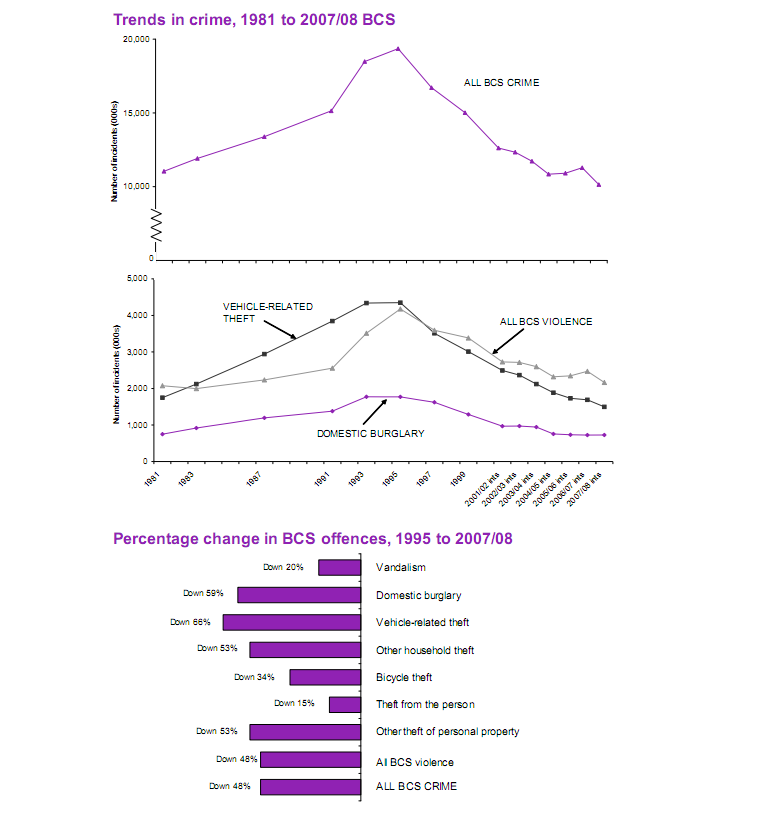
Here Brown here makes no real case for CCTV having prevented crime. Yes, in certain cases it does a fine job in identifying those that have committed crimes, but as for prevention the case has simply not been made by anyone. It would be interesting to know when Newcastle introduced its CCTV scheme and whether this is any correlation with its installation, or whether the drop is simply because crime has fell substantially over the last 10 years, but Brown doesn't provide any background, only figures which are easily amenable. A police officer recently revealed that only 3% of street crime in London, a place completely covered with CCTV, is solved using cameras, and this is a point David Davis has directly made. Many of them simply don't provide high enough quality images to be used in prosecutions, making them useless while doing nothing to reassure anyone, with the opposite often being the case. CCTV may make some feel safer, but it's a false, irrational sense of safety which is quickly forgotten. It is a praiseworthy move that the information commissioner will produce a yearly report on the state of surveillance, but whether any suggestions the report makes will be listened to or properly debated is another matter.

Finally then, to the DNA database:

Through a series of careful changes we have made DNA one of the most effective tools in fighting crime. And we have worked with the police and also the Home Affairs Select Committee and others to ensure that proper safeguards are in place.

As a result, the National DNA Database has revolutionised the way the police protect the public. In the last full year for which figures have been made public, the DNA database matched suspects with over 40,000 crimes. That's over a hundred crimes a day which would be harder to solve, sometimes impossible, without the use of DNA - including 450 homicides, almost 650 rapes, over 200 other sex offences, almost 2,000 violent offences and over 8,500 burglaries.


Again, it's not clear whether in these cases the suspect's DNA was already on the database or whether when they were arrested it was taken and then subsequently matched in order to confirm the police's case against them. No one is going to dispute that the DNA database is an incredibly helpful tool to the police which has helped them solve numerous crimes, it's over what Brown next turns to where there is real concern:

I say to those who questioned the changes in the Criminal Justice and Police Act 2001, which allowed DNA to be retained from all charged suspects even if not found guilty: if we had not made this change, 8,000 suspects who have been matched with crime scenes since 2001 would in all probability have got away, their DNA having been deleted from the database. This includes 114 murders, 55 attempted murders, 116 rapes, 68 other sexual offences, 119 aggravated burglaries, and 127 drugs offences.

And I say to those who opposed the proposals in the Criminal Justice Act 2003, to allow the police to take DNA samples not just from those charged, but from all those arrested for serious, recordable offences: again, if we had not made this change, there would be serious and dangerous criminals escaping justice and continuing to pose a threat to the public. It is simply not responsible government to let such opportunities to use new technologies to protect the public pass us by.

But again, we have matched these careful extensions in the use of DNA with the right safeguards: DNA can only be recorded for people arrested for a recordable offence; the use of that DNA has clear limits set down in legislation, by the Police and Criminal Evidence Act; and there are stringent limits on those who are able to access the information.


I don't think that anyone is now suggesting that data taken from those arrested should not at least be checked with the database to confirm that they are not a match for other serious offences, as this is after all how the likes of Mark Dixie have been convicted. Instead, there needs to be a compromise, where those who have been arrested but never charged with any crime have their data checked and if nothing comes up, then and only then should it be removed and destroyed. The problem is that we simply can't trust the police to do this, as previous cases where children who have been arrested for something completely trivial have shown, with police procrastinating and only finally destroying their fingerprints and DNA sample when parents went to the press and demanded it be done while they were present. More specifically the real concern is that the police and government are acquiring and attempting to create a representative database by stealth, and as ever more minute amounts of DNA are taken from crime scenes, the potential for miscarriages of justice increases greatly. The recent prosecution of Sean Hoey and the case of Shirley McKie are testament to this, and some might also point towards the minute amounts of samples taken from the fibres in the back of the McCann's hire car, directly leading to the lurid accusations against them also.

Brown is of course also being completely disengenuous: the police can now arrest anyone for almost any reason they can think of if they're so inclined, thanks to the final removal of any distinction over what an arrestable offence is and isn't. They're then perfectly within their rights to take your fingerprints and a DNA sample, and there's absolutely nothing you can do about it, whether you're charged with any crime or not. Seeing as the government has also then created somewhere in the region of 3,000 new offences which you can be charged with, there's plenty of room for manoeuvre.

We are now approaching the end, but Brown leaves one of the most astonishing and risible claims until now:

And it is a measure of the emphasis that we place on at all times advancing the liberties of the individual that we have in the past year done more to extend freedom of speech, freedom of assembly, freedom of the press and freedom of information. To summarise, we have given people new rights to protest outside Parliament

No you haven't - all you've done is given us our old right back! How typically New Labour to claim credit for something which they've first taken away, only to then give back. And that's not all:

We have removed barriers to investigative journalism

By removed barriers, Brown must mean "allowed tabloid scum to keep digging into celebrity lowlife and anyone ever accused of any crime" via private investigators and the very databases which Brown has just spent so much time eulogising while claiming to be secure!

It's this though that even defeats both of the above for being completely ridiculous and out-of-touch with reality:

And I agree with those who argue that the very freedoms we have built up over generations are the freedoms terrorists most want to destroy. And we must not - we will not - allow them to do so.

Except you've just admirably done their job for them. Why do they need to bother when the prime minister can hide behind technological developments and blatant scaremongering on how deadly the threat it is for further extending detention without charge and removing the very liberties they loathe?

If the prime minister so believes all of the above though, instead of just making a speech on it, why doesn't he and his party stand a candidate arguing all of the above against David Davis? If you're so sure of your case, and in some places it is more credible than in others, why not stand by your convictions? That Brown won't but that he will make a speech rather than enter into open debate suggests that he knows full well that he and the government would lose the argument, just as they did over 42 days even if they won the vote. Isn't this the prime minister that has so cornered the market in writing about courage? On civil liberties, Brown really can be accused of bottling it.

Related posts:
OurKingdom - Brown dumps UK's national security strategy
Rachel North - Scared New World
Lee Griffin - We must remove civil liberties to give you freedom

Labels: , , , , , , , ,

AddThis Social Bookmark Button

Tuesday, June 03, 2008 

There is a grave exceptional threat from terrorists of mass destruction...

If it wasn't so serious it would almost be funny. The latest safeguard that will stop 42 days detention without charge being used to hold anyone with a beard and funny ideas is that the Home Secretary herself will have to decree that the extension can only be used when there is a "grave exceptional terrorist threat", such as an attack on the level of 7/7 taking place or feared to be about to take place. Like with all the other safeguards, it's both pointless and worthless. We're being constantly reminded that the threat we face from terrorism is, in the words of the ex-head of Scotland Yard's anti-terrorist squad Peter Clarke, "deadly and enduring". The brown-trousers-o-meter already declares that the current threat level is "severe", which means an attack is highly likely. How could we possibly tell the difference between a "grave exceptional" threat and the current level?

I mention Clarke because he too has now stepped into the breach with his own article on why 42 days is necessary, while, like Brown yesterday, making no real justification other than that the police have their resources stretched to be able to manage within 28 days. It's not worth fisking in full, but there are some parts that deserve answering:

In August 2004, Scotland Yard Anti-Terrorist Branch officers spent a fortnight sleeping on their office floor. Why? Because they had been given the job of winning the race against time to find evidence of terrorist planning buried in the encrypted files of dozens of computers seized during Operation Rhyme - the investigation into a terrorist network led by Dhiren Barot, the al-Qa'eda planner.

There in a nutshell seems to be the real reason why the police want longer than 28 days. It means they don't have to rush themselves quite as much or sleep on the floor of their offices, and who frankly could disagree with police officers doing such an important job being uncomfortable while protecting the public from evildoers? It's also nice to see that Clarke mentions that Barot's computers were encrypted, meaning that as the law has since changed the police could now charge someone in Barot's position alone for refusing to provide an encryption key to decode the files. Again, whether Barot really did have any genuine links to al-Qaida is unclear - he apparently went to Pakistan to get his plans approved - and returned empty-handed.

Barot was a career terrorist who had been to training camps in Pakistan and the Far East. But we didn't know what stage his plans had reached. We could not be sure that he or other members of his group were not going to launch attacks, even as we watched. The decision was made to arrest them, and they were promptly rounded up in London and Blackburn.

As it turned out, he or his group could not have launched attacks because they didn't have funding, explosives or have even reached the first stages of preparing to launch an attack. All they had was plans, and very asinine plans they were too.

There was not a shred of evidence against them. The intelligence was clear - that he and his gang were planning attacks in this country, but there was no evidence that could be used in court.

At the time, terrorist suspects could be detained for 14 days. In this case, the pieces of the jigsaw fell into place on the morning of the 14th day. It was a very close call. We were minutes away from having to release a group of terrorists. Two years later, they pleaded guilty to plotting to make a dirty bomb and to kill fellow citizens in huge numbers.

Ah yes, either the Coke can dirty bomb or the smoke alarm dirty bomb. It's strange how when discussing these cases that no one, either police or journalists seems prepared to go into the actual details which are nowhere near as frightening or doom-mongering as the popular perception of what a dirty bomb would involve are. Why Clarke is focusing so much on this case is unclear: it shows the system working as it should have done. So does his next example:

This case told us that things had to change. Plots that have been uncovered since Barot, and the attacks on London in 2005, show the terrorist threat is growing in scale and complexity.

Plots where again the system has worked, with three men who were held for 28 days being charged, and another three released after 28 after the "liquid bombs plot". Again, where does this all end? In two years will have the police asking for 60 days because the plots have grown in scale and complexity again, with spurious amounts of data which they've had to go through being used again as the casus belli?

And yet, as Parliament prepares for the debate on the second reading of the Counter Terrorism Bill, we have to brace ourselves for another deluge of politicised comment on the proposal to extend the time terrorist suspects can be held.

The cross-party consensus that, for many years, helped guide the thinking on such issues evaporated in 2005. The parties blame each other for this, but the quality of the public debate has suffered. It is now difficult for counter-terrorist professionals to offer a view without being accused of political partiality.


Could this possibly be because the police in the first case engaged in err, political partiality, supporting the indefensible when it came 90 days? Clarke himself previously why-oh-whyed over the criticism directed the police's way in a speech last year:

I know there have been concerns expressed about the role of the police service in that debate, and whether we overstepped the mark in terms of political neutrality - but I find this slightly puzzling. If we are asked for our professional opinion, and we express it, and the Government brings forward legislation, are we supposed to be silent the moment a draft Bill is published? We were accused of being politically partial, but I reject that.

If Clarke would like to explain how Andy Hayman being asked by the Home Secretary to comment on why 90 days was needed is not the police making a political case or how the Association of Chief Police Officers' intervention prior to the 90 days debate, with officers phoning up MPs urging them to support the legislation is not the police becoming politicised, then I'm sure it would be gratefully received.

In any case, the political consensus collapsed because 90 days were so clearly beyond the pale, as the government now accepts, although the police themselves apparently don't. It's also because the evidence is simply not there for a further extension: it's been the opposition parties that have been the principled ones, holding the same position from the beginning, that beyond 28 day detention without charge is simply not acceptable.

Clarke continues:

For instance, critics claim that the proposal is a draconian extension of police powers. It is not. Detention would be a judicial discretion, to be exercised following an adversarial hearing with both sides legally represented. This would be no rubber stamp. Indeed, the record of the judiciary in challenging the Government in terrorism cases suggests that any application for extended detention will be subject to the sharpest scrutiny.

This is the exact same argument as Clarke made last year, and it was wanting then. The judiciary have been notably active in terrorism cases, but that's where the detention has been arbitrary, either indefinite or where those accused have been held under control orders. Where they have not been so active or so forceful is where the evidence against the accused has not just been around intelligence, and where they are in police rather than prison custody or under house arrest. The police case is almost always going to be stronger, making clear that the individual is a major potential threat while the defence will have to argue purely on civil liberty grounds; the judiciary, put in such a position, will almost always give the police the benefit of the doubt.

Skipping some of the rest which isn't directly relevant to why 42 days is needed so desperately:

When I was asked, in 2005, by the home affairs select committee how many terrorists I had been obliged to let go through lack of time to investigate, I inwardly despaired. It was the wrong question. We should look forward, not back. The fact that we have been able to convict more than 60 terrorists in the last year or so is irrelevant.

This seems more revealing than Clarke admits. It's because the answer is 0; the only organisations that have let some go through supposed lack of time are the security services. There is nothing to suggest that any "terrorists" will ever have to be let go because lack of time.

The better question would have been: "Is it likely that there will come a time when the present 28-day limit is insufficient?" The answer would have been, "undoubtedly". That is why we should legislate now, and not in panic in an emergency.

Except we wouldn't need to panic in an emergency. If there was some dire, dire need to go beyond 28 days, the Civil Contingencies Act could be invoked; the government could temporarily derogate from the European Convention on Human Rights; or the accused could even be charged with a lesser offence while the investigation continued, something that is apparently too obvious to consider. Doing either of the first two options would be worrying and potentially out of proportion with the actual threat posed, but then so is 42 days itself. The government and the police would however find it far more difficult to justify doing either than it would to invoke 42 days under the laughable "grave exceptional" threat when the only reason for extending the limit is so the police can get a little more sleep.

The details of the 42-day detention plan may not be perfect, but the principle of being able to protect the public in extremis must be right. The checks and balances in our system prevent arbitrary detention. The judiciary have repeatedly shown their vigilance and independence. We should trust the judges and give the public the protection they deserve.

And while we're at it - could we try, just for a moment, to take the politics out of this?


But it isn't the judges who are the ones who are proposing this; they're just the ones who'll get the blame if they get it wrong. It's not those who we have to trust, it's the police and the government, and the fact is that we don't trust either. Nothing Clarke or Labour has said is convincing, and those still on the Labour backbenches who are wavering need to continue refusing to countenance the counting dilution of our hard-won civil liberties.

Labels: , , , , , , ,

AddThis Social Bookmark Button

Monday, June 02, 2008 

Fisking Brown on 42-day detention.

How would we be able to tell when it had been implemented?

The more things seem to change, the more they stay the same. If you're getting an overwhelming sense of deja-vu, imagining that we seem to have been here before, then you're not alone. For 42 days, read 90. For Tony Blair, read Gordon Brown. For Charles Clarke, read Jacqui Smith. The whole abortion of a debate over the urgent, pressing need for more time to hold the dastardly terrorist suspects, whether it be for another 42 minutes, 42 hours, 42 months or 42 years, or for 90 minutes passim ad nauseam has become so repetitive that you could get a robot to take up the slack and make the case for both sides.

If you don't therefore want to bored to tears, you might be inclined to skip this post. Just like when Tony Blair was in trouble he depended upon the Downing Street Echo and the Times to back him to hilt, so it seems to have come full circle with Gordo. With almost every newspaper apart from the Sun opposing any extension, and you tend to not be taken too seriously if you make your scholarly case for further detention powers in the same tabloid which has topless woman on its third page, Brown has instead taken to the sympathetic pages of the Thunderer in his restless case to convince the only two remaining people whom haven't already made their mind up about just how desperately needed those further 14 days are. The results are far from encouraging.

Next week, when Parliament votes on the proposal to detain terrorist suspects without charge for up to 42 days, hard choices have to be made.

Not really. There are two choices: to either reject yet another truly unnecessary, discriminatory, unhelpful, counter-productive and chilling reduction in civil liberties, or to support the government and a band of merry supporters which can be counted on one hand, which included the already mentioned Sun, "Sir" Ian Blair, Lord Carlile, who thinks that putting a figure on it is unhelpful but is supportive in principle, Melanie Phillips (a given) and David Aaronovitch. If I've missed someone, feel free to point them out.

Britain has lived with terrorist threats for decades. But I am under no illusion that today's threats are different in their scale and nature from anything we have faced before. Today in Britain there are at least 2,000 terrorist suspects, 200 networks or cells and 30 active plots. The aim of terrorists is to kill and maim the maximum number of victims, indiscriminately and without warning, including through suicide attacks.

We can agree on the point that the threat is different; whether it is in scale or nature is less obvious. It's too easy to forget that the IRA didn't always telephone through warnings, and unlike the jihadist takfirists, also used to specifically target politicians rather than civilians. They also had far more support and far more funding than our current "friends". Quoting the 2-year old murmurings of the former head of MI5 without any explanation as there wasn't then of whether these 2,000 "terrorist suspects" are all Islamists or otherwise, and without specifying if they're allied to al-Qaida type ideology or the more Muslim Brotherhood-influenced Hamas type simply isn't good enough. If there were 30 active plots, how come that more "plots" haven't either been disrupted or come to fruition since then? No one can dispute that the aim is to kill and maim as many as possible, but the last few attempts to do just that have failed miserably. Even one police officer called Nick Reilly's apparent recent attempt to construct a bomb in a restaurant as "amateur hour"; that could have been extended to last year's Glasgow airport attacks and even the "liquid bombs" plot. While we should be concerned and rightly, we should also be making clear that we're dealing for the most part with fantasists, not deadly trained and truly motivated fighters.

Look at the scale and complexity of today's terrorist plots and you will understand why the amount of time required before charges can be brought has increased. In 2001 police investigating the last big IRA case had to analyse just one computer and a few floppy disks. The suspects used their own names and never went beyond Ireland and the UK.

By 2004 the police investigating the al-Qaeda plotter Dhiren Barot had to seize 270 computers, 2,000 disks, and more than 8,000 other exhibits. There were seven co-conspirators, and the investigation stretched across three continents. In the 2006 alleged airline bomb plot, the complexity had grown again - 400 computers, 8,000 disks and more than 25,000 exhibits.


This is just yet another attempt to blind people with statistics and figures. We don't know what 270 computers means in reality: it could be handhelds, computers in internet cafes, etc, all of which are not going to take anywhere near the time to search as a personal encrypted computer which holds most if not all of the relevant information. The same goes for the number of disks mentioned: are they burned CDs and DVDs or are the police going through suspects' entire DVD and CD collections in search of even the slightest amount of possibly hidden evidence, which would explain the huge amounts of disks apparently gone through? The possibility that this is exactly what they are doing is raised because our old friend Dhiren Barot apparently had concealed some alleged "reconnaissance" material on a Die Hard video. Fast-forwarding through DVDs and videos doesn't take that long, which underlines just how subjective the raising of such apparently vast amounts of material which needs to be shifted through is.

In any case, these examples are not even necessarily relevant; both cases involve "plots" which were disrupted before they came to fruition and where the police are searching for anything that might support their case. The "nightmare scenario" which has been raised by ministers such as Tony McNulty which would justify 42 days is 3 or 4 attacks of 9/11 type intensity occurring at the same time. In such cases, where crimes have already been obviously committed, and when the perpetrators will be presumably dead, it already seems doubtful that 42 days would be necessary. The alleged facilitators of 7/7 have only recently been brought to trial, and it certainly didn't taken anything approaching 28 days to hold them prior to being charged.

The police find themselves investigating multiple identities and passports, numerous mobile phone and e-mail accounts, and contacts stretching across the world. Simply establishing the true identity of a suspect may itself take days. Often hundreds of hours of video footage have to be viewed, layers of computer encryptions deciphered and overseas authorities persuaded to co-operate.

Why is this being used as a justification, apparently the only remaining justification? If the reason why "suspects" need to be held for longer than 28 days is because of the resources the police have, then give them more resources, don't extend the time the "suspect" can be held. Similarly, bringing up the encryptions argument again is really getting tiresome: the police have the power to demand encryption keys, and if the suspect refuses, he can be charged on that alone. As Spy Blog points out, encryption can either be broken or it cannot. Having to "persuade" overseas authorities to co-operate is also a red herring; hardly any countries refuse to co-operate, it's just the time that it takes for them to do so, which again, is not a justification for extending the time limit.

And the police cannot just wait for suspects to be caught red-handed. They have to make a judgment about intervening early to avert tragedy; which means more time may be needed, between arrest and charges being laid, to unravel the conspiracy and assemble the evidence.

Which they've up till now managed perfectly well, perhaps too well, if worries about what the "liquid bombers" could have actually achieved are substantiated. Dhiren Barot and his cack-handed "dirty bomb", used so often to scaremonger, were similarly dealt with perfectly adequately. We're being asked to legislate for a hypothetical, something that may never happen but which may happen, asking us to support it on the basis of the "increasing complexity" which adds up to the police sifting through more data than perhaps they even need to. It's about as far from convincing as it's possible to get.

The challenge for every government is to respond to the changing demands of national security, while upholding something that is at the heart of the British constitutional settlement: the preservation of civil liberties. And if the national interest requires new measures to safeguard our security, it is, in my view, the British way to make those changes in a manner that maximises the protection of individuals against arbitrary treatment.

Now Brown's assaulting us with his favourite topic, Britishness. It's the British way to lock up suspects for a random number of days on the possibility they might be nasty; that's another way to say what Brown has just written.

So our first principle is that there should always be a maximum limit on pre-charge detention. It is fundamental to our civil liberties that no one should be held arbitrarily for an unspecified period. After detailed consultation with the police, and examination of recent trends in terrorist cases, we propose the upper limit of 42 days.

Really? Where where you then prime minister while Belmarsh was being used as the British equivalent of Guantanamo Bay, albeit only for "foreign terrorist suspects"? Were you making clear your opposition to this constitutional outrage, only ended when the House of Lords ruled that it was incompatible with an act which your self same government brought in? If you want us to know the specifics of exactly why the police think we need 42 days, why don't you publish these detailed consultations? In reality this "detailed consultation" seems to amount to asking either the head of the Met or the current head of anti-terrorist policing what amount of days they'd like: we've had 90, we've had 56, and now we've got 42. How do we know that in another 2 years' time the police aren't going to be asking for yet another 2 weeks longer than the current limit?

Our second principle is that detention beyond 28 days can be allowed only in truly exceptional circumstances. The decision is made by the Home Secretary but must be backed by the Director of Public Prosecutions as well as the police. And this would allow the higher limit only for a temporary period, and only where there is a specific terrorist incident or threat under investigation that warrants it.

Which is yet another "compromise" that isn't. It just so happens that this "safeguard" has been designed so that the current director of public prosecutions, who opposes any increase, has to embarrass himself by admitting that he got it wrong. How limiting the higher limit to a "temporary period" is also any kind of safeguard is bizarre: if the higher period is needed again, the police will just ask for it again, and parliament and judges are hardly likely to disagree with them, especially when the tabloid press will be howling if they do.

Our third principle is that the Home Secretary must then take this decision to Parliament for approval. If Parliament refused to sanction the decision, the existing 28-day limit would stand.

How likely exactly is it that parliament will disagree when it's already decided that 42 days might be appropriate? How and why should parliament be asked to decide whether it is necessary when they will neither legally nor politically be able to make such a decision without either prejudicing a potential case or without bringing the whole of the weight of the media down on their heads if someone then released goes on to commit any sort of offence? This isn't a safeguard or a compromise, it's an unholy mess that makes things worse, not better. Oh, and here's a good question: what happens exactly if parliament happens to be in recess when such an extension is needed?

Fourthly, the judiciary must oversee each individual case. As happens now for detention beyond 14 days, a senior judge will be required to approve the extension of detention in each individual case every seven days up to the new higher limit.

Again, how likely is it that any judge will dare to risk the chance of releasing such a suspect, especially when the police will be making clear in no uncertain terms how they must not be? It's not a safeguard now and it certainly won't be after 28 days.

Fifthly, to enhance accountability there must be independent reporting to Parliament and the public on all cases. That is why the independent reviewer will now report publicly not just in general on the operation of the legislation but on each individual case.

And since the "independent" reviewer already supports an extension, and thinks that control orders are necessary and proportionate, we can take a guess at what his reports will say. Yet again, how his reporting on each individual case will not prejudice a trial will be interesting to discover.

So I say to those with legitimate concerns about civil liberties: look at these practical safeguards against arbitrary treatment. With these protections in place, I believe Parliament should take the right decision for national security.

These safeguards are absolutely worthless. In fact, they're worse than worthless; they justify, condone and underpin that arbitrary treatment. There could not be a better specific example that the current anti-terror laws have already gone too far than that of Rizwaan Sabir: when you can be held for 6 days for downloading an al-Qaida manual from a US government website, the potential for arbitrary treatment, injustice and increased resentment against the authorities could not be greater. While those arrested at the same time were charged and convicted, two of those arrested during the investigation into the Birmingham beheading plot were held for a week without once being questioned about the allegations being made in the press, of which they only learned after their release. It doesn't matter if for every 1 that is released after an extended period in detention 10 are charged and subsequently convicted: it's that 1 and his story that enrage, that do the damage and which show why such an extension must be resisted.

I have received much advice in recent weeks. Some have argued that I should drop or significantly water down the 42-day limit. But having considered carefully all the evidence and arguments, I believe that, with all these protections against arbitrary treatment in place, allowing up to 42 days' pre-charge detention in these exceptional terrorist cases is the right way to protect national security.

Indeed he has received much advice, and typically of Gordon, he hasn't taken a single piece of it on-board. He's still convinced that this is the one remaining piece of legislation on which he can wrong foot the Tories, making them look weak, and by at least one of the quoted polls, around 57% of the public do support the government, although that's a figure way down on the support for Blair when 90 days was defeated, showing that the unpopularity of the government and the fall in fearmongering over the terrorist threat in general seems to have had an effect. The most laughable and contemptible opinion put across is that being "tough" has nothing to do with it: the loathsome McNulty appearing on Newsnight emphasising that, while in more or less the same sentence repeating Smith's argument from earlier tonight that this would be a decision showing the government "governing". If that isn't a shot across the bows of the Tories, ridiculing them for being playing with people's lives as they're in opposition rather than government, I don't know what is.

That is why I will stick to the principles I have set out and do the right thing: protecting the security of all and the liberties of each; and safeguarding the British people by a careful and proportionate strengthening of powers in response to the radically new terrorist threats we now face.

No Gordon, you're sticking the principle of being a politician rather than governing in the interests of the "British people". While terrorists threats will grow and wither respectively, our civil liberties will only ever be weakened. Once lost, they are near to impossible to win back. From a government that has only done one thing to civil liberties, and that's to slash them, despite the welcome introduction of the Human Rights Act, to claim to be protecting the security of all and the liberties of each is obscurantist in the extreme. It was to be hoped that Labour MPs would still vote 42 days down, something now looking less likely, not because MPs have been won over by the government's case, but because they don't want to make things even worse for the party and for Gordon. The cavalier attitude that shows towards civil liberties and the people's interests is politicians at their very worst. Those that do change their minds for just that reason more than deserve eviction from parliament itself, something the electorate seems inclined to do regardless.

Labels: , , , , , ,

AddThis Social Bookmark Button

Saturday, May 17, 2008 

Woe, woe is me!

It has come to this. Faced with all her arguments disintegrating in front of her eyes, Nadine Dorries is now taking her stories of being so horribly bullied and abused to the pages of the Telegraph:

I guess I knew when watching an aborted baby lying in a bedpan struggling to breathe, that my inability to help and my complicity as a young nurse assisting in this process, would one day force me to try to alter the barbaric practice our society has become so immune to: late abortion.

Unity has already raised the point that Dorries might well be lying or exaggerating about this, and asked if any current students (Dorries said this occurred when she was a student nurse at 19) had participated in live-birth abortions. Two answered in the comments and both said it was highly unlikely, although things may have been different back in the 70s. Thing is, because Dorries has told so many lies and distorted so much in the past, it's completely impossible to trust almost anything she now says. It would be lovely if we could have a debate on the current abortion limit without having to check and double check everything that Dorries and her supporters say, but it sadly doesn't seem to be possible.

Adversely, as a result of botched abortions such as the one I assisted with, the Royal College of Obstetricians and Gynaecologists (RCOG) issued guidelines to ensure that an abortion never again becomes a live birth.

To avoid this happening, a lethal injection is placed into the baby's heart through the mother's abdominal wall via a cannula - the baby is then surgically dismembered and removed limb by limb. That'll teach 'em.


Yes, we realise that it's extremely unpleasant. Just because something is such is not a reason for lowering the limit when Dorries is relying on the work of just one doctor for her claims that babies older than 18 weeks can feel pain in the way that adults do; most other doctors working in the field are of the opinion that the cerebral cortex, which is not fully developed or properly "wired up" until 26 weeks, is central to the pain experience. In any case, as Stuart Derbyshire wrote:

Whether the fetus feels pain is an important academic and clinical question but it has no relevance to the debate about abortion. If fetal pain is possible then it might be decided that the fetus be anaesthetised prior to the abortion or that the procedure be performed more quickly. There are many good reasons to support abortion that will remain valid even if the fetus can feel pain. Equally, there are many good reasons to defend the welfare of the fetus that will remain valid even if the fetus cannot feel pain. The attempts to make a moral argument through science are deeply concerning. Arguments over life, rights and the sovereignty of a woman’s body cannot be replaced by science dictating the conditions of an acceptable abortion. Such a situation would represent a tyranny of scientific expertise that should be as equally unwelcome to the opponents of abortion as to those who support it.

Back to Dorries:

The pro-abortionists insist there have been no improvements in survival rates for babies below 24 weeks. They omit to mention that the measurement used - that of the survival of poorly babies who happen to make it into a specialist neonatal unit in time - cannot be used to compare potential outcomes of aborted healthy babies.

You don't say? Possibly we're omitting to mention it because it's completely irrelevant?

They also ignore those darned little tykes who fought against the odds and are living all over the UK, such as little Millie - born at 21 weeks and who is now living well in Manchester.

Yes, we're bastards, aren't we, ignoring all those exceptional cases? Incidentally, as someone mentions in the comments about little Millie:

Millie, the baby cited by Nadine, stood a 1 in 100 chance of survival, and that is after major medical intervention (costing £many thousands). Her twin, born a few moments earlier, died. Millie still required oxygen when she finally went home in 2007.

It's also worth remembering that in the Trent study released last weekend, none of the babies born at 22 weeks survived.

No, far better to deploy the foeticide technique. One has to ask the question: if the pro?abortionists argue that the upper limit at which abortion takes place doesn't need to come down because babies don't survive below 23 weeks, why do we need to use lethal injection and a technique more suited to a butcher than a doctor, to make sure they don't try?

Oh, I don't know, possibly because it's rather more humane than letting them die slowly, as Dorries herself supposedly experienced? Or maybe because, if the research Dorries herself relies upon does turn out in future to be correct, it results in as little trauma as possible occurring to the foetus? Actually, am I misinterpreting here, or is Dorries really suggesting that we let nature take its course in front of the mother? There's heartlessness, then there's Ms Dorries apparently. Or maybe that's the point: that'll teach her a lesson she'll never forget.

You would think that, being an advocate of safe, free and swift access to abortion in the first trimester, I might have avoided the horrors that usually befall any MP who so much as whispers the word "abortion" in Westminster.

By first trimester Dorries of course means 9 weeks, not 12 weeks, which is her personal favoured option, although despite her 20 reasons for 20 weeks campaign, she's also signed an amendment which supports 16 weeks. It seems she either can't make up her mind, or she's seriously hedging her bets. Additionally, by "advocate of safe, free and swift access to abortion", she also means that she's deeply concerned by the relaxation of the rules proposed by some, which means that rather than early abortions she's in favour of women going through the regular route of abortion services, which the self-same committee she sat on noted were causing "unnecessary delays" to patients".

I thought that. Which is why, as someone who will do anything to avoid housework, I was especially hacked off to find the word "bich" smeared on my window last Saturday morning. I'm not sure what displeased me more: the bad spelling, the fact that I had to dust cobwebs off the Marigolds, or that the dogs hadn't barked.

Not especially pleasant, but also not necessarily linked to her current campaigning. Judging by her conduct towards Ben Goldacre and Caroline Flint, I'd hazard to suggest that Dorries seems to have a special knack of pissing people off.

As I write this, my PA is on the phone to the police - again. We're on first-name terms; I know I'll be on the Met's Christmas card list. My house is "flagged" by police, as are the homes of my staff.

At least they are being involved then, which suggests that Dorries is for once being truthful.

The second dismembered doll arrived in the post this week and the number of abusive phone calls, emails and letters we have received are too numerous to mention. People are crawling all over my expenses - which I am happy for them to do - and there are the usual nasty websites.

Oh, so it wasn't shit then, but rather the less traumatic dismembered doll. Most of this is what she put on her "blog" earlier in the week, with the same lack of evidence behind her claims as then. Again Ms Dorries, if by some off-chance you happen to read this, how about providing some proof, or letting us know where what these "nasty" websites are, because if you're talking about DK or Unity who are a little more vitriolic than some of us other inhabitants of the blog world, then you're talking trash and don't understand the internet any more than you seemingly do much else.

You can't phone my Westminster office today without first being screened by the switchboard. Perversely, this animosity gives me strength. This and the fact that three-quarters of women and two-thirds of GPs support what I will try to do when the Embryology Bill comes before Parliament next week: to reduce the upper time limit at which abortions can be carried, from the current limit of 24 weeks to 20 weeks.

Dorries is yet again relying on the same old polls which are skewed from the beginning. A more reliable poll, conducted recently by YouGuv (PDF), although still slightly iffy, found that support for the current limit was at 35% with those in favour of a reduction at 48%, which is nowhere near the levels which Dorries claims. It's also to be expected when so much of the media is giving acres of room to Dorries and the emotional but irrelevant "4D" images which go hand in hand with it.

People often ask me why I'm a Conservative. It's not the usual political default position for a girl from a Liverpool council estate. Well, for me being a Conservative is about protecting the most vulnerable in our society. Who can be more vulnerable than a baby struggling to breathe in a bedpan?

Protecting the most vulnerable and the Conservative party - they go together like Graham Norton and tastefulness.

The activists can smear away - I will continue to fight the horrible injustice that befalls 2,500 babies a year. It feels like it's me and the memory of a lost baby against the rest of the world and a bunch of graffiti artists. But I am determined that something good will come from that day.

No, Nadine, it's not us doing the smearing - it's you, just as it always has been. The horrible injustice is that you're basing the entirety of your campaign on either distortions, junk science and plain old bullshit, while you're in league with those who want to completely deny women the right to choose, just as you claim that you're in fact pro-choice. The only good thing that might come from that day would be if you went back, and for just half a second, maybe just thought whether the poor speller had something of a point and whether your behaviour over the last year has been becoming of a politician. We already know you won't - you couldn't be introspective or doubtful for a second if you tried. The tragedy is that we continue to be represented by such dishonest, unaccountable and unpleasant characters as yourself, and no amount of playing the victim is going to change that.

Labels: , , , , , ,

AddThis Social Bookmark Button

Wednesday, March 12, 2008 

I'm not sorry, and I blame Allison Pearson.

Oh look, it's a rather over ripe peach.

When blogging and responding to articles both elsewhere online and in the press, there's always a case for two diametrically opposed responses. Like I did with Kamm's rampant apologia for rendition yesterday, you can fisk hard and fast but do so without peppering it with what might well be valid but also distracting insults and expletives, or you can go the whole hog and just call a cunt a cunt, as Kid in the comments does. I try not to do that too often for a couple of reasons: firstly, because it's not pleasant, the writer probably isn't a cunt however reprehensible their views, and it makes me look like one of the green-ink brigade, even here in the deepest depths of cyberspace, not to mention the deeply misogynistic tones of doing so, even if no such offence is meant, and how it also doesn't really make me feel any better in any case; and secondly, because then when you only rarely do exactly what I've just described, it seems to make the result all the sweeter.

This is one of those such occasions. Last week, while commenting on Shannon Matthews and the media response, I happened to come across Allison Pearson's views on Matthews' mother. Worth keeping in mind throughout all of this that Pearson is and remains one of the McCanns' biggest supporters in the press. Her blithering that "this kind of thing doesn't usually happen to people like us" summed up both how the press had responded to the Madeleine disappearance and how it hasn't to Matthews. The sheer class snobbery, something already endemic in the Mail, was overwhelming, and just to labour the point, Pearson said that "Shannon was already a lost child" and went on to make observations that were stupid at best and downright deplorable at worst, saying that "allowing a passing parade of boyfriends to play tickling games with your vulnerable small girl is, at best, naïve" and also that "Shannon Matthews was already a victim of a chaotic domestic situation, inflicted by parents on their innocent children, long before she vanished into the chill February night."

Pearson herself has two children
, and it's jolly good that she does, because otherwise she wouldn't be able to make such blasé generalisations about how others should look after theirs. Not content with kicking Shannon's mother while her daughter was and still is missing, Pearson obviously thought that wasn't quite potentially offensive enough. No, she had to go one better: kicking a mother when her daughter has just been raped and murdered. Yeah, I wish I was making this up too.

Fiona MacKeown, the mother of Scarlett Keeling, the 15-year-old girl who was raped and murdered in Goa, seems less like a grieving mother than an avenging tigress.

The dehumanisation therefore sets in immediately. In Pearson's fucked up, microscopic little brain, MacKeown is not someone who wants justice for her daughter's murder, something that the local police appear to have covered up, but rather a vicious creature that is out for vengeance, and more than willing to rip out a few throats in the process. Someone who ought to be supported when at her most vulnerable is instead about to be clobbered by the Daily Mail's latest and worst Glenda Slagg.

With her swishing curtain of grey hair, Fiona is taking on a corrupt local police force which initially denied that her cub had been the victim of foul play.

This is a pretty old cub we're talking about here, considering that Scarlett was 15. Never mind that the analogy is bogus, stretched to complete breaking point, and that MacKeown is instead doing what any relative, regardless of whether she was the mother or not would do if they had the personal strength to do so, in Pearson's grim calculus this is just the beginning in a build up towards far more than dehumanisation.

"If police had taken more interest in previous [suspicious] deaths, then Scarlett might not be dead now," growled Fiona.

Ah, she's growling now. I see, like a cat. How much exactly do you get paid for this you witless, brain-addled fuckbubble?

Maybe so. But isn't there an even better chance that Scarlett would still be alive if her own mother had not abandoned her for several weeks after an argument and recklessly continued her own holiday?

Or perhaps if whoever it was WHO FUCKING KILLED HER hadn't done so she would still be. Scarlett and her mother don't come into this; the entirety of the blame lies with the murderer. But then, how could the murderer resist?

Instead the blonde teenager, as tempting as a ripe peach, was left in the care of a 25-year-old tour guide - a local man she'd only recently met.

As tempting as a ripe peach. In case Pearson hasn't been paying attention, over the last month or so we've seen similar "ripe peaches" who have been killed by men, in at least one of the cases purely for his own warped sexual pleasure. They however weren't excused for their crimes because those they killed were beautiful and therefore apparently asking for it; they were rightly put behind bars for more or less the rest of their lives. They say that the Daily Mail is the most misogynistic newspaper, and with such writers as Pearson, who needs enemies?

I don't know what they call that in globe-trotting hippy circles. Back here on Planet Parent it's known as dereliction of duty.

Jolly good. Perhaps if you have daughters and one of them is subsequently whisked away, you'll not begrudge me the right to blame your fucked up small-minded bourgeois values rather than the person responsible, while adding that your daughter was clearly asking for it because she resembled a plump plum, just ready to be devoured.

Mrs MacKeown is now to be questioned by Goan police for negligence - a tactic she claims is a "disgusting" attempt to "switch the focus" away from their own failings.

If anyone's trying to divert attention away from their own mistakes, I'd say it's Mrs MacKeown.

Oh, what's the fucking point with even bothering to argue against this diatribe? Fuck you Allison, and fuck your paper for printing this despicable rant which simply couldn't want a day longer to be formed in that shell-like wrinkled, busted contraption in the middle of your head that couldn't possibly be described by anyone that has read your prose as a brain.

Scarlett was last seen at 4am in a bar surrounded by several men. Witnesses say she was totally off her head on ecstasy and cocaine.

Surrounded by men? On drugs? Clearly this was another lost child abandoned by her parents and therefore which is eminently explainable to the fuckwitted readers out there in middle England that are no doubt nodding sagely along with your sordid analysis. She doesn't matter because she was clearly a whore, took ILLEGAL SUBSTANCES and was just waiting to be plucked by any man who set eyes on her.

That kind of behaviour would have made her vulnerable in her home town back in Devon, let alone in a culture where Western girls are all too readily viewed as sexually available.

Oh, I see. Not only is it her fault and her mother's fault, but it's also both of their fault for going somewhere where the filthy fucking backward savages just can't wait to get their hands on the succulent white women. Does Pearson really not see just how enormously offensive this is? No, of course she doesn't; she's far too fucking moronic.

Forgive me for being a boringly conventional bourgeois mum, but what the hell were Fiona MacKeown and her partner thinking of taking seven kids on a six-month "dream trip" to India - and then leaving one of them to fend for herself? Why wasn't Scarlett in school studying for her GCSEs?

You know, I'm almost tempted to agree with Pearson. I don't think it's the greatest idea ever to take a 15-year-old out of school for six months at one of the most important times in their school life; then though I remember that this abnormal amoral "conventional bourgeois mum" has just more or less justified a teenager's death because she was very attractive and in a country with a load of darkies that were just bound to want to rape her and murder her. You can take Scarlett's GCSEs which will now never be filled in and poke them right up your arid cunt.

The loss of any child must be a horror beyond imagining. But there is something about Fiona MacKeown that makes me want to scream at the TV.

Why exactly? Because she wants justice for having her pride and joy taken away and because she has been denied it? Or is it because her lifestyle and everything else offend your "conventional bourgeois" values so much that you therefore think that she ought to be kicked and assaulted while she's down?

Not an ounce of doubt or regret seems to weigh on this laid-back woman. She told reporters that she had counted every mark on Scarlett's body.

Similarly, doubtless not a "doubt or regret" will weigh on the fucking harridan bitch that wrote this completely heartless piece. Personally, I hope you fucking choke on your words.

"There were almost 50 bruises and abrasions. She has clearly been battered and assaulted. I feel vindicated."

Vindicated? For crying out loud! Any normal person would be tearing out their own hair with grief and remorse.


And does it not cross your tiny fizzog that perhaps this is exactly her way of responding to that grief and remorse? Many others would have collapsed at the tragedy of their daughter dying after drowning; MacKeown instead questioned that and yes, she has been vindicated. If she hasn't grieved yet, that will doubtless come once she has achieved justice, and not before. My own mother, bless her, has questioned the McCanns because to her mind neither of them had showed enough emotion, and she ought to know, because she lost one son in an accident before I came along. I therefore don't question her on that view, despite my disagreeing with it. None of this however occurs to Pearson, or if it does, she keeps it hidden to instead only keep the most base prejudices out in the open.

Mrs MacKeown says her one consolation is that she's "got some photographs of [Scarlett] having a fabulous time".

She still doesn't get it, does she? Fiona MacKeown is an unrepentant member of the Me Generation, one of those people who would rather be a best mate than a parent.


Again, who the fuck are you Pearson to question what MacKeown is going through or state that she doesn't get it? It's you that doesn't get it; your unbearable cruelty to those going through hell through your column is far worse than any offence that Matthews' mother or MacKeown have ever committed. You're the lowest of the low, a bottom-feeding cunt that uses other people's misery against them and gets paid for doing it. You and the "newspaper" you write for are not just a disgrace to journalism, you're a disgrace to humanity itself.

It's more fun being a friend to your kids and, quite frankly, a lot less hassle.

You don't have to fight daily battles over bedtimes and body piercings. And if you have a row with your "mate" you can storm off, unlike an old-fashioned authority figure who has to weather the storm and stay put always and forever.


Oh my god! Scarlett had body piercings! Someone call the middle-class outrage brigade! Oh wait, they already did. Just what is your point exactly Allison? Do you want MacKeown to come and personally show you how sorry she is for her "mistakes" so that you're sated? I suppose you'd like that, and could write about it. TERRIBLE MOTHER WHO ABANDONED HER DAUGHTER TO DEATH AT HANDS OF EASTERN SAVAGES ON DRUGS SAYS SORRY TO TOP DAILY MAIL COLUMNIST. Read all about it!

This week, John Dunford, head of the Association of Schools and College Leaders, warned that schools are the only moral framework in many children's lives.

With the erosion of traditional family life, parents are no longer giving their offspring basic social skills or a sense of right and wrong.


I'm sorry, what's this got to do with MacKeown and Scarlett? Both seemed to have social skills and a sense of right and wrong; it's only you and the fucking murdering bastard who killed her that don't.

It's a bleak picture that brings to mind W.B. Yeats's great poem about a world where the natural order of things has catastrophically broken down: "Things fall apart; the centre cannot hold;/Mere anarchy is loosed, and everywhere/The ceremony of innocence is drowned."

Welcome one and all to Daily Mail island, where everything is going to hell, the kids all have body piercings and Allison Pearson knows exactly what the remedy is and how to dispense it. Roll up so you too can have the foot of middle England stamping on your bonce forever.

For parents who are poor and ground down by work, or the lack of it, there may be some excuse. But articulate, middle-class people should know better.

That didn't save Matthews' mother though did it? You assaulted her just as you're attacking MacKeown now. The reality is not that "articulate, middle-class people should know better", but actually those that Allison "even my parents must think I'm the lowest form of cunt" Pearson passes judgement on should know better.

Since Scarlett's brutal killing, Fiona MacKeown has fought for her daughter. Would that she had exercised half that dedication and sense of responsibility while Scarlett was still alive and in need of a mother's care.

Hug your children tight Daily Mail readers, because who knows when you too might be damned in the pages of your favourite newspaper for letting them go off on their own with another adult they trusted. You too can then experience the wrath of the very worst writers that man has ever known, with all their preening, self-centred superiority. How ironic that the newspaper which so rails against nanny statism thinks that every parent other than ones that resemble their own values exactly are the product of their own downfall. If Allison was perhaps a little wet between the ears and trying to impress the thrusting Paul Dacre, this sort of vicious attack on a grieving mother could be justified. As it is, Pearson is either 47 or 48 and at the "peak" of her career. One can't help but conclude with hoping that this typeface executioner falls under a train or something similarly messy and nasty. Then instead of blaming Pearson for being on the tracks her family can perhaps sue the train driver and company.

Related post:
Enemies of Reason - Least surprising Daily Mail headline ever...

Labels: , , , , , , ,

AddThis Social Bookmark Button