Friday, November 21, 2008 

Last words on Sachsgate.

What was all that about then? Already the furore over Jonathan Ross and Russell Brand's insulting remarks about a Satanic Slut to her grandfather seem like ancient history; we have, as Tony Blair so often urged us to do, moved on. The new pastures are much greener. Not content with just creating a moral panic, in all senses of the term, over Baby P, while making the lives of those involved with his case a living hell, we also have John Sergeant and Strictly Come Dancing to be aggravated about! Did he jump or was he pushed? Did the maniacal BBC step in end the tyrant's defiance of the judges and save their blushes? Complain to Ofcom about it! A whole collection of other people taking a shallow television contest too seriously already have!

The publishing of the BBC Trust report (PDF) into "Sachsgate" or fuckedyourgranddaughtergate or aren'tweabunchofhypocriticalcuntsgate has then turned out to be rather underwhelming. Oh, the Mail still had to splash Ross's face on this morning's front page just to keep up appearances, but even it seems to have lost heart in it.

While the report does show some fairly damning editorial failures, with it turning out that the Director of Radio 2 hadn't listened to the show before it aired and that the Head of Compliance had only listened to the part where Ross blurted out the "fucked your granddaugter" line, with them deciding that it was OK to go out as they thought Sachs had agreed to it, resulting in broadcasting a caution before the show went out, what really seems to have turned the whole thing is a misconstrued conversation between the producer Nic Phelps and Andrew Sachs himself, when Phelps contacted him to ask if what had been recorded could go out:

The Producer also telephoned Andrew Sachs. Their accounts of what each took from the conversation differ and Mr Sachs believes it may have taken place on Wednesday afternoon rather than Thursday, although the time difference does not appear material and on either account no proper consent was obtained such as to justify transmission of the material in question.

The Producer said the conversation was cordial. He asked whether Mr Sachs had heard the messages and Mr Sachs said that he had, adding words to the effect of ‘they’re a bit wild, aren’t they’. The Producer asked whether the programme could use the recordings and he recalls Mr Sachs saying ‘Yes, as long as you tone it down a bit’, or words to that effect.

The Producer said there was then a discussion about Mr Sachs appearing on a future edition of the programme and the conversation ended amicably with the Producer agreeing to contact him again about a date for his appearance.

Andrew Sachs, for his part, confirmed that the Producer sought his consent but says he demurred. He recognised, however, that he did not do so in strong terms and he agreed that he said that the content needed toning down. He added that he would have reacted more strongly had he heard everything that had been said on the programme.

Mr Sachs also agreed that the conversation went on to discuss his possible future appearance on the programme which by now he knew had been pre-recorded that week. Mr Sachs understood this future appearance was to be instead of using the material which had already been recorded.

Mr Sachs was prepared to accept that it was possible the Producer had taken away the view that his consent had been obtained and that the future appearance was in addition to the transmission of the existing material, but in his view that would, at best, have been ‘wishful thinking’.

Sachs it seems, despite listening to some of the messages left, did not hear Ross swearing or the sung "apology" song, but came away with the impression that the material regarding Georgina Baillie was to be cut. Phelps, for his part, felt that Sachs had given his permission for some of it to broadcast as long as it was, in Sachs' words, "toned down a bit". He did subsequently cut some of it, as newspapers nonetheless rejoiced in reprinting, but large parts of it did go out.

The report goes on:

The Producer did not check what Mr Sachs had actually heard on his voicemail, made no record of his conversation with Mr Sachs and no file note was made afterwards. Even if one accepts the Producer’s account, it remains clear that no proper consent was obtained. Consent in these circumstances would depend on ensuring that Mr Sachs was properly aware of what the programme intended to say about him and his family and what was to be edited out in order to tone it down. Nor could Mr Sachs consent on behalf of his grand-daughter whose separate consent would also be required. However, other than a voicemail that Russell Brand is said to have left for Ms Baillie, no steps appear to have been taken to obtain informed consent from Ms Baillie.

The BBC Trust seems to be going out of its way here to declare its independence, as it also has by rejecting the plans for the ultra-local news video sites, which will delight its competitors. A misunderstanding results in a mistake which could have been sorted out, but there was no real malice to any of the comments. Ross apparently told the Trust that he was only happy for the material to go out as long as Sachs and Baillie had given their consent, and Brand told him that they had. Brand had left a message on Baillie's own voicemail which described the messages and apologised for what was said, but not sought actual consent. Only 2 people complained about the show over the weekend. It was when the Mail on Sunday hack got involved that the story itself was set in motion. Even then the BBC could have prevented some of the fallout if the Radio 2 Director, Lesley Douglas, had responded to the request for an apology from Sachs's agent. As it was, she was on holiday, and didn't see it until Sunday evening when the MoS had already splashed on it. She had wanted to apologise as soon as she knew about the MoS story, but the BBC had wanted to do things officially, through their own Corporate Press Office. As a result of doing things "properly", the apology wasn't made until Monday, by which time Paul Dacre had apparently been enraged by Brand referring to the Mail's support for the Nazis during the 30s when he "apologised" on the follow-up show. It was somewhat slow in reacting, but not overly so considering.

Consequently, the Head of Compliance and Radio 2 director resigned, Brand quit his show, and the puritans that had been so losing the battle over what can and cannot be broadcasted have chalked up a massive victory, almost all down to the BBC's own pusillanimity and self-harm on a grand scale. Newspapers are again running campaigns against swearing on TV, as we simply can't have what we watch reflecting reality, and the Sunday Torygraph has gone so far to rail against "Vulgar Britain", a newspaper formerly owned by a convicted fraudster and now by two recluses who live on a tiny island fortress and threaten to sue if their name is so much as mentioned elsewhere in the press. Running so scared, the Trust also rakes Ross further over the coals for two swearwords on his chat show, made by a complainant with the usual grudges against the corporation:

The complainant wrote an email to the Director-General on 6 May 2008 via the BBC Complaints website. In the email he outlined his complaint against the previous Friday evening’s Friday Night with Jonathan Ross show requesting that he wanted an “absolute assurance” that Jonathan Ross would be taken off air after his “foul mouth outbursts” to two of his guests. The complainant believed the use of such language was a result of “a BBC run by trendy left wing liberals” of which, he said, Mr Ross was one. He closed his email by stating:

“You have disgusted me and I suspect just about every English person.”

That both guests had led him on was apparently irrelevant, as was, if the complainant didn't like it, he could change the channel. Instead it's his divine right to demand that Ross be completely taken off the air. Such bending over backwards to limited complaints results in the following, one of the BBC's other actions as a result of tediousgate:

Alan Yentob (Creative Director, BBC) together with Roly Keating (Director of Archive Content) and Claire Powell (Chief Adviser, Editorial Policy) will lead a group examining where the appropriate boundaries of taste and generally accepted standards should lie across all BBC output. The group will involve members of the on-air talent community and outside perspectives, together with original audience research. It will report to the BBC’s Editorial Standards Board in February 2009 and its conclusions will be reported to the BBC Trust. It will inform the revision of the BBC’s Editorial Guidelines which is currently underway and scheduled to be completed in 2009.

Hopefully they will not throw the baby out with the bathwater. After the simpering and pathetic nature of the BBC's grovelling to those who won't be satisfied until it's gone, I wouldn't bet on it.

Labels: , , , , , , , , , ,

AddThis Social Bookmark Button


This internet is so corrupt.

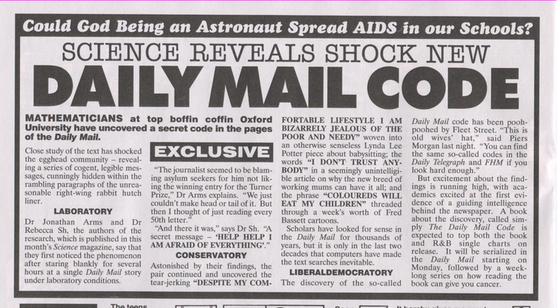
Via the Quail, a truly wonderful comment from the Mail:

Labels: , , ,

AddThis Social Bookmark Button

Monday, November 10, 2008 

The Daily Mail in the flesh.

Andrew Neil once wrote that if you want to know what Rupert Murdoch thinks, you should read the Sun's editorials. Not the Times', the Sun's; Rupert doesn't really do subtlety. It's much the same with Paul Dacre. The Daily Mail after all couldn't really be a person writ large, could it? There's too many contradictions, too much foaming hatred, so much casual cynicism combined with values that went out with rationing. No one could be like that, could they?

Dacre's latest extended utterances prove drastically otherwise. Having previously, and somewhat hilariously, delivered the Cudlipp lecture, the late great editor that Dacre doesn't deserve to even lick the boots of, railing against the "subsidariat" and the BBC, he was given the lectern at the Society of Editors bash. Clocking in at just over 7,500 words, it covers more or less everything that Dacre and by extension the Daily Mail loathes. First though he goes through what originally inspired him:

Hugh Cudlipp’s “Publish and Be Damned”, and Arthur Christiansen’s “Headlines All My Life” were my much-thumbed bibles. All those glorious memoirs by James Cameron, that brilliant reporter, were my text books.

And yet you still turned into the man you are today.

Before we've even got anywhere, he's straight in with the out and out bullshit:

I am, however, delighted, over the years, to have made my own small contribution to the chattering classes’ dyspepsia with the Rothermere press – but then no day is too busy or too short not to find time to tweak the noses of the liberalocracy which effectively run Britain.


Ah yes, the "liberalocracy" which effectively runs Britain. Fact of the matter is, like with Murdoch, no government could ever be right-wing enough to satisfy Dacre or the Mail, just as there'll probably never be a government left-wing enough to satisfy me.

How Dacre became the man he is today:

At university, I edited the student newspaper. I’m afraid I took a product that looked like the then Times on Prozac and turned it into a raucous version of Cudlipp’s Mirror complete, I shudder to admit, with Page 3 girl students whom I dubbed “Leeds Lovelies”. 

We mounted an undercover investigation, complete with photographers, into seemingly respectable pubs that were putting on strip shows. Family entertainment it wasn’t.

His hypocrisy then was already fully in action. Leeds Lovelies on one page, investigation into strippers doing the same thing on the next. Brilliant!

Open sentimental twaddle about the old Sunday Express follows:

So what was the editorial formula identified originally by the brilliant Scottish editor John Gordon and followed with ruthless will by John Junor? Firstly, the paper never, ever, forgot who its readers were and what interested them and their families. Secondly, it told everything through the prism of people. 

Page 3 of the Sunday Express said it all. The lead article under the title “Meeting People” was an interview - not with the kind of half-baked trollop who passes as a celebrity these days, but with, say, the mother of a newly chosen British Nobel Prize winner.

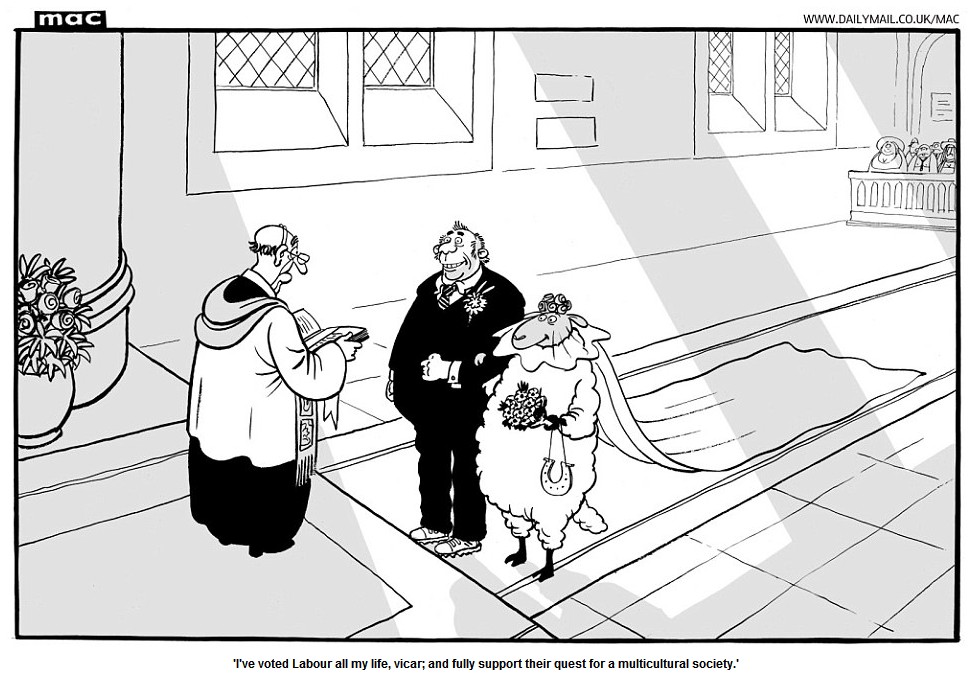
 Next to it was a large cartoon by Giles whose genius for clean, gloriously warm family humour is matched today only by the Mail’s magnificent Mac. Why this genre of cartooning - which combines superb draftsmanship with a timeless universal humour that often contains great truths - is dying out is a subject for another speech. Anyway, underneath was the “You the Lawyer” column addressing the problems of every day life such as fencing disputes and dog bites. What paper today would have such a low-key, non-newsy page 3. Yet all human life was on that page.

All human life, as long as it was suitably middle class, obviously.

Skipping a whole load of nonsense about the good ol' days, how columnists these days don't know their born, how it's all the fault of the state and some justified poking at Richard Desmond, he gets to the start of his main points.

Donning my hat as Chairman of the PCC’s Editors’ Code Committee, I would like to talk to you a little about where we are on regulation and press freedom issues. 

About 18 months ago, I, Les Hinton of News International and Murdoch MacLennan of the Telegraph, had dinner with the Prime Minister, Gordon Brown.

How very cosy. Ignoring the first two concerns he raised, which were reasonably noble, it's his last two which are the interesting ones:

Thirdly, there were the very serious financial implications for newspapers of the Conditional Fee Arrangement, the no win, no fee legislation. Introduced as a well-intentioned measure to help the poor have access to the courts, it was being ruthlessly exploited by unscrupulous lawyers who were ramping up their costs in media cases. Publishers were being faced with huge bills, sometimes running into millions, to defend even the most simple, clear-cut cases.

 Costs in CFA cases, as many of you here know, can be almost infinite with lawyers entitled to “success fees” of up to 100% on top of their actual bills. This gives them a positive financial incentive to take relatively straight-forward cases, worth just a few thousand pounds, and run them as long as possible. Adding insult to injury, CFA claimants can take out very expensive ATE (after the event) insurance policies to protect themselves against costs. If they win, the paper has to pay the claimant’s premium, but if they lose - and this is the cynicism of it all – the insurer rarely enforces the charges because the claimant invariably cannot afford to pay. 


Let me give you an example: Martyn Jones, an utterly inconsequential MP, sued the Mail on Sunday over their claim that he had sworn at a Commons official. The Mail on Sunday believed it had rock-solid witnesses and decided to fight the case. In the event, they lost and were ordered to pay £5,000 in damages. The MP’s lawyers claimed costs of £388,000 – solicitor’s costs of £68,000, plus 100% success fees, barrister’s costs of £63,000, plus 100% success fees, VAT and libel insurance of £68,000. Associated’s costs were £136,000 making a total of £520,000 costs in a case that awarded damages of just £5,000 in a dispute over a simple matter of fact.

 Can it really be right for a QC in a libel case to be paid £7,000 for a day in court whilst the same QC, prosecuting or defending a serious case at the Old Bailey, may receive less than £600 a day – less than a tenth?

Perhaps predictably, Dacre leaves some crucial facts out of this recounting of the libel case involving Jones. The trial was held in front of a jury, although Justice Eady was the judge in charge, and it reached a majority verdict in favour of Jones. The Mail on Sunday claimed that he had told a House of Commons security guard to "fuck off"; Jones claimed that he had in fact said to the security guard that "I don't give a shit what you are, you should know who MPs are." The jury sided with Jones, and presumably also with the claim from Jones's lawyers that there were "at least a dozen untrue assertions" made which had been "cranked up, spiced up and sexed up" so that it became a "grotesque distortion" of what really happened. Perhaps if the MoS had settled it might not have had to pay such costs, hmm? In any event, what Dacre is describing is extraordinarily rare. As has been well documented, only the rich and famous can usually afford to bring libel cases, with there being very few law firms that will contest cases on a no-win no-fee basis. Jones was lucky; the MoS was not. Boo hoo, isn't the world awful?

The result is that today, newspapers – even wealthy ones like the Mail – think long and hard before contesting actions, even if they know they are in the right, for fear of the ruinous financial implications. For the provincial and local press, such actions are now out of the question. Instead, they stump up some cash, money they can’t afford, to settle as quickly as possible, to avoid court actions – which, if they were to lose, could, in some case, close them. Some justice!


Dacre wilfully exaggerates. Even costs of £520,000 to the Mail group are relative peanuts, and that was about as most extreme a case as you can imagine. The reality is that most who think they have been treated unfairly go to the Press Complaints Commission - where their treatment is often not much better.

The fourth issue we raised with Gordon Brown was a truly frightening amendment to the Data Protection Act, winding its way through Parliament, under which journalists faced being jailed for two years for illicitly obtaining personal information such as ex-directory telephone numbers or an individual’s gas bills or medical records. This legislation would have made Britain the only country in the free world to jail journalists and could have had a considerable chilling effect on good journalism.

 The Prime Minister – I don’t think it is breaking confidences to reveal – was hugely sympathetic to the industry’s case and promised to do what he could to help.

 Over the coming months and battles ahead, Mr Brown was totally true to his word. Whatever our individual newspapers’ views are of the Prime Minister – and the Mail is pretty tough on him - we should, as an industry, acknowledge that, to date, he has been a great friend of press freedom. 


Again, Dacre exaggerates completely. The amendment to the DPA was to stop the sale to journalists via private detectives of information obtained from companies' and sometimes government databases. This information was and is hardly ever, if ever, used to uncover genuine scandals, and even if it was, the journalists in those cases would be protected as usual under a public interest defence. What the DPA amendment would have helped put a lid on was the casual obtaining of information on anyone who crosses the media, almost always either celebrities or those accused of crimes outside the realm of the political sphere. At the trial of Stephen Whittamore, the prosecution alleged that some of the material they delivered to journalists was on two actresses then in EastEnders, the family of Ricky Tomlinson, and a former Big Brother contestant. Quite a chilling effect the amendment would have had on good journalism, I'm sure you'll agree.

In any event, the government quickly backed down, especially in the face of private lobbying by Dacre, Hinton and MacLennan, as Dacre goes on to boast:

Thirdly, there is to be action on the “scandalous” greed of CFA lawyers. That adjective is not mine, by the way, but Justice Minister’s Jack Straw’s in a recent speech on the subject. For following Number 10’s intervention all those months ago, there have been many constructive meetings between the industry and the Ministry of Justice on what to do about CFA.

A few weeks ago, I, Rebekah Wade and Murdoch MacLennan saw Jack Straw who assured us that, in the next few months, he is set to unveil proposals to reform CFA, including capping lawyers’ fees.

...

It was agreed that the Data Protection Act should be amended so that journalists would have the right to seek out protected information if they had a “reasonable belief” that their actions were in the public interest.

 And, more pertinently, the Act was amended so that the jailing clause cannot now be implemented unless the Secretary of State seeks approval from Parliament to activate it.


That they already had that "reasonable belief" obviously didn't matter. With the jailing clause unimplemented, the industry can carry on in exactly the way it was doing before.

So that is where we are. The industry has been warned. We must make sure our house in order. Under the auspices of PressBoF, we have produced a guidance note on DPA that has been sent to every paper in Britain. Now it is up to all of us to ensure that our journalists are complying with the Act. At Associated, we are holding seminars on the subject and have written compliance with the Act into our employment contracts. 

At the Editors Code Committee, we are considering whether the current provisions of the Code on data protection and our Guidance Notes, as well as the wording in the Editor’s Codebook, can be strengthened.

Why is it that I don't believe a single word of this? Probably because it was the Mail itself, without even including the MoS, that made the most use of Whittamore, with over 952 transactions. Dacre must have known and sanctioned every single one of them, and then he is one of those responsible for updating the current PCC code! The same newspaper which rages against misuse of government data and the loss of it broke the law in numerous instances and has got away with it. No wonder Dacre is so triumphant.

The parts on Justice Eady now come into view:

But there is one remaining threat to press freedom that I suspect may prove far more dangerous to our industry than all the issues I have just discussed.

 Put to one side the United Nations’ recent attack on Britain’s disgracefully repressive libel laws that have made London the libel capital of the world – something that should be a bitter source of shame for our judicial system. Concentrate instead on how inexorably, and insidiously, the British Press is having a privacy law imposed on it, which – apart from allowing the corrupt and the crooked to sleep easily in their beds – is, I would argue, undermining the ability of mass-circulation newspapers to sell newspapers in an ever more difficult market.


Here then is Dacre's thesis. He doesn't really care, when it comes down to it, about who he and his friends in the media expose in three-in-a-bed sex romps; what he cares about is that the exposing of the rich and the famous is in his view what makes people buy newspapers. Without it, the industry will be further damaged, and the state will have to step in. To suggest this is nonsense would be to give it too much respect: it is crap of the highest order. The Sunday tabloid press, which delivers the scandals and the sex in spades, is already falling of a cliff circulation wise. By contrast, the broadsheets, both daily and weekly are holding up fairly well. The tabloids have to face up to the fact that their readers are increasingly being lost to the internet, where no holes whatsoever are barred. The broadsheets on the other hand are doing OK because they rely on their quality: something which the tabloids simply do not provide, and that includes Dacre's paper, which most agree is the best tabloid regardless of the politics. Would a privacy law further heighten the drops? Probably, but it probably wouldn't make much difference.

In any event, we are not having a privacy law developed in front of our eyes - yet. That might depend on the verdict in the upcoming trial involving Sienna Miller and the Big Pictures photo agency. Just to emphasise how the tabloids don't learn, the Sun and News of the World today settled with her over the publication of nude photographs, awarding £35,000 plus costs, or a pittance as it is to News Corp. Miller has been serially offended against: the Star paid her £15,000 in September over similar photographs and the Sun and News of the World paid her £37,500 last December over, you guessed it, naked photographs. Some will hardly be predisposed to Miller because of her alleged behaviour, but surely the right not to be effectively stalked by paparazzi to the extent where you fear for your life, which is what Miller has been, is one which the law should recognise.

This law is not coming from Parliament – no, that would smack of democracy – but from the arrogant and amoral judgements – words I use very deliberately – of one man. 

I am referring, of course, to Justice David Eady who has, again and again, under the privacy clause of the Human Rights Act, found against newspapers and their age-old freedom to expose the moral shortcomings of those in high places. 


Two cases in particular underline this threat. 

Two years ago, Justice Eady ruled that a cuckolded husband couldn’t sell his story to the press about another married man – a wealthy sporting celebrity – who had seduced his wife. 

The judge was worried about the effect of the revelations on the celebrity’s wife. Now I agree that any distress caused to innocent parties is regrettable but exactly the same worries could be expressed about the relatives of any individual who transgressed which, if followed to its logical conclusion, would mean that nobody could be condemned for wrongdoing. 

But the judge – in an unashamed reversal of centuries of moral and social thinking – placed the rights of the adulterer above society’s age-old belief that adultery should be condemned.


Because Dacre cannot dispute Eady's rulings in a legal sense, he instead turns to morals to try to traduce him. The problem with this is obvious - the country has moved on. Unless hypocrisy is involved, or those involved are mega famous, no one really cares any more. We still disapprove of adultery, but we don't think those involved should be shamed just because they're famous. Dacre however thinks this is exactly the way it should be, that shame is what newspapers are meant to provide, but it isn't. They're supposed to inform, educate, and entertain. Shaming celebrities does none of those things.

The other problem is that the Mail is hypocrisy on stilts itself. The paper is wholly immoral - it thinks nothing of accusing innocent people of terrible crimes with no evidence, such as Robert Murat, who unsurprisingly doesn't warrant a mention in this speech, not to mention Colin Stagg. While it defended the McCanns to the hilt, because they were "its people", the second that Fiona MacKeown came to public attention in a similar plight she was smeared, her home broken into and pictures taken of her dead daughter's bedroom, and attacked by the same columnists who cried fake tears of sympathy for Kate McCann. It ran the most vicious and mendacious campaign possible against the MMR vaccine, now responsible for increased cases of measles up and down the country. It breaks the law with impunity, as we have seen. And then it imagines that it has the right to deliver lectures on what is and what is not moral, as Dacre goes on to do:

Recently, of course, the very same Justice Eady effectively ruled that it’s perfectly acceptable for the multi-millionaire head of a multi-billion sport that is followed by countless young people to pay five women £2,500 to take part in acts of unimaginable sexual depravity with him. 

The judge found for Max Mosley because he had not engaged in a “sick Nazi orgy” as the News of the World contested, though for the life of me that seems an almost surreally pedantic logic as some of the participants were dressed in military-style uniform. Mosley was issuing commands in German while one prostitute pretended to pick lice from his hair, a second fellated him and a third caned his backside until blood was drawn. 


Now most people would consider such activities to be perverted, depraved, the very abrogation of civilised behaviour of which the law is supposed to be the safeguard. Not Justice Eady. To him such behaviour was merely “unconventional”. 

Nor in his mind was there anything wrong in a man of such wealth using his money to exploit women in this way. Would he feel the same way, I wonder, if one of those women had been his wife or daughter? 

But what is most worrying about Justice Eady’s decisions is that he is ruling that - when it comes to morality - the law in Britain is now effectively neutral, which is why I accuse him, in his judgments, of being “amoral".

Dacre then is the only one who can decide what is and what is not moral. The whole point of the Mosley case was that the News of the World claimed it was a Nazi orgy; it was not, as Eady painstakingly pointed out. If it had been a Nazi orgy, the News of the World would have had a public interest defence; it wasn't, so it didn't. Fact is, Dacre thinks that what goes on in other people's bedrooms is his business; it isn't, and it is no business of the government's either. If Dacre really thinks that some mild BSDM is "unimaginable sexual depravity" he has a very very poor imagination. As for his comments about the way Mosley "exploited" the women who were more than willing to take part and who subsequently testified for his defence, with him suggesting that Eady might have been more concerned if they had included a daughter or his wife, that says far more about Dacre's own insecurity than it does about anything else.

In the sporting celebrity case, he rejected the idea that adultery was a proper cause for public condemnation. 

Instead, he declared that because family breakdown was now commonplace, there was a strong argument for “not holding forth about adultery” or, in other words, attaching no greater inherent worth to marriage than to any other lifestyle choice. 

Thus no moral delineation was to be made between marriage and those who would destroy it, between victim and victimiser, between right and wrong.


We're talking about three people's private affairs here, not the breakdown of society as we know it. One person's infidelity is not about to bring this country down; Dacre's sophistry has to be seen to be believed.

In the Mosley case, the judge is ruling that there is no public interest in revealing a public figure’s involvement in acts of depravity.

 What the judge loftily calls the “new rights-based jurisprudence” of the Human Rights Act seems to be ruling out any such thing as public standards of morality and decency, and the right of newspapers to report on digressions from those standards.

Except Mosley was not a public figure. He was not a hypocrite. He was just someone who the News of the Screws could make money out of. They couldn't care about the morals involved, as you'd expect; that was the excuse, just as it is here with Dacre. Or perhaps it isn't; maybe he really cares about morals whilst being completely immoral himself.

But most worrying is that when it comes to suppressing media freedom, the good Justice Eady is seemingly ubiquitous.... 

It was he who was going to preside in Tesco’s libel case against the Guardian, which was, in the event, recently settled out of court. 

It was the same Justice Eady who, in Lord Browne versus the Mail on Sunday, ruled that BP’s shareholders had the right to know that Browne had lied to the court – but did not have the right to know details of his conversations with his boyfriend, despite the paper’s case that they had serious public-interest implications. 

Again, it was Eady who found in favour of a Canadian folk singer called Loreena McKennitt, who had objected to the publication of a book about her by a former adviser, Niema Ash. Ms McKennitt did not claim that the book was in any way untrue, merely that it infringed her right to privacy. Never mind Ms Ash’s right to freedom of expression.

Except Eady was more than fair to the Guardian, despite his reputation. Browne's case is difficult, but in the main he came down on the side of the media. In the case of McKennitt, Eady's original ruling was then backed by both the Court of Appeal and the House of Lords. Hardly all the blame can be placed on his shoulders in that instance.

And it is Eady who, almost unnoticed here, has the distinction of having provoked the US Congress – in what’s dubbed the Libel Tourism Bill – to consider making English libel judgments unenforceable in America. This follows the judge’s decision to allow a Saudi banker to sue a New York author in the London courts even though she hadn’t published her book in Britain. Not for the first time, it seems that our colonial cousins can teach us a thing or two. 

But surely the greatest scandal is that while London boasts scores of eminent judges, one man is given a virtual monopoly of all cases against the media enabling him to bring in a privacy law by the back door.

Dacre makes about his only salient point here. This was a disgraceful decision by Eady, but is all about our libel laws, not the unwritten laws on privacy. The best course of action would be a re-writing of both: removing only the rich and famous from being able to sue for libel, whilst ensuring London cannot be used to silence critics worldwide, whilst protecting individual privacy against press intrusion. Neither though is about to happen, as, although newspapers complain about both, for the most part they are thoroughly happy with the situation. Their belief in freedom only extends as far as their wallets.

English Common Law is the collective wisdom of many different judges over the ages. The freedom of the press, I would argue, is far too important to be left to the somewhat desiccated values of a single judge who clearly has an animus against the popular press and the right of people to freedom of expression.

This is another fair enough point, but it's not as if Eady is purely making it up as he's going along: he's drawing extensively on past rulings and interpreting Articles 8 and 10 of the HRA; if he wasn't, he would be subject to far more criticism than just from those concerned with libel tourism and tabloid editors.

I personally would rather have never heard of Max Mosley and the squalid purgatory he inhabits. It is the others I care about: the crooks, the liars, the cheats, the rich and the corrupt sheltering behind a law of privacy being created by an unaccountable judge. 

If Gordon Brown wanted to force a privacy law, he would have to set out a bill, arguing his case in both Houses of Parliament, withstand public scrutiny and win a series of votes. Now, thanks to the wretched Human Rights Act, one Judge with a subjective and highly relativist moral sense can do the same with a stroke of his pen. 


All of those adjectives, apart from corrupt, could be applied to Dacre just as much as they could those he attacks. He describes what Gordon Brown would have to go through, but he doesn't mention another trial he'd have to pass: the opprobrium of the media, and that is not covered by public scrutiny. Put simply, the unaccountable media with all its power would not accept it, and they would ensure it would never pass, even though their actions have led to its effective creation. Here exposed then is why the likes of the Mail and Sun so hate the HRA; not because it's a criminals' or terrorists' charter, but because it directly affects their business models. They have to remember that the HRA was passed by parliament, that they had the opportunity to oppose it then and failed, and that it was the HRA that has helped to establish the Reynolds defence.

All this has huge implications for newspapers and, I would argue, for society. Since time immemorial public shaming has been a vital element in defending the parameters of what are considered acceptable standards of social behaviour, helping ensure that citizens – rich and poor – adhere to them for the good of the greater community. For hundreds of years, the press has played a role in that process. It has the freedom to identify those who have offended public standards of decency – the very standards its readers believe in – and hold the transgressors up to public condemnation. If their readers don’t agree with the defence of such values, they would not buy those papers in such huge numbers.


This may as well be Dacre's justification for the witch-hunt against Jonathan Ross and Russell Brand. It doesn't matter that the Mail has its own individual view of what public standards of decency are, as long as people keep buying the papers that justifies support. This is abject nonsense - people buy the newspaper they do for numerous reasons, not just for its political or moral outlook. This is simply the fig-leaf which those who think they have a right to decide what's right and what's wrong cover themselves with.

Put another way, if mass-circulation newspapers, which, of course, also devote considerable space to reporting and analysis of public affairs, don’t have the freedom to write about scandal, I doubt whether they will retain their mass circulations with the obvious worrying implications for the democratic process.


This is nothing more than blackmail covered with eye-watering cynicism. The same person who goes on to lionise the press and how wonderful it is is here suggesting that the gutter press needs scandal to survive. Nice little free press you've got here, be a shame if something was to happen to it. The proles need scandal, whilst we provide them with the finest news coverage in the world at the same time. What isn't there to like?!

Now some revile a moralising media. Others, such as myself, believe it is the duty of the media to take an ethical stand.

Did Paul Dacre just claim to have ethics? No, seriously, Dacre's taking an ethical stand? If he ever genuinely did, the ethics would snap beneath him in an instant. Not satisfied with descending into parody, Dacre then further suggests just how completely mad he is:

Why does not half an hour go by that the high priests of the subsidariat, the BBC, can’t resist a snide reference to the popular press, again blissfully oblivious that all too often they are following agendas set by those very popular newspapers whose readers pay their salaries.

Yes Paul, the BBC is always sneering at the "popular press". Please, keep taking the medicine.

He warms to this further theme by attacking Flat Earth News and Nick Davies without so much as mentioning the name of either:

Again, blissfully oblivious to the need for self-criticism of their own papers – the sine qua non of such pages is, by and large, that the liberal media can do little wrong while the large-circulation press is invariably scurrilous, malign and beyond all salvation. 

There was, of course, that recent book that savaged the behaviour of virtually every national newspaper. The book, which began with a presumption of guilt, was itself a pretty sloppy piece of journalism, full of half-truths, anonymous sources, gossip and urban myths presented as facts, and the very selective reporting that it accused papers of employing. And heaven forbid that its author should have observed the basic journalistic nicety of checking those facts with the parties concerned.

Could it possibly be because the liberal media is that which is also the least complained about, the least likely to have to settle damages out of court, and the least likely to be taken to court, and when it is, it's also more likely to win, as the Guardian did twice during the 90s? The tabloid press meanwhile continues to show itself invariably up as it is, as during the Mosley trial: unaccountable, lazy, disreputable, and downright nasty. It would be nice also if Dacre bothered to bring up examples of just where Davies was wrong in Flat Earth News, although I suspect it's because the book dedicated a whole chapter to the Mail, whilst the Mail itself has mentioned it twice, and that was prior to actual publication, even while the "liberal" press which he so disdains discussed and argued about its findings at some length. Half of this is because the tabloid press presents itself as infallible; the broadsheet media does not.


Fair enough. Newspapers should be constantly criticised. If you dish it, you should take it with bells on. The problem, I would argue tonight, is that this unrelenting and corrosive drip, drip, drip of criticism of the press does huge harm to our standing in the eyes of the politicians, the regulators, the judges, the public and, most pertinently, I suspect, to newspaper sales.

 In good times, such a poisoning of the well is unhelpful, to say the least. Today, with large parts of our industry fighting to stay alive, it is damnably, unforgivably and depressingly damaging. 

I am not a Jeremiah. I passionately believe that Britain has the best newspapers in the world and – indeed, our papers today are as good as they’ve ever been. Nostalgia be damned.

Gosh, anyone feel deja vu after Hazel Blears' similar rave last week? It couldn't be that the tabloid press gets everything it deserves could it, when it demands accountability at the BBC over authorised comedy pranks and then no one resigns when dozens of stories about Robert Murat result in huge payouts? In Dacre's eyes though there's nothing wrong with it, and after all, who are we to argue? He's the Daily Mail in the flesh, and the Daily Mail can never be wrong.

Labels: , , , , , , , , , , , , , ,

AddThis Social Bookmark Button

Friday, October 31, 2008 

Analysing the ashes.


After four days of moral panic, the BBC's actions in suspending Ross, with the Radio 2 director resigning does seem to have managed to bring the curtain down for the time being on the Brand-Ross-Sachs affair. What then, if anything, have we learned or have those involved learned?

For Andrew Sachs himself, if he had any illusions about what his granddaughter does with her life, he can't have any now. As always happens to those who choose to sell their stories, the rivals have digged up the not quite frankly very difficult to find "dirt" on her. The Daily Sport splashed on the finding of a lesbian hardcore video in which Baillie has a leading role, the Daily Mirror discovered that she was operating as a £110 an hour dominatrix, and even the Daily Mail, which this morning declared that their witch-hunt had led to a "victory for decency", has decided that the young woman they were so avid in defending the dignity of earlier in the week has a "sordid secret life". The Sun meanwhile, having paid Ms Baillie a princely sum for her story, has what looks like an exclusive video featuring Baillie alongside her fellow "Satanic Sluts". For what Baillie decried as an invasion of the privacy of her grandfather and herself, she has been amply rewarded, seems destined to feature in the lads' mags and on reality TV, and is doubtless thrilled with what has occurred. While impossible to know for sure how much Sachs knew about what his granddaughter got up to, it's hard not to think that he might be somewhat more humiliated by what has followed than by the initial insult from a show that he apparently said could be broadcast as long as it was toned down slightly.

For Lesley Douglas, it seems hardly likely that she'll be out of work for long. Just read the Sun's editorial defence of her, and try to dispel the feeling that there will be shortly be an offer coming her way from News Corporation or BSkyB:

POPULAR Radio 2 boss Lesley Douglas is the first person at the BBC to emerge with any dignity from the Russell Brand-Jonathan Ross debacle. But her head should not have rolled.

It was down to the production staff who let the filth be broadcast to fall on their swords or for Mark Thompson to fire them.

Instead, a talented senior executive whose only fault was that it happened “on her watch” felt compelled to take the blame for the whole sorry bunch of them.

A brilliant 23-year career at the BBC was thus ended by the disgusting stupidity of two highly-paid stars, only one of whom also chose to do the decent thing.

...

But many will question whether he was right to accept Ms Douglas’ resignation.

...

One thing is certain. Ross owes Ms Douglas an enormous debt for deflecting rather greater flak.

Either that or she already has friends in high places in Wapping.

Ross himself meanwhile has stood down from the British Comedy Awards, perhaps more out of the fact that he would be the joke of the evening rather than out of respect for his hiatus from the BBC. Still, the reporters are outside his home, watching the preparations for a Halloween party. Perhaps Paul Dacre might go along as himself?

As for the "self-appointed, self-obsessed metropolitan narcissists who control so much of our public life", they still must be wondering where this will all end. When year old comedy shows are being dredged for offensive jokes, and not just by the Mail but the Guardian as well, then the possibility for the neutering of Auntie can't be that far away. The Mail has even more examples of "smutty and degrading obscenities" that have recently been broadcast. It apologises to those who might be offended, but quite clearly these things must be repeated, such is the way our tax money is being spent. That there is a Facebook group urging the reinstatement of Ross and Brand which already has 23,549 members, getting close to the total number of complaints made about the Brand show is neither here nor there.

Perhaps though for everybody else this week will show just where the real power really does lie in this land, and it certainly isn't with the politicians. They're just useful when there's a bandwagon already running. No, it's quite clear that for all the advancements of the last decade, even with the rise of blogging and diversification of the media, what really still has the most ability to shape our lives and decide what is and isn't obscene and also potentially what we can and can't watch is the tabloid media. That these people are quite possibly the most unaccountable but powerful individuals in the land has been shown in extraordinary detail. We can at least attempt to get politicians voted out at the next election, but there is no similar way of telling newspaper editors and proprietors with conflicting commercial interests and hypocrisy in spades to take a running jump. Dacre especially, but all the others also will be sitting there tonight absolutely delighted with what they've achieved, and who could blame them? They're meant to be getting weaker, their circulations inexorably dropping, the internet and with it the young and urban now in control, but they've emerged victorious. Who could possibly have known last Saturday evening that two not very funny comedians could have led to such a turn-around over just the course of a week?

Labels: , , , , , , , , , , , , ,

AddThis Social Bookmark Button

Thursday, October 30, 2008 

Spinelessness beyond belief.

Yesterday I wrote that this mind-blowing farce was beyond our finest satirists. You can actually probably go far further: this is now even beyond the most absurdist brainstorms of cartoonists, such is the ridiculousness not just of the entire situation, but the sight, yet again, of the BBC donning the sackcloth and ashes, down on its knees pleading for forgiveness whilst, as Aaron so vividly describes it, the "collective tabloid media buggers it silly with its enormous cock of hypocrisy".

It's really difficult to even begin to get your head around the cant we are talking about going on here. The young woman at the heart of this, the one so deeply offended and betrayed by Russell Brand's bringing up of the fact that he had a sexual relationship with her, has not just sold her story to the Sun for what is reportedly a six figure sum, via the auspices of Max Clifford, but gone even further into exactly what she did with Brand. There I was imagining that this was partially about a grandfather being humiliated by two overgrown teenagers with tales of sexual shenanigans involving a dear relative, something that very few would want to be informed of. Well, unless Mr Sachs is now staying in bed with the covers over his head to escape from this outbreak of hysteria, he's been informed via the front page of the nation's biggest selling newspaper that whilst pounding his granddaughter Brand shouted out a few of his most well known character's famous lines. Or, at least that's if you believe it, which I certainly don't. Still, at least Brand, according to Ms Georgina Baillie, is a crap lover. So crap in fact that she had sex with him three times just to make sure, as she also regales the positively salivating Sun hacks. This self-same newspaper, and I use that word in the loosest possible sense, then in its leader column attacks the BBC for daring to allow such filth to be broadcast.

Nothing though can exonerate the sheer supineness of the BBC's response. It's being criticised for reacting slowly, for not nipping it in the bud immediately as soon as the issue came apparent, but why on earth should the BBC act within moments of a newspaper deciding that something it has broadcasted simply isn't acceptable? It's really difficult to remember that not so long back the organisation stood up defiantly and in the face of really quite bitter pressure, went ahead and showed Jerry Springer: The Opera. The comparison with that majestic piece of theatre is partly why it's so difficult to defend the absolute opposite this time round, but the persecutors then are more or less the exact same ones as now. You can it seems thoroughly satirise religion and trash culture and get away with it, but instead play a prank call on a man who was due to appear on a radio show, who then gave the OK to the show going out as long as some of it was toned down, and the blood and contrition simply don't cease to flow.

Lesley Douglas, the head of Radio 2 has then resigned, but it seems impossible to imagine she would have gone if she hadn't been about to be either severely criticised or pushed out after today's BBC Trust meeting, or as it might as well have been, a kangaroo court upon which the full glare of the tabloid media was on. Brand's resignation was nowhere near enough they had decreed. These self-same moral arbiters, the ones that every single day authorise the effective stalking of celebrities via the paparazzi, who invade the privacy of others for their own short-term gain, who routinely find themselves having to apologise to completely blameless individuals whose grief they have either mocked or interfered with, as the records of the Press Complaints Commission routinely show, who just this year have had to apologise to Robert Murat for accusing him of being involved in the abduction of Madeleine McCann (and let's not even begin on the Express's payouts to the McCanns themselves and the Tapas seven) suddenly found themselves as judge, jury and executioner, with the supposed moral outrage of the public firmly behind them as cover, and they wanted the heads to roll, with them duly handed them.

The real one they wanted though was Ross's, and that's the one that they have as yet not got. Judging by tomorrow morning's front pages, their lust for blood may well have been sated, as they do not seem to be, on the first appearances, calling for his complete banishment. The suspension for twelve weeks though is no real solution, and Ross himself really ought to simply resign, with his apparent so far decision not to do so perhaps suggesting a deal has been made. He has been left high and dry by a management unwilling to throw back a single of the brickbats directed at it, and whilst it is very very difficult to feel sympathy for such a man, it's his salary that has been the scapegoat, and it was the management that decided he was worth £18m, when both ITV and Channel 4 had made clear they were prepared to pay £15m or more over three years for his signature. He will be left by this bizarre sudden disregard for perspective as an emasculated figure, no longer able to do the things that his contract says he is supposed to. What therefore is the point of him?

The real fire though deserves to be aimed at the politicians who decided that this was a bandwagon worth jumping on. The sheer lunacy of the Tories demanding a debate on the subject, just as the news emerges that this year's parliamentary session will amount to just 128-days is indicative of the lack of reality which currently afflicts both the main parties, not just the Conservatives. The bile in my throat had not really risen however until I noticed that Jack Straw's ghost-writer had felt that Ross and Brand were a suitable topic for his regular Lancashire Telegraph column. Here is a man at the heart of our current government's decision to go to war in Iraq, who has spent our collective blood and treasure decimating a country which is only now beginning to get back on its feet, a man that has lied about our country's role in the abduction and torture of "terrorist suspects", and a man that thinks we ought to completely ignore penal reformers in preference to the opinions of our nation's finest tabloid newspapers, and now here he is, asking completely without any apparent irony or self-awareness whether we agree with him that Jonathan Ross has "underwhelming skills". Yes Jack, he does; that however doesn't affect the fact that compared to you he's an absolute fucking renaissance man. Ross and Brand insulted someone; you pissed on our heads and had the audacity to tell us that it was only raining.

This invented scandal has in fact been a real boon for both politicians and the media. There we were last weekend still talking over the fact that both our main parties were looking as sleazy as usual, the economy going down the tubes, oil supplies likely to peak between either 2011 and 2013, with no contingency plan whatsoever for that occurring, a new US president to be elected who will almost certainly be someone who puts our equivalents to absolute shame, questions being asked about Rupert Murdoch's involvement with them again, and up pops something completely irrelevant which for the last three days has been the only story in town, and what's more, one which they can jump on and grab plaudits for from the other press. It is of course directly in this government's interests for the BBC to be as weak, forlorn and unquestioning as possible, and this will directly affect that as well as on general decency standards. For those who haven't forgotten Hutton and still have a grudge to settle, what a fantastic opportunity when everyone else is already aiming the kicks at the corporation's stricken body! For those who want to be able to object to the slightest thing that might offend them or someone else, when better then to strike out for censorship than now, with the BBC itself more or less asking for it?

After all, just how many friends does the corporation now have left? Only the Independent tomorrow has a sympathetic front page, and the Guardian seems to have completely abandoned anything even resembling a kind word, with Peter Tatchell about the only person to have mounted something approaching a defence, and a poor one at that. The Mail's is so vile, so hypocritical, so completely beyond parody that it literally must have emerged from out of Paul Dacre's steaming arsehole. THE BBC WAKES UP TO DECENCY it screams, when the immoral paper wouldn't know decency if it came up and happy-slapped it. Above that, Richard Littlejohn calls it a "stunning victory over self-appointed, self-obsessed metropolitan narcissists who control so much of our public life." You really couldn't make it up. These are the people declaring victory, looking forward to be able to point out every single slightest thing that they don't like, comfortable in the knowledge that for a long time they are going to have a free ride to attack, attack and attack. Already on Newsnight Mark Thompson was asked by Emily Maitlis about a joke involving the Queen which was made on Mock the Week; you can only imagine the mileage that will be got out of everything similar.

What then should the BBC have done? Simple: by yesterday they should have said that the phone calls were out of line, apologised to everyone involved, immediately declared that there will not be a recurrence and that much stricter rules will be put in place before such content is authorised for broadcast. Both Ross and Brand would be reprimanded, told that they were on their last chance, and that their salaries would likely fall as a result. It also though would have additionally made clear that they would not give in to a witch-hunt conducted by a sickeningly unaccountable media, that standards in general would not be changing just because of two men going over the line, and that its commitment to pushing the boundaries, producing challenging programming and confronting those who need to be would undiminished, and that it would be saying no more on the matter. The press may have continued to scream until it was sick, but it would have tired of it eventually. Instead what we have is an organisation once again conducting an act of self-harm in front of the nation as a baying mob looks on, delighted by what it's achieved. It knows full well that self-harm comes before suicide, and they will be looking for every opportunity to provide the noose. And yet again, the BBC can blame no one but itself.

Labels: , , , , , , , , , , , , ,

AddThis Social Bookmark Button

Wednesday, October 29, 2008 

A farce beyond satire.

At one point today the Guardian website had the row over "Sachsgate" or whatever completely unoriginal, moronic and false name you want to give this putrid manufactured scandal as its top story. Beneath it, two stories down, was the obviously less important fact that only 200 or so people had died in an earthquake in Pakistan. The contrast and lack of perspective really does say it all; even now the BBC, perhaps understandably, has Brand's resignation as its top story, whilst below it are the irrelevant bursts that Alistair Darling is set to relax the fiscal rules and that Debby Purdy has failed in her attempt to get the Crown Prosecution Service to reveal its thinking over assisted suicide in a foreign country.

Make no bones about it, the events of today have been beyond even our finest satirists. The only people who emerge from it with anything approaching dignity are, bizarrely, Brand for sacrificing himself because he realised he was just a fig-leaf for attacking the BBC, and Andrew Sachs for being magnanimous and as understated as you would perhaps expect. Jonathan Ross emerges looking as aloof as ever, issuing an apology through his solicitors; Georgina Baillie, erstwhile member of the "Satanic Sluts", rails against the "sicko" that she slept with, a cheque bulging in her pocket; the media as a whole looks ever more insular and self-regarding, and moreover smugly happy with itself for leading a witch-hunt that has resulted in just what it wanted, a BBC weakened and emasculated; and the BBC is left with no one to blame but itself.

To start back at something resembling the beginning, it must be pointed out that Brand and Ross did cross a line; regardless of whether Sachs was appearing on the show or not and then couldn't make it, informing a man down the phone that Brand had "fucked" his granddaughter is unacceptable, again, even when you consider that Baillie is hardly the shrinking violet that she wishes to portray herself as. This though is where it starts to get curious: according to the Guardian, Sachs was asked whether the show could be broadcast as it was, and he said yes, as long as it was toned down. We don't know whether it was or not, but it appears that Sachs either didn't listen to the show or the messages until informed by a MoS hack who contacted him on the following Wednesday for a comment. This set in train the complaint and the subsequent storm which has followed. While some of the show went beyond a line, parts of it also were undeniably funny, and I'm no fan of either man. Also to be remembered is that just two people complained after the show at this point, and that was about the swearing. There also was a warning before it went out about the language, but considering it was on past the watershed this should be a moot point in any event.

At most, what should have happened is that all involved should have been raked over the coals. Mark Thompson, rather than suspending the men or setting up kangaroo courts involving the BBC Trust should have repeated the profuse apologies, said that Brand and Ross would be given a formal last warning over their conduct, perhaps hinting their salaries would be cut as a result, and that the systems involved in broadcasting such material would be examined and overhauled if necessary. That would, I should imagine, have satisfied most reasonable people, without going in for empty self-flagellation and being completely craven to the demands of the gutter press and its owners which are the most despicable hypocrites as well as having commercial interest in the BBC facing further brickbats over its content. As soon as he suspended both however there was only one outcome, and that was one or both of them resigning, having apparently lost the confidence of the director general.

The BBC's problem is that it is held to a completely different standard to everyone and everything else. This is partially justified, considering the fact it is funded by the manifestly unfair but still in this writer's opinion lesser of two evils licence fee, but it also means that it has to be all things to all people, and as tastes and the media environment radically change this is becoming more and more difficult. Last year's "fakery" scandals were a case in point: the BBC's were relatively minor oversights that were mostly undertaken to keep a show going, for with the most part no one losing out. This was in complete difference to those involving all three of its main commercial rivals, all of whom had ran telephone competitions which had defrauded those who entered as a result of some never having a chance of winning. These, especially ITV's keeping of £7.8 million, and Ant and Dec's production company being directly involved in one case, were on a completely different plane of seriousness. This though simply wasn't reflected in the media coverage: the BBC was pilloried whilst the rest were almost brushed under the carpet, and it already seems forgotten. For all the claims of the purity and accountability of the private sector, as far as I'm aware not a single individual involved in the running of ITV, Channel 4 or 5 either resigned or was sacked, with Michael Grade, who had promised "zero tolerance" suddenly deciding that no one should be the victim of a witch-hunt. This was again in contrast to the BBC, where Peter Fincham, BBC1 controller resigned over "Crowngate". He was, naturally, swiftly re-employed by ITV. Whether this was partially down to the Daily Mail and General Trust's shareholding in ITN, broadcaster of news on ITV and Channel 4, or to BSkyB's 17.9% stake in ITV is up for you to decide.

There are multiple reasons for deeply regretting what has transpired today. It may be over-the-top to suggest that this will potentially affect the BBC to a similar extent or more to the fallout from the Hutton inquiry, but at the moment it genuinely looks that way. Then the BBC had the benefit of the public siding overwhelmingly with it, and what's more with the Mail declaring a temporary truce, backing the Beeb while declaring war on the government. This time initial sound taking suggests that today a backlash had started against the Mail etc, or at least the Guardian's comment sections suggest that, when yesterday's were overwhelming filled with bile against the BBC. It does though set an absolutely dreadful precedent: the Mail and others have won, the BBC has been vanquished, and now they have carte blanche to object to every little thing that our moral arbiters decide is offensive or which the taxpayer shouldn't be funding. Already, as Greenslade points out, the emphasis is shifting from Brand and Ross to, incredibly, inoffensive pap like Love Soup. You could accept it if they were targeting Chris Moyles or some BBC Three nonsense, but not a harmless rom-com.

Additionally, it's also emboldened politicians who think nothing of deciding what we can and cannot watch. Just witness Jeremy Hunt, Conservative culture secretary with an appropriate name, giving a speech on how his party would like to introduce a "social responsibility" contract with the broadcasters, under which the likes of Brand and Ross's prank calls would not be broadcast lest they "legitimise negative social behaviour." This is censorship under another guise which would mean the cutting of Simpsons' episodes with Bart playing prank calls on Moe, or Channel 4's entire acclaimed series, Fonejacker. It puts all the onus on the broadcaster to justify itself while allowing busybodies of the kind I dearly hoped we'd got rid of to object to every little thing that appears on our screens. No surprises that John Beyer has turned up like a bad penny, having been mainly banished to the pages of the Mail and Telegraph, whilst the likes of Nadine Dorries who doesn't just want to control what women do with their bodies but also wants the wages of Brand and Ross redistributed to needy families, branch out into media comment.

This wasn't then, as it is already being described, a "perfect storm", but an example of just how the modern media are now going to operate. A minor act of bullying and unpleasantness that to an extent was authorised has been completely overwhelmed by a major act of bullying and unpleasantness by those who so often rail against political correctness. Hypocrisy, conflict of interests and sanity have all been cast aside in favour of sticking a quick boot in, whilst the majority of public I would wager are left completely bemused by the whole thing and wonder why the economy or even what's happening in the northern Congo isn't the top story. For brands which dedicate themselves to producing what the people apparently want, they've instead gone with their own interests rather than those of those they are meant to serve, and anyone not caught up in the drama can just go hang, because the editors and elite are interested even if you aren't. And yes, I myself am a glorious hypocrite for having excreted all of these pointless words on the subject. Those with an interest not just in public service broadcasting but also in freedom of speech and a return to casual censorship have much to fear from this stage-managed and sordid scandal.

Labels: , , , , , , , , , ,

AddThis Social Bookmark Button

Tuesday, October 28, 2008 

An utter farce.

Is there really so little going on in the world right now that what Russell Brand and Jonathan Ross said to an actor over the phone on a radio show is not just the day's top story, but the top political story of the day as well? To suggest that this phony, invented scandal, just as invented as the Sun's attempts to smear Katy Perry because she dared to pose three years ago in the company of a knife has been spectacularly blown out of all proportion is an incredible understatement. It tells us absolutely nothing whatsoever about the current state of Britain or increasing concern at the tone of public discourse - it instead only highlights the media's obsessions, both with itself and with fighting each other as circulations fall and audiences plummet.

Alastair Campbell was wrong about many, many things, but he was completely right when he said that the media loves talking about itself. To be fair, bloggers are among the very worst for doing just that, but the point still stands. This was not about concern for Andrew Sachs being humiliated by two overgrown teenage boys, but rather almost certainly out of a desire to get at the BBC for daring to employ them. Here it must be stated that both in my estimation are colossal wastes of money, although Jonathan Ross, as his documentaries in the past and his more recent BBC 4 ones have shown does have insights, especially into more neglected film genres, but the BBC is perfectly within its rights to employ them - regardless of what those now at the forefront of the malestrom are saying about them, they certainly do have their admirers, otherwise Ross's chat show would not be so popular, and Brand's autobiography would have not been the hit of the last year. Yes, Ross's £6 million contract over three years is obscene and worthy of complaints, but this is a highly roundabout way of expressing discontent over that.

All you really need to know is that prior to the Mail on Sunday getting involved, just 2 complaints had been made about the 18th of October show on which Brand and Ross phoned Sachs voicemail and left the insulting and offensive messages, and those were about Ross swearing, not what he was swearing about. Considering that around 400,000 are meant to listen to it, this suggests that the majority tune in knowing full well what they'll be getting from Brand. That there is any need for a timeline of what happened when in this tedious "scandal" is perhaps an indictment of the entire thing, but it wasn't until the Wednesday that Sachs himself apparently even knew that any messages had been left, after being contacted by the MoS. With it then being brought to the attention of the BBC, Brand apologised on the following week's show, but without any humility in his usual fashion. The MoS prints the story, and before you know it, David Cameron and Gordon Brown are sticking their noses in for God knows what reason.

If the Mail had any real care for not further embarrassing Sachs about his granddaughter, then its articles featuring Georgina Baillie in various states of undress whilst revealing her role in the "Satanic Sluts" would not currently be featured pride of place on their site. The Mail hasn't at least created the montage which adorns one of the Sun's articles, featuring Baillie topless with Brand and Sachs included alongside. The Sun however at least isn't calling for either to be sacked, as the Mail is. It's difficult to believe in any case that he wasn't aware of her vocation, although obviously Brand's humiliating remarks were completely out of order. Again though, it's still difficult to have any sympathy for her; it certainly hasn't been denied that she has indeed had a relationship with Brand, and his behaviour towards women is notorious. In his book, for example, he relates how he had sex with a girl at school, who asks him not to mention it to her friends or anyone else, to which he promptly does, then wonders why she's upset. As has been used in different contexts over the past week, if you sleep with dogs you shouldn't complain when you get fleas.

Even more hilariously hypocritical of the Mail, apart from the fact that it is by proxy defending the dignity of a "satanic slut", is that when the Celebrity Big Brother racism row ballooned last year, the paper ran a front page ridiculing the fact it was the story of the day. This time round it's leading the outrage, despite the fact that there was and are far more notable news stories around both today and yesterday, in profound difference to then. All this is leading towards the idea that there are things that the BBC should do and should not do - and promoting new comedy talent such as Russell Brand is apparently one of the things it should not do, if the Mail got its way. It doesn't matter that there are far more worthy things that could be chopped from the BBC, such as much of the crap produced by BBC Three, which could be directed into nuturing real new comic talent such as those behind and involved with Peep Show (which the "moralists" on the Mail would loathe) or even not turning up the opportunity to develop the likes of Chris Morris's jihadi comedy, it's more that the BBC is even thinking of doing these things. It also doesn't seem to matter that this was broadcast after the watershed - even if it was on radio - and so the "offensiveness" of the material should not really breach any guidelines, let alone Ofcom's.

Once the involvement of politicians on a matter such as this would have been limited to the realms of satire. It's not quite apposite to bring in the 2001 BrassEye paedophile special and the hysteria which followed that, as clearly that was a case of Morris seeking controversy, achieving it, and skewering the media all at the same time. That though was followed by politicians involving themselves when none of them had watched it, with David Blunkett who certainly hadn't seen it even joining in. David Cameron and Gordon Brown certainly wouldn't have been listening, and Cameron's demands for full transparency just when his own shadow chancellor has refused to provide just that is laughable.

Eric the Fish is right when he says that this has done a disservice to those of us who do think that the BBC, despite its flaws, is great value, and that it has also done a disservice to itself. There should be questioning over who thought that this particular unpleasantness was acceptable, as it was recorded and reviewed before broadcast, but there should not be a witch-hunt, and apologies all round, perhaps more profuse than those already offered, should be enough. One additional thing this highlights though is the increasing power of the Mail, and the BBC's terror of being targeted by it. It has helped to develop this partly itself by regarding whatever is on its front page automatically as news. Most of all, the BBC needs to defend itself better when it comes in for unfair criticism, instead of taking the beating given it. Last week the Mail and Sun were outraged that the BBC devoted more time to the George Osborne story than to the competing Peter Mandelson debacle, but that was a sound decision based on the fact that far more was known about Osborne's transgressions, and that it involved donations in this country rather than what Mandelson might have done whilst EU trade commissioner. The more the BBC slinks back, the more blows it will take, even whilst it is far more accountable than any tabloid or almost any newspaper. How ironic it would be if newspapers and their proprietors that have done more than anyone else to both lower the tone in this country and to debase politics are those that bring down one of the few remaining bastions of quality and high-brow programming we have, and how they will celebrate it.

Labels: , , , , , , , ,

AddThis Social Bookmark Button

Tuesday, October 07, 2008 

Quentin Letts and the wreckers of Britain part two.

I've started so I might as well finish. Either that or I'm a glutton for punishment. Quentin Letts' 50 people who buggered up Britain continues,